

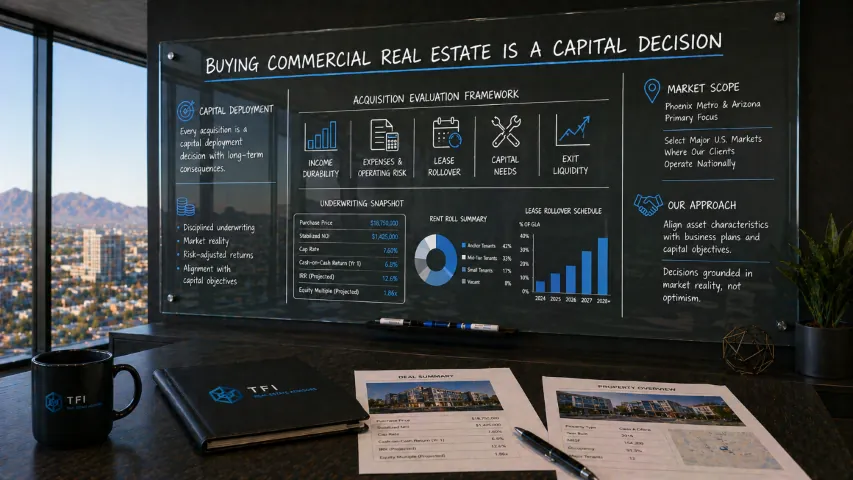
Buying Commercial Property in the Greater Phoenix Area Is a Capital Decision
Every acquisition puts capital at risk for an extended period. The assumptions you accept at purchase—income durability, expenses, lease rollover, capital needs, and exit liquidity—continue to shape the outcome long after closing.
TFI Real Estate Advisors represents owner-users and investors buying commercial property across the Greater Phoenix Area and Arizona. We evaluate office, industrial, retail, medical, mixed-use, land, and multifamily opportunities against the business plan, capital structure, risk tolerance, and exit strategy.
TFI Real Estate Advisors supports owners, investors, landlords, tenants, and developers across the Greater Phoenix Area and Arizona, with selective national reach for larger commercial, multifamily, investment, and capital-driven assignments where the scope and structure support the engagement.
Buyer representation may involve Phoenix, Scottsdale, Tempe, Mesa, Chandler, Gilbert, Glendale, Peoria, Goodyear, Surprise, Buckeye, Queen Creek, and other Greater Phoenix Area markets. The search and underwriting process is organized around the buyer’s use, property type, capital plan, and target submarkets.
That perspective helps keep the acquisition disciplined when competition increases and deadlines begin to compress.
Who We Represent
Owner-Users
We advise operating businesses acquiring real estate for long-term occupancy, operational control, and balance-sheet strength. Owner-user decisions require a different framework than investor acquisitions, as operational fit, future flexibility, and total occupancy cost matter as much as purchase price.
Our work includes site selection and evaluation across office, industrial, medical, and specialty-use assets, with an emphasis on long-term utility, cost certainty, and execution risk reduction.
Private and Accredited Investors
We work with investors pursuing income, appreciation, and tax-advantaged exposure through stabilized, transitional, and value-add commercial and multifamily assets. Our focus is on income durability, the realism of the business plan, and the full stack of risks that can impair cash flow or exit pricing.
Family Offices and High-Net-Worth Buyers
Family offices and high-net-worth buyers engage us for capital preservation, downside protection, and long-term wealth strategy supported by real assets. We emphasize risk-adjusted performance, governance-friendly decision-making, and alignment between deal structure and long-term objectives.
Institutional and Semi-Institutional Buyers
We support institutional and semi-institutional buyers requiring market precision, disciplined underwriting, and governance-aware execution across complex transactions and portfolios. At this level, execution quality matters because process gaps and assumption drift can compound rapidly across asset counts.
What a Greater Phoenix Area Commercial Buyer Broker Actually Does
Commercial buyer representation is not simply property searching or deal sourcing. A buyer broker should protect your interests through evaluation, negotiation, risk identification, and disciplined execution across the full acquisition process.
We help define acquisition criteria, identify on-market and selective off-market opportunities, compare submarkets and properties, review rent rolls and lease structures, validate income and expenses, analyze comparable sales and rents, underwrite scenarios, and structure negotiations. We also coordinate due diligence through closing so the transaction remains tied to the original investment or occupancy objective.
This keeps the acquisition decisions connected as timelines compress and competitive pressure increases.
What “Buying Correctly” Looks Like in Practice
Commercial acquisitions often fail in subtle ways. Overpaying based on trailing income, underestimating capital requirements, misreading tenant rollover concentration, and assuming rent growth without submarket support are among the most common errors.
We focus on validating the story of the asset. If the numbers only work under perfect assumptions, the deal is not truly underwritten. If the exit requires a buyer profile that will not pay for the risk, liquidity is compromised. Buying correctly means the transaction remains viable under conservative assumptions, not just best-case scenarios.
Our Acquisition Framework
We use a repeatable framework to test the property, the assumptions, and the buyer’s ability to execute.
Market Fundamentals
We evaluate supply, demand, absorption, and pricing at the submarket level rather than relying on citywide averages. The assumptions should reflect how the asset actually performs and how buyers and lenders perceive risk in that micro-market.
Asset-Level Performance
In-place income, operating expenses, capital needs, tenant rollover risk, and operational complexity are analyzed in detail. We look for concentration risk, expense leakage, and operational assumptions that commonly create post-close disappointment.
Downside Risk
Assumptions are stress-tested against vacancy risk, rent stagnation, cap rate movement, and capital expenditure exposure. We focus on what happens when conditions are less favorable, not just when everything goes right.
Exit and Liquidity
Acquisitions are evaluated with a clear understanding of future buyer expectations and exit requirements. Liquidity is treated as a core component of risk management, particularly in cycles where buyer pools narrow and capital becomes more selective.
Commercial Asset Types and What Changes in Underwriting
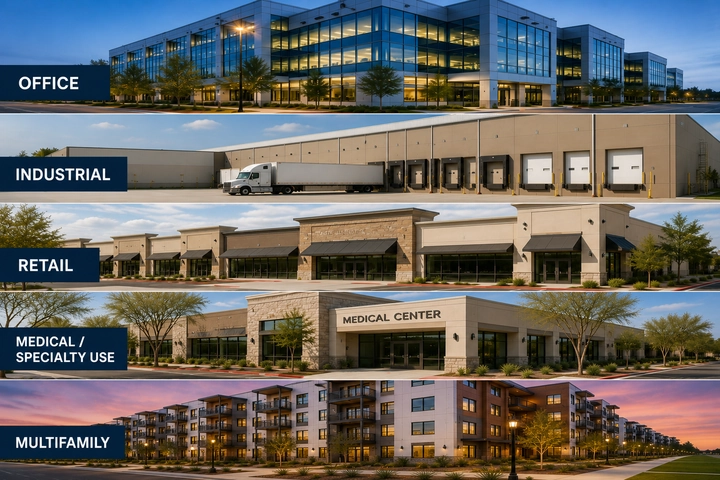
The underwriting must change with the asset. Office, industrial, retail, medical, land, and multifamily properties carry different operating sensitivities, risk profiles, and liquidity constraints.
Office
Office underwriting is shaped by tenant credit quality, lease term durability, and rollover timing. Submarket positioning, functional utility, parking ratios, and tenant improvement exposure materially affect performance. We focus on income stability, rollover concentration, and the realistic cost of maintaining occupancy in competitive environments.
Industrial
Industrial acquisitions tend to be sensitive to location-driven demand, loading functionality, clear heights, and tenant improvements. Lease structure and operating expenses are evaluated alongside functional utility and submarket supply pipelines, particularly where new construction can alter competitive dynamics.
Retail
Retail performance is closely tied to tenant quality, co-tenancy dynamics, site access, visibility, and local demand drivers. We emphasize lease clauses, tenant health, and demand durability rather than surface-level cap rates that can obscure underlying risk.
Medical and Specialty Use
Medical and specialty-use assets often involve unique build-outs, regulatory considerations, and tenant dependency. Diligence focuses on whether the real estate truly supports the tenant’s operational model and whether lease economics reflect replacement cost realities.
Multifamily
Multifamily underwriting emphasizes operational efficiency, unit-level churn, expense control, and renovation execution. While the principles overlap with other commercial assets, multifamily performance is often more sensitive to execution consistency and localized demand shifts.
On-Market vs Off-Market Acquisitions
On-market transactions offer pricing transparency but typically involve greater competition. Competitive environments increase the likelihood of aggressive assumptions, making underwriting discipline essential.
Off-market opportunities can reduce exposure and competition but require realistic pricing expectations and strong execution controls. Off-market does not mean risk-free, and incomplete diligence can introduce hidden issues. We approach both channels with the same underwriting rigor, ensuring acquisition decisions remain defensible regardless of sourcing path. Buyers considering controlled or non-public sourcing can also review our Off-Market Commercial and Multifamily Advisory framework.
Buying for Business Use vs Investment
Owner-users and investors approach acquisitions with different objectives, and confusing the two can undermine outcomes.
Owner-users prioritize operational fit, flexibility, and long-term occupancy costs. Investors prioritize income durability, lease structure, tenant credit, and exit liquidity. We help buyers clearly distinguish between these objectives so acquisitions align with actual use and long-term goals rather than abstract deal metrics.
Working With Listing Brokers and Managing Conflicts
A listing broker represents the seller. Separate buyer representation keeps your underwriting, negotiation, and diligence focused on your own objectives.
We collaborate professionally with listing brokers while maintaining clarity around representation roles. Clean communication, complete documentation, and disciplined timelines reduce friction and support smoother execution without compromising buyer advocacy.
Capital Strategy Integration
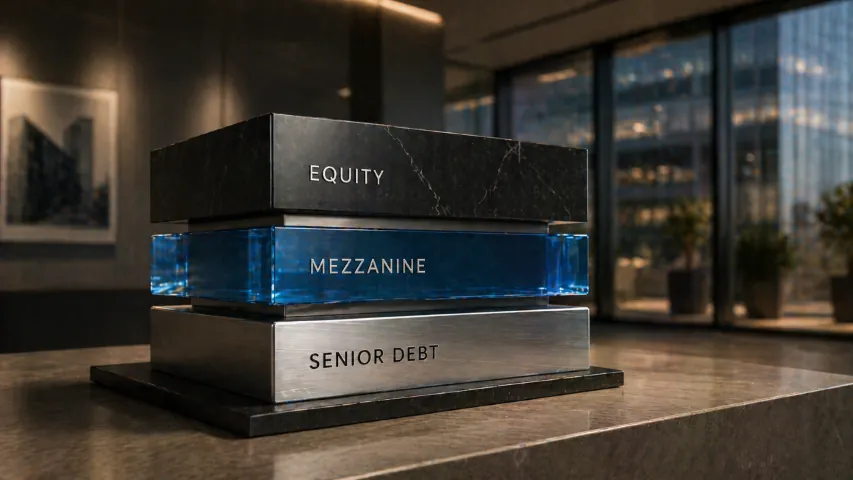
The acquisition and the capital structure cannot be separated. The property you buy affects financing terms, refinance potential, cash flow, and eventual exit pricing.
Considering capital implications early helps buyers avoid late-stage surprises and structure offers that are both competitive and defensible. Capital strategy integration supports execution discipline without duplicating the detailed financing and capitalization work addressed through our Commercial Real Estate Capital Strategy services.
Buyer Questions and Answers
What does a commercial buyer's broker do in Phoenix?
A Phoenix commercial buyer's broker represents the buyer's interests throughout the acquisition process. This includes defining requirements, sourcing and comparing opportunities, analyzing the property and submarket, underwriting financial performance, identifying risk, structuring and negotiating offers, coordinating due diligence, and managing execution through closing.
How do I buy commercial property in Phoenix?
Start by defining whether the property is for business occupancy or investment, then establish location, property-type, size, return, financing, and timing requirements. A buyer broker can identify on-market and selective off-market opportunities, compare pricing and property fundamentals, structure the offer, coordinate inspections and document review, and help manage the transaction through closing.
Is a buyer’s broker worth it in commercial real estate?
For most buyers, yes. Commercial transactions involve complex financial, legal, and operational risk. Buyer representation helps validate assumptions, reduce avoidable mistakes, and maintain execution discipline so decisions remain aligned with buyer objectives.
What due diligence is required when buying commercial property?
Due diligence typically includes lease review, rent roll verification, income and expense validation, physical inspections, title and survey review, financing review, and assessment of market fundamentals and exit risk. Scope varies by asset type and complexity.
How long does it take to buy commercial real estate?
Timelines vary, but many transactions close within 60 to 120 days from contract to closing. Financing structure, diligence scope, and transaction complexity can extend or compress timelines.
How do you evaluate whether a deal is priced correctly?
Pricing is evaluated through comparable sales, rent validation, expense realism, lease structure, and scenario testing. A price is defensible when cash flow remains coherent under conservative assumptions and exit expectations align with market reality.
Can you help buyers outside of Arizona?
The Greater Phoenix Area and Arizona are our core markets. Selective national reach applies for larger commercial, multifamily, investment, and capital-driven assignments where the scope and structure support the engagement.