
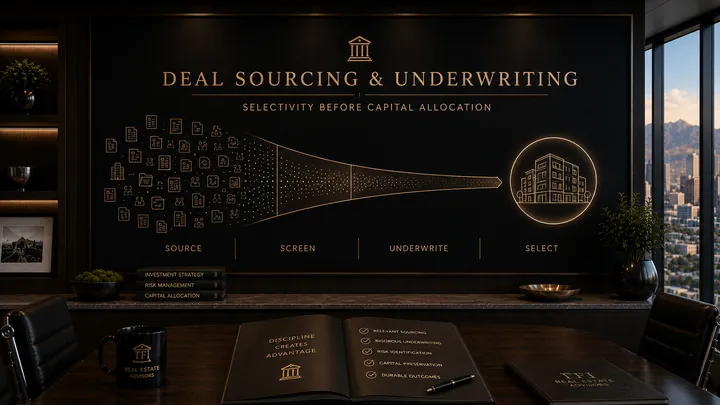

What TFI Provides in a Real Estate Underwriting Assignment
TFI provides broker-led underwriting and deal analysis for investors evaluating commercial, multifamily, and select residential investment property. The work can support an acquisition client, existing owner, family office, private capital group, or potential TFI-sponsored investment relationship.
The scope is tailored to the decision. An early screen may determine whether a property deserves additional time and expense. A more developed assignment may normalize historical operations, model the business plan and financing, compare scenarios, identify diligence priorities, and support negotiations or an investment decision.
TFI connects the model to the real property. Financial projections are evaluated alongside leases, residents or tenants, physical condition, market supply and demand, capital needs, management requirements, financing, transaction terms, and the investor's portfolio objectives. When the investor advances, TFI can coordinate the appropriate brokerage, lender, title, legal, inspection, engineering, environmental, appraisal, tax, and other professional resources.
Deal Flow Versus Deal Quality
More deal flow does not necessarily produce better decisions. A large pipeline can consume attention without adding value when opportunities fall outside your strategy, depend on unrealistic pricing, or lack the information required for responsible analysis.
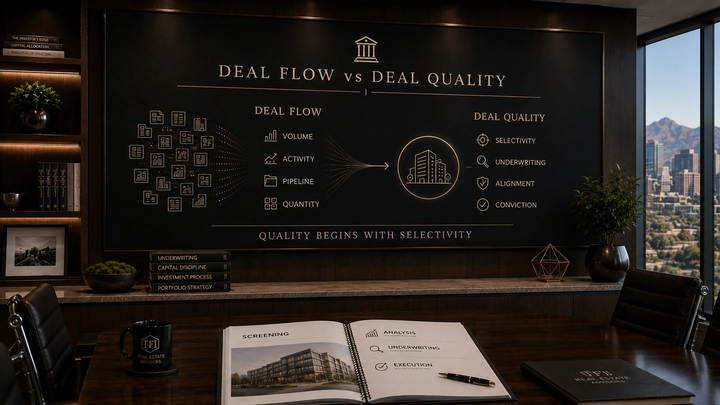
Effective sourcing begins with a defined mandate: property type, geography, transaction size, target basis, return and risk objectives, leverage parameters, operational capabilities, time horizon, and decision authority. Those criteria help distinguish a relevant opportunity from a property that is merely available.
Selectivity protects analytical capacity. Many opportunities should be declined during initial screening so the investor can concentrate resources on properties that have a credible path to meeting the mandate.
Sources of Investment Opportunities
Opportunities can come from brokerage relationships, marketed listings, direct owner conversations, repeat counterparties, lenders, attorneys, property managers, developers, operators, or private relationships. The source may improve access, but it never removes the need for independent underwriting.
A broadly marketed property may provide transparent competition and organized information while creating pricing pressure. A direct or off-market opportunity may offer controlled access or a motivated counterparty, yet still require realistic valuation, complete diligence, and disciplined negotiation. Repeat relationships can improve efficiency, but familiarity should not replace verification.
TFI's Commercial Buyer Representation, Multifamily Advisory, Controlled Off-Market Advisory, and Wholesale and Discount Property Advisory provide several pathways through which sourcing and transaction execution may be coordinated.
Initial Screening and Investment Criteria
The first screen should answer a basic question before a full model is built: does this opportunity fit the investor? That means testing the market, size, price, available capital, income, occupancy, business plan, and any obvious property, financing, title, tenant, governance, or timing conflicts.
Screening also tests the proposed basis against available market evidence. If the price requires aggressive rent growth, unusually low expenses, perfect renovation execution, or an immediate improvement in capital markets merely to reach a reasonable outcome, the property may not warrant deeper analysis.
Clear early filters reduce analytical drift. They also help investors explain why an opportunity advanced or was declined, improving consistency across a changing market.
Market and Submarket Analysis
Broad population or employment headlines rarely tell you enough about an individual property. Useful market analysis reaches the submarket level and tests competing supply, construction, absorption, rent and vacancy trends, tenant or resident demand, transportation, access, employers, neighborhood change, taxes, insurance, regulation, and local operating conditions.
The relevant geography depends on the asset. An industrial property may be influenced by freeway access, labor, truck routes, power, and competing distribution inventory. Retail depends on trade area, visibility, access, co-tenancy, demographics, and consumer behavior. Office and medical properties are affected by employment clusters, tenant requirements, parking, buildout costs, and lease rollover. Multifamily analysis requires attention to rents, concessions, unit mix, resident incomes, competing communities, construction pipeline, taxes, insurance, utilities, and property-level operations.
TFI's Greater Phoenix Area and Arizona experience helps place local data in context. Select national assignments may require local brokerage and diligence resources in the subject market while maintaining a consistent underwriting framework.
Property and Operational Review
At the asset level, underwriting asks how the property functions today and what the proposed business plan will require. That includes physical condition, functional utility, occupancy, lease or resident profile, deferred maintenance, capital needs, management intensity, service contracts, regulatory requirements, and competitive position.
A property with attractive current income may still face concentrated lease rollover, below-market tenants requiring expensive improvements, obsolete systems, insurance pressure, tax reassessment, or capital needs that reduce distributable cash. A low-occupancy or value-add property may have upside, but only if the renovation, leasing, management, and capital plan are realistic.
The analysis should separate existing performance from projected improvement. That distinction helps investors understand how much of the outcome comes from the property as acquired and how much depends on future execution.
Income and Expense Normalization
Historical statements are evidence, not finished underwriting. Income must be reconciled to leases, rent rolls, occupancy, concessions, collections, reimbursements, ancillary revenue, and known changes. Expenses must be tested for recurring operations, owner-specific items, deferred work, management, payroll, utilities, repairs, insurance, taxes, contracts, reserves, and capital expenditures.
Normalization asks what the property is likely to earn and cost under the investor's ownership and business plan. It should not automatically accept the seller's trailing results, broker pro forma, or a buyer's desired outcome.
For multifamily property, the review may include unit mix, loss-to-lease, bad debt, concessions, renewals, turnover, payroll, utility responsibility, make-ready costs, repairs, property taxes, insurance, and renovation premiums. Commercial assets require lease-by-lease attention to rent, escalations, reimbursements, options, expirations, tenant improvements, commissions, credit, and downtime.
Financial Modeling and Return Analysis
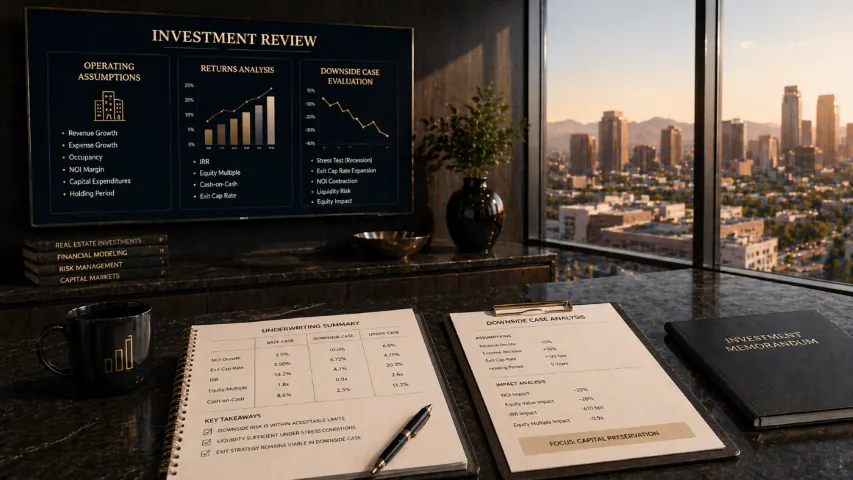
A useful model makes its assumptions visible. It should show what must happen for the investment to work, how the returns change when those assumptions move, and which inputs depend on execution rather than verified property performance. Depending on the assignment, the analysis may include net operating income, purchase basis, capital expenditures, financing, cash flow, debt-service coverage, loan-to-value, cash-on-cash return, internal rate of return, equity multiple, break-even occupancy, and sale proceeds.
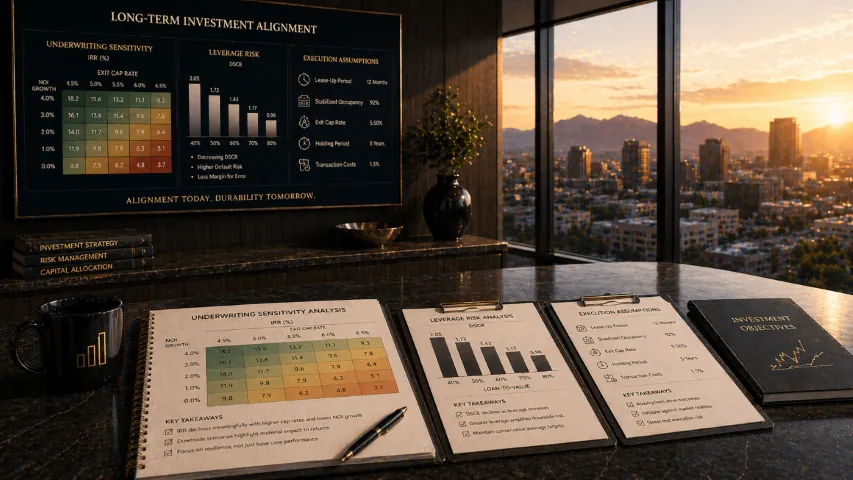
The model should distinguish property operations from financing and investor-level economics. A highly leveraged structure can increase projected equity returns while also increasing default, refinance, cash-call, and loss risk. A low initial yield may be appropriate for a credible value-add plan, but the investor should see the cost, timing, lease-up, and exit assumptions required to create that value.
Complexity does not make a model more reliable. The analysis should be detailed enough to capture material variables while remaining understandable, reviewable, and adaptable as new information becomes available.
Financing and Capital Structure
Debt terms can materially change an otherwise sound property decision. Underwriting should address loan proceeds, interest rate, amortization, maturity, extension options, reserves, covenants, recourse, prepayment provisions, required improvements, and the lender's assumptions about value and cash flow.
Capital structure analysis also considers preferred equity, subordinate debt, common equity, sponsor capital, and potential future capital requirements. The question is not simply how much leverage is available, but whether the structure preserves flexibility through the expected business plan and less favorable scenarios.
TFI's Commercial Real Estate Capital Strategy work can help connect property underwriting to financing and recapitalization alternatives in coordination with qualified lenders and capital professionals.
Underwriting as Risk Identification
Underwriting should identify where the investment is vulnerable before emphasizing the upside. The model needs to expose the factors that can impair income, consume capital, delay the plan, weaken financing, or reduce exit value—not merely calculate an attractive base case.
A risk-first process does not assume that every negative scenario will occur. It asks whether the investor can recognize, price, finance, manage, and survive the material risks if conditions are less favorable than projected.
The strongest opportunities are not necessarily those with the highest modeled return. They are opportunities where the relationship among basis, current income, execution requirements, capital structure, downside exposure, and potential reward is understandable and acceptable.
Scenario and Sensitivity Analysis
A single base case can hide how dependent the investment is on a few assumptions. Sensitivity analysis can test changes in rent, occupancy, concessions, operating expenses, taxes, insurance, capital costs, interest rates, refinancing proceeds, hold period, capitalization rate, and sale price.
The relevant scenarios depend on the business plan. A stabilized acquisition may be most sensitive to tenant rollover, interest rate, and exit value. A multifamily renovation may depend on unit-turn pace, renovation cost, premium achievement, resident retention, and construction disruption. Development requires additional analysis of entitlement, construction, interest carry, absorption, and total project cost.
Scenario analysis should help define decision thresholds, reserves, negotiating priorities, and the conditions under which the investor would restructure or decline the opportunity.
Kill Criteria and Decision Discipline
A disciplined process includes clear reasons to stop. Kill criteria may involve pricing that leaves no margin for error, unreliable income, excessive deferred maintenance, unacceptable environmental or title risk, unsuitable financing, governance problems, unworkable timing, insufficient control, or a business plan that exceeds the available operating capacity.
The purpose is not to reject complexity automatically. It is to distinguish complexity that can be understood and managed from uncertainty that cannot be priced or controlled responsibly.
Documenting the reason for a decline improves future sourcing. It also prevents an investor from repeatedly spending time on opportunities that do not fit the strategy.
Due Diligence as Verification
Underwriting begins with available information; due diligence tests whether that information is accurate and complete. Once a property advances, the investor may need to verify leases, rent rolls, operating statements, bank records, service contracts, tax bills, insurance, title, survey, zoning, environmental matters, condition, structural and building systems, permits, litigation, tenant credit, and other property-specific issues.
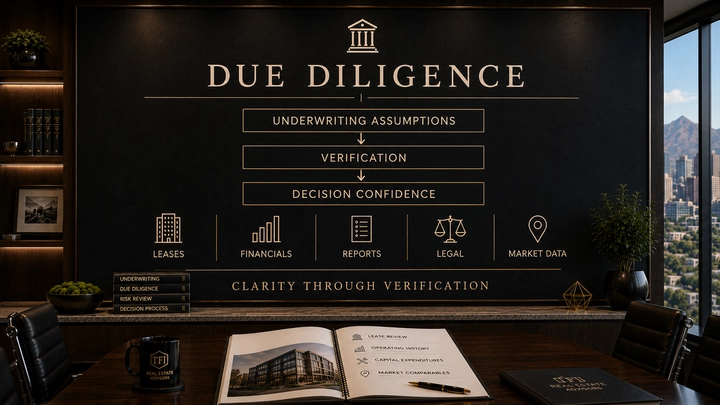
Third-party reports and professional advice should be integrated into the model and decision. If inspection, engineering, environmental, legal, appraisal, lender, or title findings differ from the initial assumptions, the investor should update the underwriting, negotiate the transaction, change the capital plan, or decline the property.
Diligence is not complete merely because reports were ordered. The material findings must be understood and reflected in the investment decision.
Execution Capacity and Business-Plan Feasibility
The model also needs to identify who will execute the plan and whether the required resources actually exist. Renovation, leasing, construction, property management, lender reporting, investor communication, legal coordination, and asset management each require time, expertise, systems, and capital.
An attractive model can fail when the schedule is unrealistic, vendor capacity is limited, ownership lacks decision speed, or the operating team is responsible for more projects than it can manage. Execution assumptions should reflect actual capability rather than an idealized organization.
For a partnership opportunity, the review should also consider sponsor experience, staffing, financial capacity, governance, reporting, incentives, and the relationship between the sponsor and affiliated service providers. Private Real Estate Investment Partnerships provides additional context.
Portfolio Fit and Capital Pacing
A property can underwrite well on its own and still be a poor portfolio decision. It may deepen exposure to one market, property type, tenant, financing maturity, operating strategy, or sponsor—or consume liquidity needed for existing assets and future obligations.
TFI's Real Estate Investment Strategy and Portfolio Advisory places the deal in the context of current holdings, concentration, leverage, liquidity, time horizon, and capital pacing. This helps the investor distinguish a good property from the right property for the portfolio at that time.
Decision Documentation and Investor Communication
Clear underwriting records should show the information used, assumptions made, material risks, unresolved questions, scenarios tested, and reasons for the decision. That record supports internal review, partner communication, lender discussions, and later comparison between projected and actual results.
For a private investment relationship, investors should be able to understand how the property was sourced, why it fits the strategy, what risks were identified, how the capital structure works, and which events could change the plan. Transparency builds confidence more effectively than a model filled with precise but unsupported assumptions.
Post-Acquisition Monitoring and Feedback
Underwriting should remain useful after closing. Comparing actual occupancy, rents, expenses, capital expenditures, financing, leasing, renovation, and timing with the original assumptions helps ownership identify problems early and improve future decisions.
A feedback loop also tests the underwriting process itself. If the same expense is repeatedly underestimated, a market assumption proves unreliable, or a particular sourcing channel produces poor fits, the criteria and model should change.
Good underwriting becomes more useful when it is treated as a living decision framework rather than a document completed solely for acquisition approval.
Geographic and Property Scope
TFI is based in the Greater Phoenix Area and works throughout Arizona. Select national underwriting and acquisition assignments may be considered for larger commercial, multifamily, portfolio, institutional, or capital-driven matters when the property type, market coverage, client relationship, information, and execution resources support the engagement.
The underwriting scope may address multifamily, office, industrial, retail, mixed-use, development, residential investment, and other income-producing real estate. The required analysis varies materially by asset type, business plan, ownership structure, and available information.
Frequently Asked Questions About Real Estate Underwriting
What is the difference between valuation and investment underwriting?
Valuation estimates what a property may be worth under a defined approach and date. Investment underwriting asks whether the property, price, financing, business plan, risk, and projected outcomes fit a particular investor. The two analyses overlap but answer different questions.
Is investor underwriting the same as lender underwriting?
No. A lender primarily evaluates collateral, borrower strength, cash flow, and repayment risk under its credit standards. An investor evaluates the equity business plan, capital requirements, range of returns, downside exposure, execution, liquidity, and fit with ownership objectives. Both perspectives may use some of the same property information.
What information is needed to begin underwriting a property?
The starting package commonly includes the offering memorandum, purchase price, rent roll or leases, historical operating statements, current budget, tax and insurance information, capital history, property details, financing assumptions, and the proposed business plan. The exact requirements depend on the asset and stage of review.
Can TFI underwrite multifamily and commercial property?
Yes. TFI can support multifamily, office, industrial, retail, mixed-use, development, and select residential investment analysis when the assignment and available information fit TFI's experience and resources. Specialized property or technical issues may require additional experts.
Does underwriting guarantee that an investment will perform as projected?
No. Underwriting is a decision tool based on available information and assumptions. Market conditions, property operations, financing, physical issues, counterparties, and execution can produce results that differ materially from projections.
Can TFI help source and acquire the property after underwriting?
Yes, when the assignment is appropriate. TFI may combine underwriting with buyer representation, market searches, off-market outreach, negotiation, diligence coordination, financing strategy, and closing support under a clearly defined brokerage or advisory engagement.
How does TFI handle incomplete or seller-provided information?
TFI identifies what is verified, what is provided but unconfirmed, what is assumed, and what remains missing. Material gaps are reflected in the risk analysis and diligence plan rather than being hidden by the model.
Is underwriting available for an existing property or portfolio?
Yes. The same analytical framework can support a hold, improve, refinance, recapitalize, or sell decision for an existing asset. Portfolio-level work may also address concentration, leverage, maturity exposure, liquidity, capital needs, and transaction sequencing.
Advisory and Investment Disclosure
Underwriting involves estimates, assumptions, and information that may be incomplete or inaccurate. It does not guarantee property performance, financing, value, tax treatment, or investment returns. TFI's work is focused on real estate analysis, strategy, brokerage, and transaction coordination. Legal, tax, accounting, engineering, environmental, appraisal, securities, and investment-management matters should be addressed by the investor's qualified professionals.