


Multifamily Is Real Estate and an Operating Business
Apartment properties are often discussed through cap rates, price per unit, rent growth, and comparable sales. Those measures matter, but they do not explain the whole asset.
A multifamily property is an operating business built around dozens, hundreds, or potentially thousands of recurring unit-level decisions. Leasing velocity, renewals, concessions, bad debt, maintenance, unit turns, payroll, utility recovery, renovations, and resident experience all influence the income a buyer will capitalize.
That is why multifamily requires more operating awareness than a price-per-square-foot comparison. Two communities in the same submarket can produce materially different outcomes because the physical asset, management, resident profile, expenses, and capital requirements differ.
TFI approaches multifamily brokerage from both the real estate and operating sides of the asset. We focus on what produces the income, what suppresses performance, where assumptions may be too aggressive, and how the next owner, lender, or capital partner is likely to evaluate the property.

Multifamily Brokerage Requires Asset-Class Context
A multifamily broker should do more than circulate an offering memorandum or search listing databases. The advisory value comes from understanding how the asset class is underwritten and how the owner’s objective changes the appropriate strategy.
An owner considering a sale may need to decide whether to transact now, complete deferred capital work, improve financial reporting, stabilize occupancy, or allow a renovation program to season before going to market. A buyer may be evaluating whether projected rent premiums are realistic, whether expenses have been normalized correctly, or whether the property's physical condition supports the proposed business plan.
The same property can support very different conclusions depending on the decision being made.
Our multifamily advisory work is therefore grounded in five questions:
- What does the asset actually produce today?
- What operational or capital issues are affecting that performance?
- What assumptions are required to reach the proposed future income?
- How will the relevant buyer, lender, or capital partner view those assumptions?
- What execution path best aligns with the owner's or investor's objective?
This is the core of our approach to Phoenix multifamily real estate and apartment brokerage assignments.
Multifamily Properties and Situations We Advise
TFI advises multifamily owners and investors across conventional apartment situations, including stabilized assets, value-add opportunities, partially renovated communities, lease-up or stabilization issues, portfolio decisions, and properties where ownership is still trying to understand value and available paths.
Our perspective is especially relevant to:
- Garden-style and low- to mid-density apartment communities
- Conventional Class A and Class B multifamily assets
- Stabilized income-producing properties
- Value-add and renovation-driven business plans
- Transitional assets with occupancy, expense, or operational issues
- Lease-up and stabilization situations
- Privately held apartment properties and multifamily portfolios
- Institutional and semi-institutional multifamily assignments where process, reporting, and decision controls matter
Each property requires a process shaped by the asset, ownership structure, market position, capital needs, and reason for the decision.
Garden-Style and Conventional Multifamily Perspective
Garden-style multifamily is an important part of our real estate and investment perspective because operating execution across a broad physical footprint can materially affect value.
These communities often appear simple from the outside: residential units distributed across multiple low-rise buildings with surface parking, internal drives, landscaping, and common amenities. Operationally, however, their performance can be highly sensitive to unit turns, maintenance efficiency, utility structure, staffing, exterior capital needs, amenity positioning, and the consistency of management across a larger physical footprint.
A garden-style community can also offer multiple levers for repositioning. Interior renovation programs, exterior upgrades, amenity improvements, utility recovery, parking strategies, operating efficiencies, and management changes may all affect performance. The important question is whether the projected improvement is supported by the submarket and whether the capital required to achieve it produces an acceptable risk-adjusted outcome.
We are cautious about the phrase "value-add" because it is frequently used as a substitute for actual analysis. A property does not become a compelling value-add opportunity simply because some units are unrenovated. The rent premium must be supportable, the renovation cost and downtime must be realistic, the resident base must be able to absorb the repositioning, and the exit assumptions must still make sense after the business plan is executed.
That operating discipline is central to how we evaluate conventional and garden-style multifamily opportunities.
How Multifamily Performance Is Actually Evaluated
Multifamily value begins with income, but the quality and durability of that income matter just as much as the headline number.
Occupancy and Economic Occupancy
Physical occupancy alone can hide performance issues. Economic occupancy, concessions, delinquency, bad debt, and loss-to-lease provide additional context about how effectively the property is converting occupied units into collectible revenue.
A highly occupied property may still have revenue leakage. Conversely, a temporarily lower occupancy level may be explainable if the asset is in an active renovation or lease-up phase. The numbers need to be interpreted within the business plan.
Rent Roll, Unit Mix, and Revenue Positioning
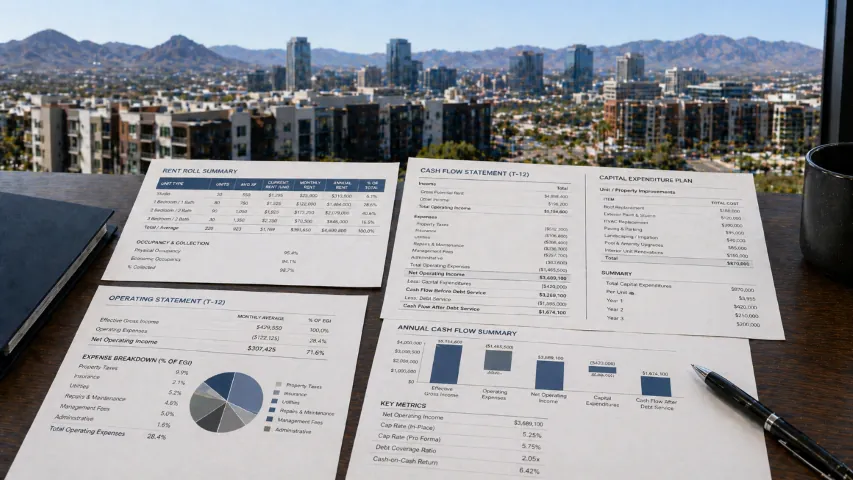
Unit type, square footage, floor plan, renovation status, lease expiration concentration, in-place rent, asking rent, and achieved rent all influence underwriting.
We look at the rent roll as an operating map of the property. It can show where revenue is concentrated, where lease rollover may create opportunity or risk, and whether projected rent growth is broadly achievable or dependent on a narrow group of units.
Concessions, Bad Debt, and Resident Churn
Headline rent can be misleading when concessions are required to maintain leasing velocity or when bad debt is materially affecting collections.
Turnover also has a cost. Vacancy days, make-ready work, marketing, leasing labor, and concessions can reduce the economic benefit of an aggressive rent strategy. A disciplined review considers not only what rent can theoretically be charged, but how efficiently the property can retain and replace residents.
Operating Expenses
Payroll, repairs and maintenance, contract services, utilities, insurance, property taxes, administrative expenses, and management costs all affect net operating income.
Expense comparisons must be handled carefully. A low expense number may reflect genuine efficiency, deferred maintenance, unusual owner accounting, or costs being carried outside the property's operating statement. A high number may reflect temporary disruption, catch-up maintenance, or an operating model that can be improved.
The review separates recurring expenses from temporary items and identifies the assumptions a buyer is likely to normalize.
Capital Expenditures and Deferred Needs
Roofs, mechanical systems, paving, plumbing, electrical systems, balconies, pools, common areas, building envelopes, and unit interiors can create substantial capital exposure.
A strong trailing twelve-month statement does not eliminate physical risk. Multifamily analysis should connect financial performance to the condition of the actual property and the timing of future capital requirements.
Management and Execution Risk
Many multifamily business plans fail because execution is assumed rather than evaluated.
Renovation pacing, vendor capacity, leasing performance, staffing, maintenance response, reporting discipline, and management transitions can determine whether projected improvements are realized. The best spreadsheet in the world cannot compensate for a business plan that the ownership or operating team cannot execute consistently.
The Greater Phoenix Area Multifamily Market Is Not One Market
The phrase "Phoenix multifamily market" is useful at a broad level, but it can mislead when applied to an individual property.
The Greater Phoenix Area is a large, decentralized region with materially different employment centers, development patterns, freeway access, housing supply, land availability, resident demographics, and competing apartment inventory. A garden-style community in the West Valley is not underwritten solely from the same demand story as an infill asset near Tempe, a Scottsdale apartment community, or newer product in the Southeast Valley.
Submarket context matters because multifamily demand is local before it is metropolitan.
TFI’s multifamily work spans the Greater Phoenix Area, including Phoenix, Scottsdale, Tempe, Mesa, Chandler, Gilbert, Glendale, Peoria, Goodyear, Surprise, Buckeye, Queen Creek, and surrounding communities. The relevant market may be a West Valley garden-style submarket, an infill location near Tempe or Scottsdale, or newer product in the Southeast Valley.
We evaluate how the property relates to its immediate competitive set, surrounding housing alternatives, employment access, new construction pipeline, development age, transportation patterns, and the type of resident the asset is positioned to attract and retain.
This local-market perspective is especially important when underwriting rent growth or renovation premiums. Metro-level growth does not automatically translate into unlimited pricing power at every property. The relevant question is whether the specific asset and submarket support the proposed operating assumptions.
For owners and investors seeking a Phoenix multifamily broker, that distinction should be fundamental. Brokerage strategy should begin with the property's actual competitive environment, not a generic Valley-wide narrative.
Apartment Investment Sales and Multifamily Disposition Advisory
Selling an apartment property is a capital event, and preparation can materially change how buyers interpret the income, capital needs, and execution risk.
Our work in Arizona apartment investment sales focuses on the property's income story, operating history, capital condition, buyer universe, and the assumptions that are most likely to receive scrutiny during underwriting and due diligence.
Before recommending a disposition strategy, we consider whether financial reporting is sufficiently clear, whether recent operational changes need time to season, whether deferred issues will weaken buyer confidence, and whether the asset is likely to benefit from broad market exposure or a more controlled process.
The detailed disposition process belongs on our Commercial & Multifamily Seller Advisory page. The role of this multifamily page is to establish how apartment assets are viewed differently: buyers are often underwriting hundreds of recurring revenue decisions, operational systems, and unit-level risks rather than a small number of commercial leases.
Owners considering a sale can also request a Broker Price Opinion before deciding whether a formal disposition process makes sense.
Multifamily Acquisitions and Buyer Representation
Multifamily acquisitions can become deceptively easy to rationalize when the business plan depends on rent growth, renovation premiums, or future expense savings. Those assumptions need to be tested before they are capitalized into the purchase price.
Our role in a buyer assignment is to pressure-test the operating story and keep the original investment objective visible as the transaction progresses. That may include reviewing the submarket, rent roll, trailing operations, expense structure, capital needs, renovation assumptions, financing exposure, and potential exit position.
Buyer representation adds the most value after an opportunity is identified: testing the assumptions, understanding the property’s risks, and deciding whether the acquisition still makes sense.
Our full acquisition framework is detailed on the Commercial & Multifamily Buyer Advisory page.
Multifamily Valuation and Pricing Strategy
Cap rates matter in multifamily valuation, but cap rates do not operate independently from the quality of net operating income.
A buyer may adjust revenue, normalize expenses, account for property taxes and insurance differently, reserve for capital needs, or discount projected renovation premiums. Those underwriting decisions can materially change the income being capitalized and therefore the price a buyer views as supportable.
Price per unit can also be useful as a market reference, but it does not explain differences in unit size, age, condition, land, amenity package, operating efficiency, renovation status, or income quality.
Our multifamily pricing work focuses on forming a defensible view of value from the asset outward. We consider operating performance, comparable transactions, current buyer underwriting, market liquidity, physical condition, capital requirements, and the likely buyer pool.
For a deeper explanation of our methodology, see Commercial & Multifamily Valuation & Pricing Strategy. Owners seeking a property-specific opinion can Request a BPO.
Institutional and Private Capital Context
Multifamily assets attract a wide range of ownership and capital structures. A privately held apartment property may involve a small ownership group and long hold history. A larger asset or portfolio may involve institutional committees, family office capital, separate account requirements, or multiple layers of debt and equity.
The property may be the same asset class, but the decision process is not the same.
Institutional and semi-institutional assignments often require greater process control, reporting consistency, governance awareness, and coordination among internal and external stakeholders. Private owners may have more flexibility but can face concentration, tax, estate, partnership, or liquidity considerations that materially influence timing.
Our role is to understand the ownership context before recommending an execution strategy. Clients with more complex governance or portfolio requirements can review our Family Office Advisory approach. Where leverage, refinance exposure, or recapitalization is central to the decision, our Capital Strategy Advisory page explains the capital-structure framework we use.
Development, Lease-Up, and Stabilization
Multifamily development risk does not end when construction is substantially complete. The transition from development to lease-up and from lease-up to stabilized operations can materially affect value, financing, and exit timing.
Unit delivery schedules, absorption, concession strategy, competing supply, operating ramp-up, and the pace at which expenses normalize all influence how the asset is perceived.
We provide high-level advisory where development, lease-up, stabilization, and broader asset strategy intersect. Our role is not day-to-day property management or onsite leasing. It is to help ownership evaluate how the operating transition affects the larger real estate and capital decision.
See Commercial & Multifamily Development Advisory for feasibility and development strategy, or Leasing Advisory for the limited multifamily lease-up and stabilization context in which leasing strategy intersects with asset positioning.
Off-Market and Controlled-Distribution Multifamily Strategies
Not every apartment sale should be off-market, and privacy alone does not guarantee a better outcome.
A controlled-distribution strategy may make sense when ownership has a strong need for discretion, the likely buyer universe is narrow, or the asset presents circumstances that are better handled through direct qualification and information control. The trade-off is reduced market feedback and potentially less pricing tension.
We evaluate off-market multifamily opportunities using the same underwriting discipline as broadly marketed transactions. Limited exposure should serve a clear strategic purpose rather than function as a marketing label.
Our Off-Market Commercial & Multifamily Advisory page explains when a controlled process may or may not make sense.
How TFI Approaches Multifamily Advisory
Our multifamily work begins with the decision, not the transaction label.
We first seek to understand:
- The asset and its current operating condition
- The ownership or investment objective
- The quality and durability of current income
- Known operational, physical, or capital issues
- The assumptions embedded in the proposed strategy
- Financing and capital-structure considerations
- Timing, liquidity, and stakeholder constraints
- The realistic alternatives to buying, selling, refinancing, repositioning, or waiting
From there, we identify the service and execution path that fit the decision.
A sale moves into Seller Advisory. An acquisition moves into Buyer Advisory. A pricing question may require Valuation & Pricing Strategy or a BPO. A more complex ownership structure may require Family Office Advisory, while a capital issue may require a closer look at Capital Strategy Advisory.
This structure is intentional. The multifamily practice page explains how we think about the asset class. The shared advisory pages explain how we execute a specific service.
Multifamily Questions and Clarifications
What does a Phoenix multifamily broker do?
A multifamily broker may represent apartment owners in dispositions, advise buyers on acquisitions, provide pricing and market analysis, help evaluate transaction strategy, and coordinate execution through due diligence and closing. The quality of the advice depends on whether the broker understands how multifamily income, operations, capital needs, and buyer underwriting interact.
Does TFI represent both apartment owners and multifamily buyers?
Yes. We advise owners considering dispositions or strategic decisions and buyers evaluating multifamily acquisitions. The scope and representation structure are clarified before an engagement so the client's role, objective, and brokerage relationship are understood.
Is TFI focused only on large institutional apartment properties?
No. Our multifamily perspective can apply to privately held apartment properties, investment groups, portfolios, and institutional or semi-institutional situations. The appropriate process depends on the asset and assignment rather than applying one institutional-style process to every property.
Can TFI provide a multifamily Broker Price Opinion?
Yes. A multifamily BPO or pricing review can be used to help an owner understand current market positioning and evaluate whether a sale, hold, refinance, recapitalization, or further asset preparation deserves additional consideration. A BPO is not an appraisal.
Does TFI provide day-to-day multifamily property management?
Our multifamily advisory practice is focused on brokerage, transaction strategy, valuation context, and asset-level decision support. We may evaluate management and operating issues as part of an assignment, but the page does not represent TFI as the onsite or day-to-day property manager for apartment communities.
Do you work outside the Greater Phoenix Area?
The Greater Phoenix Area and Arizona are our primary multifamily markets. Selective national reach may apply for larger commercial, multifamily, investment, and capital-driven assignments where the scope and structure support the engagement and appropriate licensed local-market resources can be aligned.