
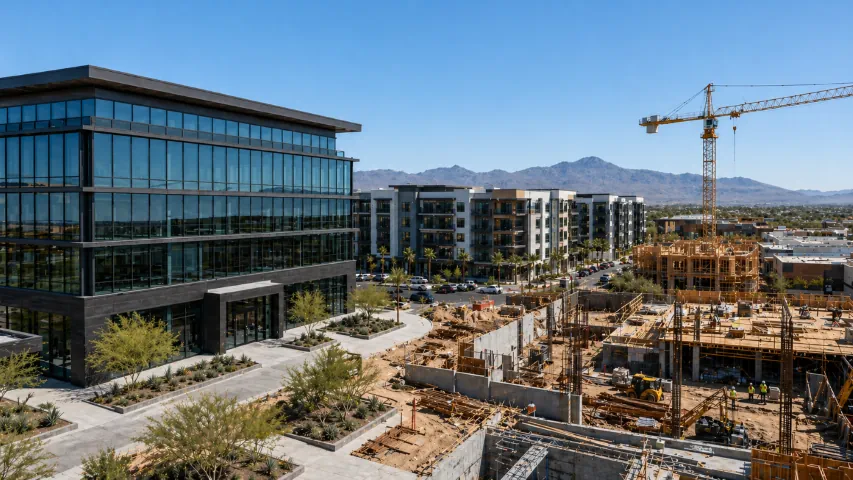

Commercial & Multifamily Development Advisory
TFI Real Estate Advisors provides broker-led development advisory and real estate facilitation for commercial and multifamily projects across the Greater Phoenix Area and Arizona.
We focus on the real estate decisions connecting the site, intended use, demand, capital plan, project team, and eventual lease-up, operation, or disposition. The work may support a first-time developer, an owner comparing development with acquisition, or an experienced sponsor seeking additional property-level and market perspective.
TFI Real Estate Advisors supports owners, investors, landlords, tenants, and developers across the Greater Phoenix Area and Arizona, with selective national reach for larger commercial, multifamily, investment, and capital-driven assignments where the scope and structure support the engagement.
Specialized architectural, engineering, entitlement, legal, environmental, construction, appraisal, lending, and tax work is performed by the corresponding qualified professionals. TFI helps organize the real estate decision, coordinate relevant information, and keep the project strategy connected to the owner's objectives.
What TFI Can Support in a Development Assignment
The scope is tailored to the project and may include:
- Site identification, land acquisition strategy, and transaction support
- Acquisition-versus-development comparisons
- Preliminary market, competitive-supply, demand, rent, pricing, and absorption analysis
- Conceptual highest-and-best-use and property-positioning review
- Evaluation of access, visibility, utilities, infrastructure, surrounding uses, and submarket context
- Preliminary development assumptions and sensitivity analysis
- Identification of entitlement, timing, and third-party diligence issues requiring specialist review
- Coordination with architects, engineers, land-use counsel, entitlement consultants, contractors, lenders, and other project professionals
- Capital sequencing and decision points across pre-development, construction, and stabilization
- Leasing, operating, valuation, refinance, or sale considerations that affect the development plan
The objective is a coherent development strategy and a defensible basis for each go, pause, redesign, acquire, or exit decision as new information develops.
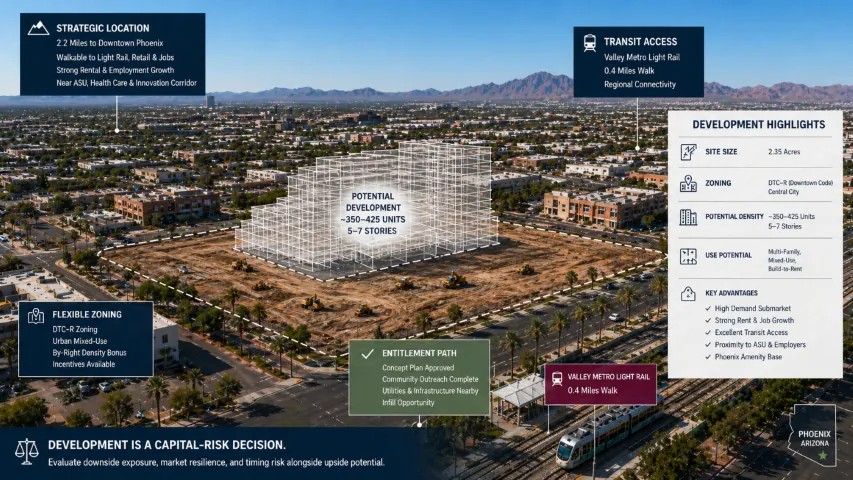
Development Is a Capital-Risk Decision
Development commits capital before operating income exists. Early assumptions about demand, absorption, pricing, cost, financing, and timing determine whether the project remains viable through entitlement, construction, and stabilization.
TFI helps clients frame development as an integrated real estate and capital decision. That means evaluating downside exposure, market resilience, timing, and optionality alongside the potential upside. A durable project should be able to withstand reasonable changes in demand, cost, schedule, and financing assumptions.
Development Versus Acquisition: Choosing the Right Path
One of the first questions is whether development is the best path—or whether an existing asset can meet the objective with less time, uncertainty, and capital exposure.
Development can provide customization, modern design, operational efficiency, and long-term positioning advantages. Acquisition may provide immediate occupancy or income, clearer current-market evidence, and a shorter path to execution.
TFI helps principals compare the alternatives based on capital availability, timing, property requirements, market conditions, risk tolerance, and long-term objectives. When acquisition is the stronger path, Commercial Buyer Representation can support the property search, underwriting, negotiation, and closing process.
Feasibility Before Entitlement and Design Commitments
Test the high-impact assumptions before entitlement, design, and consultant costs accelerate. Early feasibility work should show whether the site, intended use, demand, and capital plan justify continued pursuit.
TFI's preliminary real estate review may consider:
- Market demand and achievable rent or pricing assumptions
- Competitive projects and the future supply pipeline
- Absorption or lease-up timelines
- Site access, visibility, surrounding uses, and location fit
- Capital requirements and exposure sequencing
- Sensitivity to delays, cost escalation, financing changes, and slower stabilization
- Potential acquisition, lease, refinance, or exit alternatives
Formal feasibility studies, engineering, environmental work, cost estimates, appraisals, and entitlement opinions are provided by the appropriate specialists when the project requires them.
Highest and Best Use — Conceptual Framing
Highest and best use is not simply the maximum density or intensity that may be allowed. The concept requires alignment among legal permissibility, physical characteristics, market demand, financial feasibility, capital tolerance, and execution capability.
TFI advises on highest and best use at a conceptual, market-facing level. The focus is on uses supported by actual demand, pricing, operating economics, and project constraints, not only what may be theoretically permitted.
This framing helps clients identify a development concept that is responsive to the site and market before detailed design and entitlement work begins.
Market Demand, Competition, and Absorption
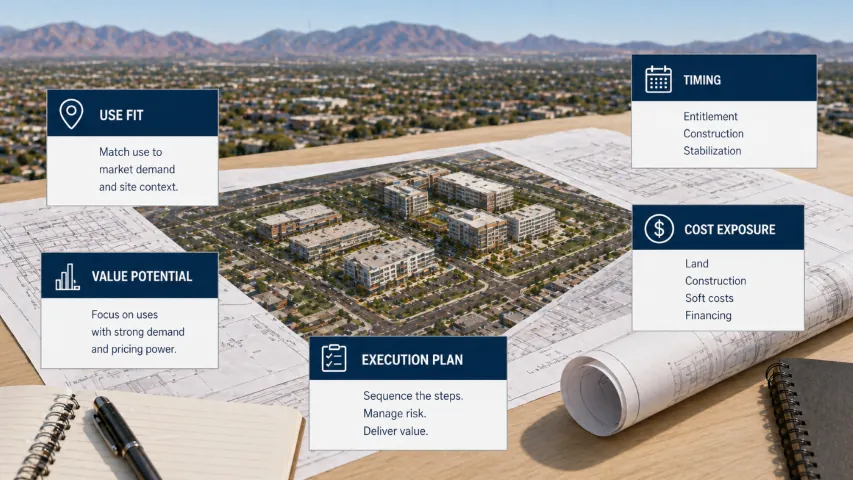
Development underwriting depends on the depth and timing of actual demand. The project must compete for tenants, residents, buyers, users, and capital when it reaches the market—not when the initial concept is prepared.
A market review may evaluate:
- Existing and proposed competing supply
- Achievable rents, sale prices, concessions, and operating assumptions
- Tenant, resident, buyer, or occupier demand within the defined submarket
- Unit mix, suite size, building configuration, or use-specific requirements
- Lease-up or sell-through timing
- Sensitivity to a slower absorption period
The development concept should remain workable under conservative assumptions, with clear decision points if market evidence changes.
Site, Infrastructure, Utilities, and Due-Diligence Coordination
A development site must support the intended use physically, legally, operationally, and economically. Access, utility capacity, drainage, environmental conditions, off-site improvements, easements, traffic, neighboring uses, and municipal requirements can all affect feasibility and timing.
TFI helps identify the real estate questions that need to be answered and coordinates those issues with the client's engineers, environmental consultants, surveyors, land-use attorneys, utility representatives, municipalities, and other specialists. Early identification of a material site constraint can preserve capital and optionality.
Capital Exposure and Sequencing
Development risk is layered. Capital exposure increases as a project moves from site control and preliminary diligence into entitlement, design, construction, lease-up, and stabilization.
TFI helps principals map major decision points and connect each phase to the information that should be available before the next capital commitment. This supports disciplined go, pause, redesign, or exit decisions and reduces the risk of continuing solely because prior costs have already been incurred.
Development capital questions can also be evaluated through TFI's Commercial Real Estate Capital Strategy work.
Entitlement and Regulatory Context
Entitlement and regulatory requirements can materially affect the development concept, schedule, cost, and capital plan. Zoning, general-plan alignment, public processes, infrastructure capacity, design requirements, and municipal sequencing may all influence the path forward.
TFI helps clients incorporate entitlement timing and uncertainty into the real estate decision and coordinate with qualified land-use counsel, entitlement consultants, planners, engineers, and municipal professionals. The purpose is to keep the market and capital strategy aligned with the actual approval path.
Project-Team Coordination and Decision Support
Development requires collaboration among the owner, broker, architect, engineer, attorney, entitlement team, contractor, lender, property manager, leasing team, and other specialists. The quality of the project depends on the quality, timing, and alignment of those decisions.
TFI can support the owner by:
- Keeping the real estate assumptions visible as plans and costs evolve
- Connecting market demand and property positioning to design decisions
- Evaluating trade-offs among cost, timing, flexibility, and marketability
- Coordinating property and transaction information across the project team
- Reassessing acquisition, leasing, valuation, financing, and exit assumptions at major milestones
The owner retains decision authority, while each specialized professional remains responsible for work within that professional's scope.
Multifamily Versus Commercial Development Considerations
Many development principles apply across property types, but multifamily and commercial projects have different demand, operating, and stabilization patterns.
Multifamily development is often highly sensitive to unit mix, rent positioning, concessions, absorption velocity, operating expenses, and property-management efficiency. Commercial development may depend more heavily on tenant credit, lease term, improvement allowances, building configuration, parking, access, visibility, and the depth of demand for a particular use.
TFI helps clients evaluate these distinctions so the project assumptions reflect how the intended asset type performs in the market. Multifamily owners and developers can also review TFI's dedicated Multifamily Advisory capabilities.
When Development Is a Strong Strategic Fit
Development is most compelling when the site, market, capital, timing, and sponsor capabilities reinforce one another.
Indicators may include:
- Demonstrated demand that existing supply does not adequately serve
- A site with characteristics that support the intended use
- Capital aligned with the entitlement, construction, and stabilization timeline
- A project team capable of executing the required approvals and delivery plan
- A business plan that remains viable under conservative cost and absorption assumptions
- Strategic objectives that benefit from purpose-built space or new construction
- Sufficient flexibility to adapt the plan as market and project information changes
When those conditions are not yet established, additional diligence, redesign, site comparison, acquisition analysis, or delayed commitment may improve the decision.
Market Cycles, Timing, and Optionality
Development timelines often cross market and credit cycles. A project may begin under one set of demand, cost, and financing conditions and deliver under another.
TFI helps principals evaluate timing through the lens of optionality. Site-control terms, diligence periods, phased commitments, adaptable design, leasing strategy, financing structure, and exit alternatives can all affect the owner's ability to respond as conditions change.
Timing discipline does not require predicting every market shift. It requires structuring the decision so the project can absorb uncertainty without losing sight of the intended outcome.
Greater Phoenix Area, Arizona, and Select National Reach
Within the Greater Phoenix Area, development assignments may involve Phoenix, Scottsdale, Tempe, Mesa, Chandler, Gilbert, Glendale, Peoria, Goodyear, Surprise, Buckeye, Queen Creek, and surrounding communities. Relevant submarkets may include the West Valley, Southeast Valley, Scottsdale Airpark, Deer Valley, Sky Harbor, the I-10 corridor, and other employment, industrial, retail, medical, office, and multifamily locations.
The Greater Phoenix Area and Arizona are TFI's core markets. Select national development-related assignments may be considered where the project scale, client relationship, asset type, advisory scope, local licensing, and market-specific professional resources support responsible engagement.
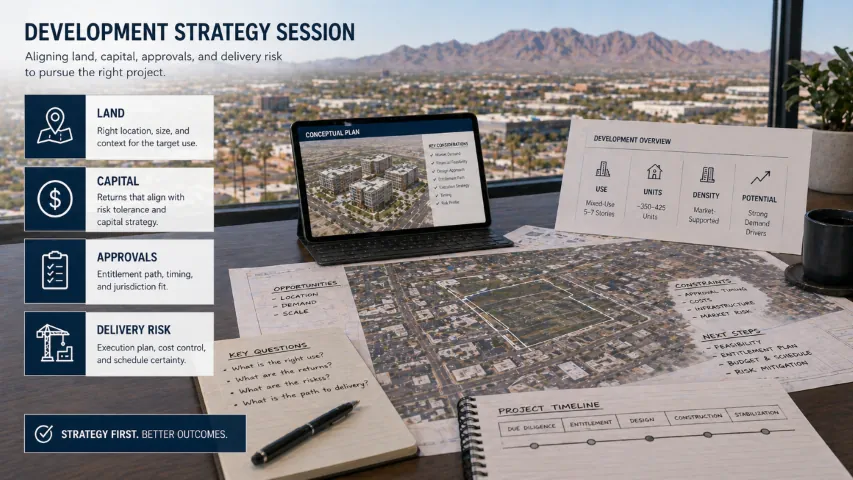
Frequently Asked Questions About Commercial Development Advisory
When should development advisory begin?
Development advisory is most useful during site selection, site-control negotiation, or the earliest feasibility stage—before major entitlement, design, or construction commitments are made. It can also add value later when assumptions, costs, timing, or market conditions need to be reassessed.
What role does TFI play in a development assignment?
TFI provides broker-led real estate strategy, market perspective, transaction support, preliminary feasibility framing, and project-team coordination. The work keeps the site, intended use, demand, capital plan, and ownership objectives connected as the project develops.
Does TFI manage construction or perform entitlement work?
TFI supports the real estate strategy and coordinates with the project team. Construction management, architecture, engineering, entitlement representation, environmental work, legal services, appraisals, and other specialized functions are performed by the appropriately qualified professionals responsible for those disciplines.
Can TFI help compare development with purchasing an existing property?
Yes. TFI can help compare timing, customization, current supply, acquisition cost, development cost, capital needs, operating requirements, and risk. If acquisition is selected, TFI can support the transaction through its Commercial Buyer Advisory services.
What information is useful for an initial development review?
Useful information may include the site address or parcel, ownership or contract status, intended use, preliminary program, target timing, available studies, zoning information, utility information, market assumptions, preliminary budget, capital plan, and the client's operating or investment objectives.
Does TFI work on both commercial and multifamily development?
Yes, when the assignment fits TFI's experience and advisory scope. Potential property types may include multifamily, office, medical office, industrial, flex, retail, mixed-use, land, and owner-user projects.
Does TFI work outside the Greater Phoenix Area?
Yes. The Greater Phoenix Area and Arizona are the core markets. Select national assignments are evaluated under the scope, licensing and local-coordination standards described above.