


Residential Real Estate Services Across the Greater Phoenix Area
TFI Real Estate Advisors works directly with buyers, sellers, homeowners, investors, and families across the Greater Phoenix Area, including Phoenix, Scottsdale, Tempe, Mesa, Chandler, Gilbert, Glendale, Peoria, Goodyear, Surprise, Buckeye, Queen Creek, and surrounding Arizona communities.
Those decisions may involve purchasing a primary residence, selling a long-held home, relocating into or out of Arizona, evaluating current value, comparing traditional and alternative sale options, or coordinating a transaction during divorce, probate, inheritance, or another life transition. In each case, the real estate decision carries consequences beyond the contract itself.

You work directly with Ian Johnson, a licensed Arizona Real Estate Associate Broker and real estate professional since 2010. The engagement combines market analysis, property evaluation, negotiation, contract and transaction coordination, and practical guidance shaped by brokerage, property-management, ownership, and investment experience.
Choose the Residential Service That Fits Your Decision
This hub connects the principal residential services and resources available through TFI:
- Home Buyer Representation: property search, neighborhood and community comparison, offer strategy, inspections, appraisal, financing coordination, due diligence, and closing.
- Home Seller Representation: pricing, preparation, marketing, buyer qualification, negotiation, inspection, appraisal, and closing strategy.
- Home Value Estimate and CMA: broker-led review of comparable sales, competing listings, property condition, buyer demand, and current market context.
- Greater Phoenix Area Relocation: community comparison, remote property review, search visits, financing readiness, transaction coordination, and local orientation.
- Financing Readiness: preparation for lender prequalification or preapproval and alignment between financing, affordability, the search, and offer strategy.
- Luxury Property Representation: buyer and seller guidance for custom homes, estates, golf and gated communities, luxury condominiums, second homes, and other distinctive properties.
- Expired Listing and Relaunch Strategy: review of prior pricing, presentation, marketing, showing feedback, property condition, and the changes required for a stronger relaunch.
- Cash-Offer Request and Comparison: evaluation of direct-sale convenience, certainty, contingencies, fees, timing, and likely net proceeds compared with broader market exposure.
- Probate and Estate Property Sales: valuation, preparation, marketing, offer review, title and escrow coordination, and collaboration with the estate’s attorney and other professionals.
- Divorce Real Estate Guidance: valuation, sale-versus-buyout context, listing execution, communication, documentation, and coordination with the parties’ attorneys.
- Arizona Wholesale Transaction Guidance: broker-led review of wholesale contracts, required disclosures, as-is property economics, and owner sale alternatives.
- Canadian Snowbird Real Estate: Arizona buying and selling support coordinated with qualified cross-border tax, legal, financing, currency, insurance, and title professionals.
What TFI Provides to Residential Clients
Residential brokerage is more than arranging a showing or placing a property in a listing system. We help you define the decision, understand the tradeoffs, and manage the transaction from the first strategy conversation through closing.
Depending on the assignment, that may include:
- Clarifying goals, timing, financial constraints, and decision authority
- Interpreting Greater Phoenix Area market conditions and neighborhood-level differences
- Evaluating property condition, improvements, maintenance, HOA obligations, taxes, insurance, and long-term ownership cost
- Preparing pricing, offer, negotiation, and contingency strategy
- Reviewing comparable sales, competing listings, buyer demand, and appraisal risk
- Coordinating inspections, title, escrow, lenders, appraisers, contractors, attorneys, accountants, and other qualified professionals
- Managing contractual deadlines, documentation, communication, and closing execution
- Comparing traditional and alternative transaction paths when the property or ownership situation requires flexibility
Types of Residential Properties
The property type changes the decision. Financing, maintenance, association obligations, insurance, valuation, and future resale can differ substantially across residential property types and ownership structures.

- Single-family homes: detached residences with direct control over the structure, site, maintenance, and improvements.
- Condominiums: individually owned units with shared common elements, association rules, fees, insurance, and financing considerations.
- Townhomes and villas: attached or semi-attached homes that may combine individual ownership with shared maintenance responsibilities.
- Duplexes and small multi-unit properties: residential assets that may combine owner occupancy with rental income or function primarily as investments.
- Luxury, custom, golf, gated, and large-lot properties: distinctive homes that may require specialized pricing, inspection, appraisal, privacy, and marketing strategies.
- New construction: builder transactions requiring evaluation of contracts, incentives, options, inspections, completion timing, and resale context.
The intended use matters. An owner-occupied home is usually evaluated through lifestyle, affordability, location, functionality, and future resale. A rental or small investment property places more emphasis on income, expenses, tenant demand, capital requirements, and long-term performance.
Residential and Commercial Real Estate Use Different Decision Frameworks
Residential real estate centers on homes and smaller residential properties, where lifestyle, affordability, condition, financing, family needs, and personal timing often carry substantial weight. Commercial and Multifamily Real Estate is generally evaluated more heavily through income, lease structure, operating performance, capital requirements, and investment returns.
The disciplines overlap, but their transaction processes, financing, valuation methods, buyer motivations, and risk analysis can differ materially. TFI applies the residential framework that fits the property while drawing on broader brokerage, property-management, ownership, and investment experience.
How Residential Real Estate Transactions Work
Although every transaction differs, the process generally follows a defined sequence:
- Strategy and preparation: buyers establish priorities, financing readiness, and search parameters; sellers evaluate value, property condition, timing, and market position.
- Search or marketing: buyers compare communities and properties; sellers prepare and expose the home to the appropriate buyer pool.
- Offer and negotiation: price, financing, concessions, contingencies, possession, repairs, and other terms are structured and negotiated.
- Due diligence: inspections, disclosures, title, HOA documents, appraisal, financing, insurance, and other property-specific matters are reviewed.
- Closing: final loan and title conditions are completed, documents are signed, funds are transferred, ownership is recorded, and possession is delivered according to the contract.
Experienced representation matters most in the connections between the steps. Pricing, financing, inspection, appraisal, title, contract, and timing decisions should support one another rather than create avoidable conflict later in the transaction.
Buyers and Sellers Have Different Objectives and Risks
Buyers generally focus on value, affordability, condition, location, daily-life priorities, financing, and future resale. They may rely on inspection, appraisal, loan, title, and document-review contingencies to evaluate the property before fully committing.
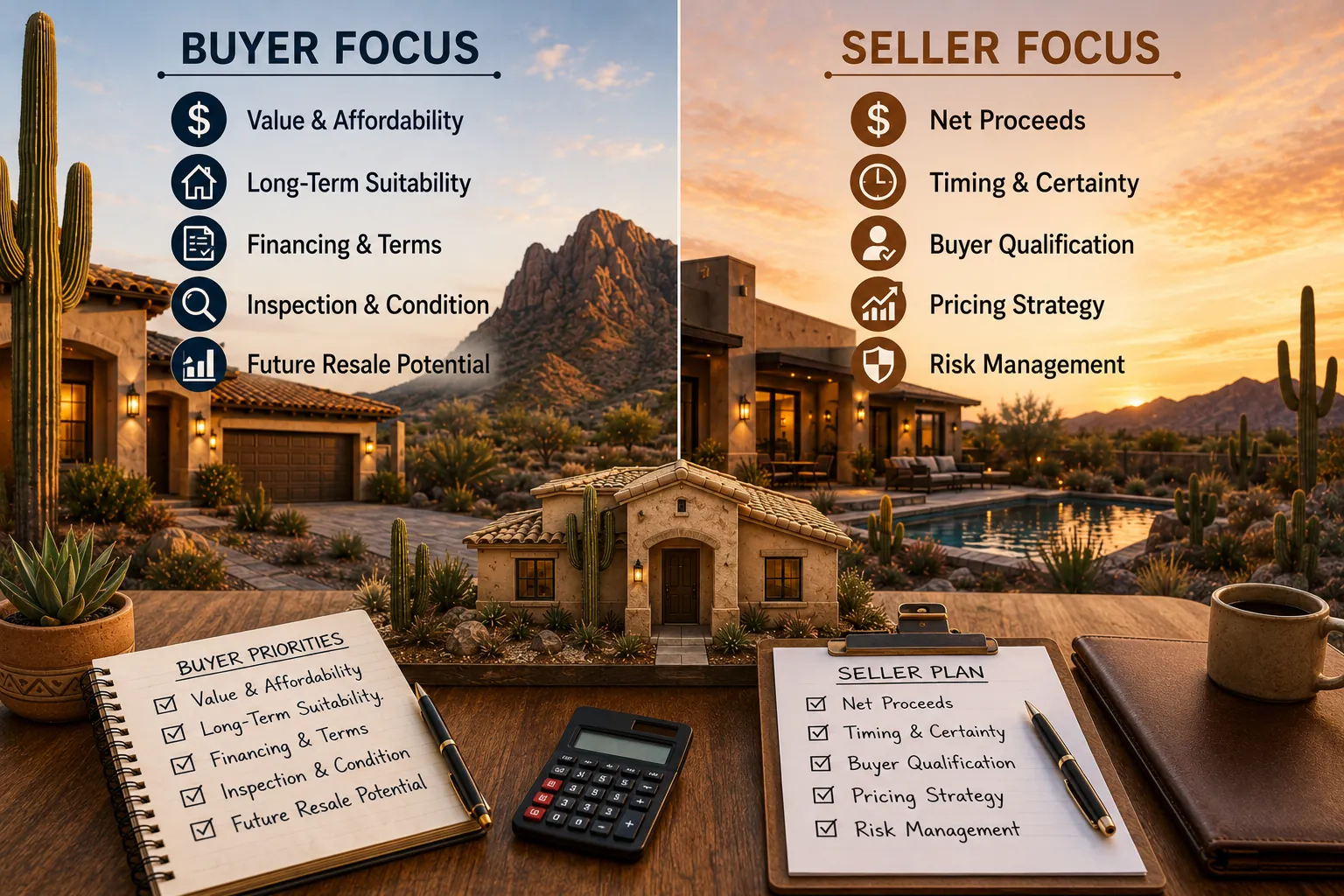
Sellers generally focus on net proceeds, certainty, timing, property preparation, market exposure, buyer qualification, and the probability that the transaction will close. They must balance the highest stated price against financing strength, contingencies, concessions, inspection exposure, appraisal risk, and timing.
Because buyer and seller objectives are not identical, the transaction requires clear agency, informed negotiation, realistic expectations, and careful management of information and deadlines.
Market Conditions, Pricing, and Property Value
Residential markets are local, and they move. Supply, buyer demand, interest rates, lending standards, employment, migration, new construction, seasonality, property condition, HOA structure, school boundaries, and neighborhood competition can all change value and negotiating leverage.
A citywide average or automated estimate cannot fully explain a specific property. You need the recent comparable sales, active and pending competition, market time, price reductions, concessions, condition, location, and likely buyer pool placed in context.
TFI’s Home-Value and CMA Service provides a property-specific starting point for owners evaluating a sale, refinance, estate issue, buyout, or broader planning decision.
Financing, Affordability, and Long-Term Ownership Cost
Purchase price is only one part of residential affordability. Buyers should evaluate the monthly payment, interest rate, loan structure, taxes, insurance, HOA fees, utilities, maintenance, repairs, solar obligations, and reserves required after closing.
Lender prequalification or preapproval also affects the search range, offer credibility, appraisal exposure, and closing timing. TFI helps you connect lender readiness with a comfortable ownership plan instead of treating the maximum approved loan amount as the automatic budget.
Sellers also need to understand financing because loan type, down payment, appraisal conditions, lender overlays, and buyer documentation can influence the strength and certainty of an offer.
Contracts, Disclosures, Title, and Professional Coordination
Residential transactions involve purchase agreements, agency agreements, disclosures, inspection rights, contingencies, title and ownership verification, HOA documents, escrow instructions, financing conditions, and closing documents. These materials carry legal and financial consequences.
TFI provides brokerage guidance, negotiation, and transaction coordination while working with qualified attorneys, lenders, title and escrow professionals, inspectors, appraisers, accountants, contractors, and other specialists when their expertise is required.
Residential Real Estate and Long-Term Wealth
Homeownership can contribute to long-term wealth through principal reduction, equity accumulation, appreciation, and housing stability. Residential investment property may also produce income and additional appreciation.
Those benefits are not automatic. Overpaying, underestimating repairs and carrying costs, choosing unsuitable financing, overlooking association or insurance issues, or selling without adequate pricing and exposure analysis can erode value. A sound decision aligns the property, ownership cost, market conditions, holding period, and personal or investment objective.
Residential Real Estate During Life Transitions
Some residential assignments involve far more than an ordinary move. Relocation, divorce, probate, inheritance, aging, marriage, employment changes, financial stress, and family restructuring can all affect authority, timing, occupancy, communication, tax considerations, and the appropriate sale or purchase strategy.

- Relocation requires coordination among the home search or sale, employment timing, financing, temporary housing, travel, and closing.
- Divorce-Related Real Estate may involve valuation, sale-versus-buyout analysis, occupancy, mortgage liability, communication protocols, and attorney-approved authority.
- Probate and Estate Property may require confirmation of the personal representative’s authority, title review, property preparation, heir or occupant coordination, and documented fiduciary decision-making.
- Inherited Property may involve probate, trust administration, multiple owners, tax questions, deferred maintenance, or an out-of-state decision-maker.
TFI handles the real estate strategy and execution while coordinating with your legal, tax, lending, and other professional advisors.
Traditional and Alternative Residential Sale Options
A traditional listing is often the strongest path when broad exposure, buyer competition, and market price discovery are priorities. Other circumstances may justify a different approach.
- Cash Offer: prioritizes speed, simplicity, and reduced financing uncertainty, often with a trade-off in price or fees.
- Wholesale or Assigned-Contract Transaction: may fit experienced investors or owners comparing an investor-oriented solution with other sale paths.
- Expired-Listing Relaunch: addresses prior pricing, presentation, access, marketing, or property-condition issues before returning to the market.
- Hold or rent: may be appropriate when the ownership economics, financing, tenant demand, management requirements, and long-term plan support continued ownership.
Compare the paths by considering likely net proceeds, time, property preparation, carrying costs, certainty, tax and legal context, and the owner’s broader goals—not merely the stated purchase price.
Common Residential Real Estate Pitfalls
Residential transactions are most vulnerable when expectations are disconnected from the property or market. Common problems include:
- Pricing or offering without relevant comparable and competitive context
- Underestimating repairs, maintenance, insurance, taxes, HOA costs, or ownership reserves
- Misunderstanding financing, appraisal, inspection, title, or contingency risk
- Failing to verify authority, ownership, disclosures, or contractual deadlines
- Choosing a sale or purchase path based only on speed, headline price, or marketing claims
- Entering a complex transaction without coordinating the appropriate legal, tax, lending, or property professionals
When the preparation is structured and the communication is direct, you are less likely to be surprised and more likely to preserve useful options.
Choosing the Right Residential Path
There is no single residential strategy that fits every client. The appropriate path for you depends on the property, market, financing, timeline, condition, ownership structure, risk tolerance, and personal or investment objective.

- Buyers may prioritize affordability, location, schools, commute, lifestyle, condition, new construction, or future resale.
- Sellers may prioritize maximum exposure and price, certainty, privacy, condition, a compressed timeline, or coordination with another purchase.
- Owners in a life transition may need the real estate decision aligned with attorney instructions, family communication, occupancy, authority, or estate administration.
- Investors may focus on acquisition basis, repair exposure, rental demand, operating cost, holding period, financing, and exit strategy.
TFI helps you identify the service path and transaction strategy that best fits those facts.
Homeowner Education and Risk Resources
TFI’s Homeowner Education section provides deeper guidance on issues that can affect ownership and transactions, including:
- Real Estate Wire Fraud
- Deed Fraud and Fake Sellers
- Spousal and Ownership Fraud
- Title Defects
- Property Title Monitoring
- FIRPTA for Foreign Owners
- Selling Inherited Property
For market and community research, explore the Residential Market &Amp; Area Insights hub and the Greater Phoenix Area City Guides.
A Direct, Broker-Led Residential Real Estate Model
Many broad Phoenix search results emphasize large agent directories, team size, transaction counts, reviews, and listing inventory. TFI takes a more direct approach. You work with an experienced Arizona associate broker who connects the market, property, contract, transaction, and ownership decision rather than moving the engagement through a high-volume lead funnel.
This model fits buyers, sellers, and owners who value practical analysis, direct access, clear communication, and a strategy built around the specific property and objective.