
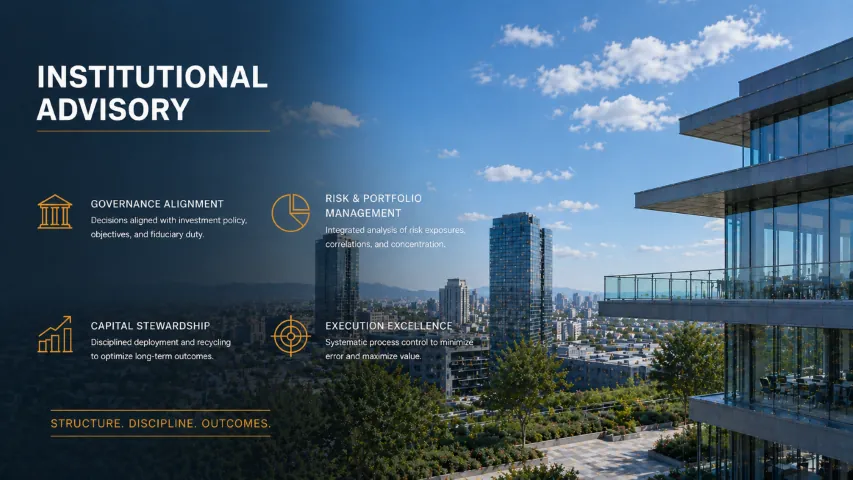

Property-Level Real Estate Advisory for Sophisticated Owners
A sophisticated owner is often evaluating more than one transaction. The decision may involve multiple stakeholders, concentrated exposure, internal approvals, reporting requirements, liquidity needs, succession considerations, or a long-term ownership mandate.
A property decision should remain defensible after closing and across future reporting periods. That requires clear documentation, consistent assumptions, visible risk factors, and alignment between ownership strategy and transaction execution.
TFI applies an institutional-quality decision standard without presenting itself as a large institutional platform. The assignment may involve one complex property, a small portfolio, or a larger mandate where direct broker access, an operator-informed perspective, and coordinated execution add value.
Clients and Ownership Structures We May Support
The advisory framework may be appropriate for:
- Single-family and multi-family offices with direct commercial real estate ownership
- Private real estate funds, syndicators, and sponsor groups
- Closely held investment companies and operating businesses
- Sophisticated private owners with multiple properties or complex ownership structures
- Asset managers, trustees, fiduciaries, attorneys, accountants, and other advisors coordinating real estate matters for a client
- Developers and ownership groups evaluating larger or more complex assignments
- Institutional or semi-institutional owners requiring local Greater Phoenix Area or Arizona execution
The engagement is scaled to the asset, decision, stakeholders, and risk. A focused property assignment may need concise analysis, while a multi-asset or multi-stakeholder matter may require more formal reporting and coordination.
Governance, Process, and Accountability
Strong governance improves real estate decisions. Clear authority, documented assumptions, reliable information flow, and defined escalation paths keep the work moving and reduce avoidable rework.
Before execution, identify who owns the decision, who approves strategy and material terms, which stakeholders need reporting or consultation, what information may be shared, and how changes or exceptions will be handled. Legal, tax, appraisal, financing, engineering, environmental, and other specialist responsibilities should also be explicit.
That structure prevents an assignment from advancing on assumptions that the actual decision-makers have not accepted.
Portfolio Context and Asset-Level Decisions
A sophisticated owner evaluates property decisions within portfolio construction and capital allocation. Concentration, geography, asset type, leverage, liquidity, tenant exposure, capital needs, and timing may matter more than the result of any single asset.
We place each property-level decision within that broader context. A sale may improve liquidity but increase concentration elsewhere. An acquisition may strengthen income while duplicating tenant or market exposure. A capital project may make sense only when considered alongside debt maturities, partnership obligations, and other pending transactions.
The property analysis should support the portfolio decision, not compete with it.
Repeatable Execution Across Properties and Stakeholders
Working across multiple assets, markets, stakeholders, and counterparties requires more consistency than a one-off transaction.
Comparable underwriting standards, documented assumptions, clear responsibilities, and defined approval points allow decisions to be reviewed across assets without losing local context. Exceptions and unresolved issues should be visible early enough for the appropriate people to address them.
The process can remain practical while still being repeatable.
Risk Management, Market Cycles, and Downside Awareness
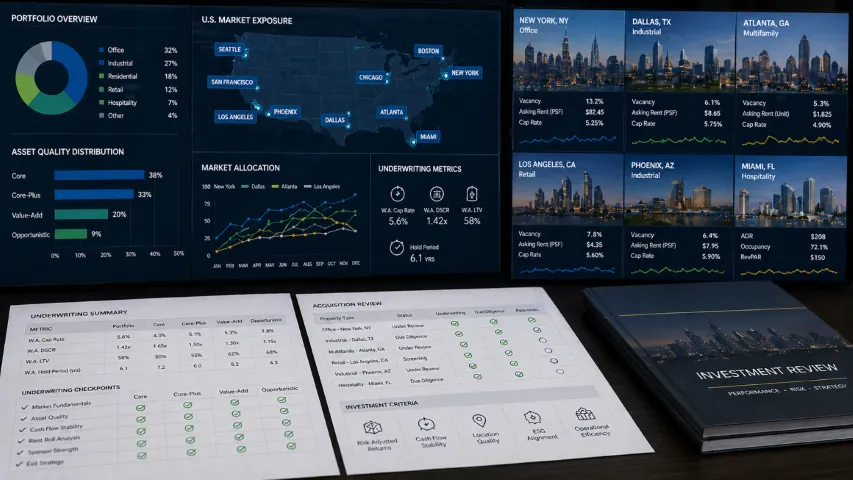
Portfolio risk is rarely isolated. Market cycles, tenant behavior, financing costs, insurance, regulation, and liquidity can affect several assets at the same time.
TFI’s analysis considers income durability, tenant concentration, lease rollover, debt maturities, refinancing exposure, deferred maintenance, capital requirements, buyer depth, and sensitivity to changes in rents, expenses, cap rates, and exit timing. It also considers the consequence of being forced to transact when conditions are unfavorable.
Good timing is less about predicting the perfect market than maintaining preparedness, liquidity, and flexibility.
Property and Transaction Decisions We Address
TFI's family office and sophisticated-owner work is centered on real property and transaction execution. Depending on the engagement, that may include:
- Acquisition strategy and Commercial Buyer Representation
- Disposition planning and Commercial Seller Representation
- Portfolio review and transaction sequencing
- Property-specific Valuation and Pricing Strategy
- Commercial BOV/BPO analysis for ownership decisions
- Leasing, renewal, occupancy, and tenant-risk strategy
- Multifamily operating and transaction considerations
- Off-market or controlled-distribution strategy
- Development feasibility and execution context
- Debt, equity, recapitalization, and refinancing coordination
- Local-market execution for a client or advisor based outside Arizona
The appropriate service page explains the detailed execution framework. Institutional advisory establishes how those services are coordinated when the ownership structure, portfolio context, or decision process is more complex.
Underwriting and Decision Documentation
Decision-ready work depends on whether the important assumptions are visible, supported, and usable by the people responsible for the decision.
A TFI work product may address:
- Property and submarket context
- Rent roll, lease, tenant, and income-quality issues
- Historical operations and normalized assumptions
- Physical condition and capital requirements
- Comparable sales, listings, and buyer behavior
- Financing and capital-market context
- Acquisition, hold, repositioning, or exit scenarios
- Key risks, sensitivities, and unresolved diligence items
- Recommended next actions and decision points
The level of documentation should match the assignment. A focused property review may call for a concise work product, while a multi-asset or multi-stakeholder engagement may require formal tracking, reporting, and approval records.
Acquisition, Disposition, and Portfolio Execution
Acquisitions
Family office and sophisticated private buyers often need more than access to listings. The assignment may require market screening, opportunity comparison, underwriting review, offer strategy, diligence coordination, financing context, and documentation suitable for internal approval.
Our Commercial Buyer Representation page explains the acquisition framework in greater detail.
Dispositions
A sale may be driven by portfolio rebalancing, liquidity, debt maturity, partnership changes, operating performance, tax planning, estate considerations, or a strategic decision to exit a market or asset type. Those objectives affect pricing, timing, preparation, marketing, buyer selection, and acceptable transaction risk.
Our Commercial Seller Representation page details the disposition process. Where discretion is material, Off-Market Commercial Real Estate Advisory may also be relevant.
Portfolio decisions
A portfolio review should remain tied to ownership objectives. The useful question is which decision improves the portfolio after considering income durability, capital needs, debt, concentration, liquidity, marketability, timing, and strategic fit—not merely which asset appears to perform best or worst.
Coordination With Internal Teams and External Advisors
Family offices and sophisticated owners often already have internal staff and trusted outside professionals. TFI works alongside investment and asset-management personnel, property managers, attorneys, tax advisers, accountants, appraisers, lenders, engineers, architects, contractors, environmental consultants, and local brokers in other markets.
Our role is to keep the real estate assumptions, market work, deadlines, reporting, and responsibilities connected so the client’s team can evaluate the decision using a common set of facts.
Property Advisory, Capital Relationships, and Financing
These related services address different decisions and should remain clearly separated.
This commercial advisory page concerns owned or targeted real estate: properties, portfolios, acquisitions, dispositions, leasing, valuation, development, and transaction execution.
The Family Office & Private Capital Real Estate Relationships page concerns mandate fit, direct-investment relationships, governance, reporting expectations, co-investment or joint-venture structures, and alignment between capital providers and real estate operators.
The Commercial Real Estate Capital Strategy page addresses how financing, leverage, maturity, proceeds, liquidity, and control interact with a property or transaction strategy. The client’s selected lenders, mortgage bankers, capital advisers, securities professionals, attorneys, and CPAs provide the specialized execution required for financing or capital activity.
Keeping the assignments distinct allows the property work, capital relationship, and financing process to be scoped around the client’s actual decision.
Direct Broker Access and a Right-Sized Advisory Team
TFI’s model gives the client direct access to the broker leading the work, a principal-led and operator-informed perspective, and coordination across brokerage, leasing, property operations, valuation, and ownership considerations. The engagement can be built around the client’s existing team, governance structure, and reporting needs.
This approach is suited to clients who value senior involvement, clear communication, and a team assembled around the actual property or portfolio decision. When additional research depth, local execution, capital-markets capability, legal analysis, appraisal, engineering, or other specialization would improve the outcome, TFI can help identify and coordinate the appropriate resources.
Greater Phoenix Area, Arizona, and Select National Reach
TFI Real Estate Advisors supports owners, investors, landlords, tenants, and developers across the Greater Phoenix Area and Arizona, with selective national reach for larger commercial, multifamily, investment, and capital-driven assignments where the scope and structure support the engagement.
Family office and sophisticated-owner assignments may involve assets in Phoenix, Scottsdale, Tempe, Mesa, Chandler, Gilbert, Glendale, Peoria, Goodyear, Surprise, Buckeye, Queen Creek, and other Greater Phoenix Area markets. Multi-market work is organized around the portfolio, transaction, governance, and resource requirements of the assignment.
The Greater Phoenix Area and Arizona are the core market. Select national assignments are considered where transaction size, complexity, client relationship, asset type, local licensing, and market-specific execution resources support responsible engagement.

Ongoing Alignment and Decision Continuity
Sophisticated advisory relationships are built on alignment rather than transactions alone. Some assignments are discrete; others benefit from continuity as market conditions, asset performance, financing, leases, ownership objectives, or portfolio priorities change.
Ongoing work should have a defined purpose and scope. It may involve periodic portfolio reviews, transaction sequencing, property-level decision support, valuation context, leasing strategy, or coordination with the client’s internal and external teams. TFI provides the real estate brokerage and advisory work while the client retains decision authority and its investment, asset-management, legal, accounting, appraisal, and tax professionals remain responsible for their respective functions.
The work is organized to preserve clarity and decision continuity as complexity grows while keeping responsibilities appropriately divided.
Frequently Asked Questions About Family Office and Sophisticated-Owner Real Estate
Does TFI work with family offices?
TFI may support family offices with direct commercial or multifamily ownership when the assignment fits our brokerage and advisory capabilities. That can include acquisitions, dispositions, valuation context, leasing strategy, portfolio decisions, and local Greater Phoenix Area or Arizona execution.
Does TFI manage a family office’s or owner’s real estate portfolio?
TFI’s work is scoped around commercial real estate brokerage, property analysis, transaction strategy, decision support, and coordination. The client retains investment authority and any separate asset-management or investment-advisory responsibilities unless a distinct, properly structured engagement provides otherwise.
Can TFI work with a client's attorney, CPA, investment adviser, or asset manager?
Yes. Complex decisions are often stronger when responsibilities are clearly divided among qualified professionals. TFI can provide real estate market and transaction input while the client's other advisors address legal, tax, accounting, securities, estate, or broader portfolio matters.
Can TFI advise on multiple properties at once?
Potentially. The scope depends on the number and type of assets, available information, markets, intended decisions, stakeholders, and required work product. A preliminary review can determine whether TFI should lead, support, or help assemble additional resources.
Can TFI coordinate financing or a capital relationship?
Yes. TFI can define the property-level need, compare strategic alternatives, and keep the real estate analysis connected to the process. The client’s selected lenders, mortgage bankers, capital advisers, securities professionals, attorneys, and CPAs perform the specialized or regulated execution their roles require.
Does TFI work outside Arizona?
The Greater Phoenix Area and Arizona are the core markets. Select national commercial, multifamily, investment, and capital-driven assignments may be considered where the scope, structure, client relationship, and licensed local-market resources support the engagement.
How is this different from a standard one-property brokerage assignment?
The underlying brokerage functions may be similar, but the decision environment can be more complex. Family office and sophisticated-owner assignments may require more stakeholder coordination, repeatable process control, documentation, portfolio context, approval discipline, downside analysis, and integration with external advisers.