


What TFI Provides in a Real Estate Strategy Engagement
TFI provides broker-led strategy for investors who own or intend to acquire direct real estate. We connect portfolio objectives to property-level decisions, market conditions, financing, operating requirements, and transaction execution.
The review may examine the role of each property, concentration by market or asset type, income durability, capital expenditures, debt maturities, liquidity, acquisition criteria, hold and exit timing, and the resources required to execute the plan. The result is a framework you can apply when a new opportunity, refinancing decision, capital need, or sale question arises.
This service is real estate-specific. TFI evaluates direct property holdings and real estate decisions. Broader securities allocation, personalized investment management, and comprehensive financial planning are coordinated with the investor's registered investment adviser, wealth manager, CPA, attorney, or other qualified professional. TFI's Wealth Management page explains the separate advisory relationship available through Desert Rose Capital Management.
Start With the Investor and the Existing Holdings
A useful strategy begins with your actual circumstances, not a model portfolio. The same property can fit one investor and be poorly suited to another because of differences in liquidity, income needs, debt exposure, business obligations, experience, time horizon, or willingness to manage operating complexity.
We can begin with one property or a multi-asset portfolio. The review looks at how the holdings were assembled, which assets are carrying performance, where capital is concentrated, which properties require near-term decisions, and whether the portfolio reflects an intentional strategy or a series of unrelated transactions.
Clarity at this stage often reveals that the next best decision is not necessarily another acquisition. It may be to stabilize an existing asset, address a maturity, sell an underperforming property, improve liquidity, or establish better criteria before pursuing new opportunities.

What Is a Real Estate Investment Strategy?
A real estate investment strategy is the framework you use to make property decisions over time. It defines the objective, acceptable risk, suitable property types and markets, use of leverage, required liquidity, and the conditions that should trigger acquisition, reinvestment, refinancing, or sale.
A strong strategy provides both direction and restraint. It identifies the opportunities that fit and creates a reasoned basis for declining transactions that do not. This reduces the tendency to make isolated decisions based on urgency, attractive marketing, or short-term market sentiment.
Strategy is not a prediction that one market or property type will outperform. It is a durable method for evaluating changing conditions without abandoning the investor's underlying objectives.
The Role of Direct Real Estate Within Broader Wealth
Direct real estate may provide income, appreciation potential, tax characteristics, control, and a tangible operating asset. The same ownership can also create concentration, illiquidity, financing exposure, management demands, and large capital obligations.
TFI evaluates how those real estate characteristics affect the investor's cash flow, liquidity, risk, and decision flexibility. A portfolio heavily concentrated in property may require different acquisition criteria and reserves than a portfolio in which real estate is a smaller component. An investor whose operating business is also tied to real estate or construction may have additional exposure that is not obvious from the property schedule alone.
The real estate analysis should be coordinated with broader financial planning, but TFI does not substitute for the professional responsible for securities, retirement, estate, tax, or comprehensive wealth advice. The most useful result comes from keeping those roles distinct while ensuring the advice is not developed in isolation.
Allocation and Concentration Risk
Several properties do not automatically create diversification. Concentration can accumulate by property type, geography, tenant, lease expiration, operating strategy, lender, maturity date, or capital need—even when the assets sit in separate entities.
TFI helps investors identify where exposure is accumulating and whether that concentration is intentional. Concentration is not automatically a flaw. An experienced owner may have a durable advantage in one property type or market. The question is whether the potential reward justifies the reduced flexibility and whether the investor has enough liquidity and operating capacity to manage an adverse scenario.
Portfolio-level decisions often have a greater effect on long-term results than small differences in the projected return of one acquisition.
Time Horizon, Capital Pacing, and Liquidity
Real estate is illiquid and frequently capital-intensive, so the strategy must account for loan maturities, capital calls, repairs, tenant improvements, lease-up costs, development expenditures, taxes, insurance, and the possibility that a sale or refinancing takes longer than expected.
Capital pacing determines how quickly an investor deploys cash and accepts new obligations. Aggressive pacing can create a portfolio that looks strong under the base case but has little capacity to absorb a vacancy, delayed project, refinancing shortfall, or personal liquidity need. Excessive caution can also leave capital unproductive or prevent the investor from acting when a well-aligned opportunity appears.
The objective is to maintain enough flexibility to make deliberate decisions throughout the hold period rather than being forced into a transaction by the capital structure.
Acquisition Criteria and Decision Filters
Written acquisition criteria make decisions more consistent. They can address property type, market, investment size, leverage, condition, tenant profile, required yield, renovation scope, management intensity, hold period, exit alternatives, and the amount of uncertainty you are prepared to accept.
TFI helps translate broad goals into criteria that can actually be used to screen opportunities. Criteria should be specific enough to eliminate poor fits without becoming so rigid that they exclude a compelling property for an immaterial reason.
Related services include Commercial Buyer Representation, Multifamily Advisory, Residential Wholesale & Discount Property Advisory, and Deal Sourcing & Underwriting.
Hold, Improve, Refinance, Recapitalize, or Sell
Portfolio strategy does not end with acquisition. Existing properties should be reviewed periodically to determine whether they still serve your objectives and whether additional capital is likely to produce an appropriate return.
A hold decision may be supported by durable cash flow, attractive financing, limited reinvestment alternatives, or a property-specific advantage. An improvement or repositioning plan may make sense when capital can address a clear leasing, condition, or operational issue. Refinancing or recapitalization may improve liquidity or extend the business plan, but it can also increase leverage and future constraints. A sale may reduce risk, realize value, address an approaching capital need, or allow proceeds to be redeployed more effectively.
TFI can help compare these paths using consistent assumptions. Commercial Valuation & Pricing Strategy, Commercial Real Estate Capital Strategy, Commercial Seller Representation, and 1031 Exchange Strategy may support the analysis where applicable.
Risk, Volatility, and Downside Scenarios
Real estate risk is broader than a change in market value. Vacancy, tenant credit, lease rollover, operating costs, taxes, insurance, repairs, capital expenditures, regulation, competition, and management execution can all affect income. Financing adds interest-rate, covenant, maturity, and refinancing risk.
TFI uses downside scenarios to identify which assumptions matter most and how much flexibility the investor retains if the business plan takes longer or costs more than expected. The analysis may consider slower leasing, lower rents, higher expenses, a delayed sale, reduced refinance proceeds, additional capital requirements, or an extended hold.
A durable strategy does not assume that every adverse event will occur. It ensures that the portfolio can respond when one does.
Real Estate and Market Cycles
Real estate markets move through cycles shaped by construction, employment, population, capital availability, interest rates, lender appetite, investor demand, and local supply. Different property types and submarkets can be at different points in the cycle at the same time.
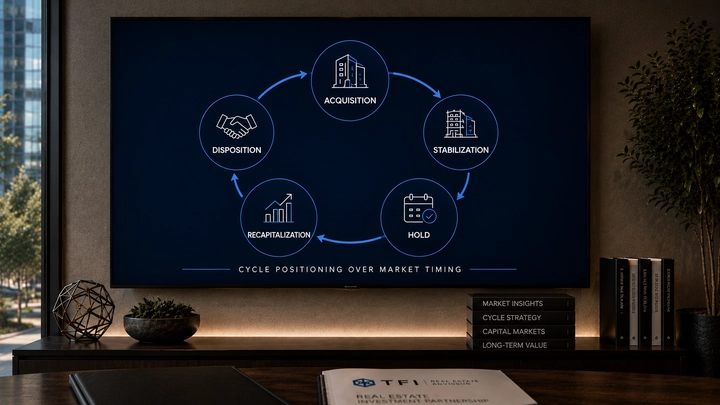
We use market-cycle context to improve decisions, not to pretend that turning points can be timed precisely. The practical questions are whether the basis is defensible, the income can support the capital structure, competing supply threatens the plan, and you have enough time and liquidity for the strategy to work.
Cycle awareness should improve assumptions and pacing, not create false confidence in a precise forecast.
Capital Structure and Leverage Strategy
Leverage can improve capital efficiency and equity returns, but it also magnifies income shortfalls, valuation changes, interest-rate exposure, and timing risk. The right structure depends on the property’s cash flow, business plan, hold period, capital needs, and your tolerance for refinancing risk.
TFI helps investors evaluate leverage at both the property and portfolio levels. Several individually reasonable loans can create a portfolio-wide problem if maturities cluster, rate protection expires at the same time, or multiple properties need capital during a weak market.
Capital structure should preserve enough flexibility to execute the real estate strategy. It should not force the strategy to serve the financing.
Tax-Aware Ownership and Professional Coordination
Depreciation, gain recognition, entity structure, estate planning, state taxation, 1031 exchanges, and the timing of capital improvements can materially affect the economics of a property decision.
TFI keeps those considerations visible while coordinating with the investor's CPA, tax attorney, qualified intermediary, estate-planning counsel, and other professionals. The real estate recommendation should provide those advisors with clear facts, timing, and alternatives, while the tax and legal professionals determine the applicable treatment and structure.
Early coordination is more valuable than attempting to repair an avoidable structural problem after a contract is signed.
Decision Discipline and Behavioral Risk
Even experienced investors can weaken a sound strategy by chasing yield, holding an asset for emotional reasons, allowing urgency to override diligence, or changing criteria whenever a new opportunity appears.
A written framework creates decision checkpoints. It establishes the information required, the assumptions that must be tested, the risks that need an answer, and the people who have authority to approve the transaction.
Discipline does not mean refusing to adapt. It means changing the strategy because the facts or objectives changed, not because the market became noisy.
Strategy by Investor Profile
Individual investors, operating-business owners, family offices, and institutional capital partners have different resources, governance, liquidity, reporting, and decision requirements. A hands-on owner with local operating expertise may accept a property that would be inefficient for a passive investor. A family office may prioritize control and generational continuity. An institutional partner may require a repeatable process, formal reporting, and defined approval rights.
TFI tailors the real estate framework to the investor's actual profile. The strategy should reflect who will make decisions, who will operate the assets, how much complexity the investor can support, and what the real estate is expected to accomplish.
The Family Office & Private Capital Real Estate Relationships page addresses capital relationships and structures where the engagement involves family office, institutional, or programmatic capital.
From Strategy to Execution
Strategy creates value only when it improves real decisions. It should guide sourcing, underwriting, financing, due diligence, operating priorities, capital planning, and exit timing.
TFI helps investors convert strategic priorities into practical guidelines and then connect those guidelines to the appropriate brokerage, underwriting, valuation, capital, and transaction resources. The framework can be used for one major decision or as a consistent reference across a growing portfolio.
The Greater Phoenix Area and Arizona are TFI's core real estate markets. Select national strategy and portfolio assignments may be considered when the property type, scale, market coverage, client relationship, and execution resources support responsible engagement.

Frequently Asked Questions About Real Estate Investment Strategy and Portfolio Advisory
Who is real estate portfolio advisory designed for?
The service is designed for direct real estate investors, property owners, family offices, operating-business owners, and other sophisticated investors who need a clearer framework for acquiring, holding, improving, financing, or selling property. The engagement can address one consequential property or a multi-asset portfolio.
What information is useful for a strategy review?
Useful information may include a property schedule, current values, debt and maturity information, operating statements, rent rolls, capital-expenditure plans, ownership structures, liquidity needs, acquisition criteria, investor objectives, and upcoming decisions. The review can begin with incomplete information and identify what should be assembled next.
Does TFI recommend stocks, bonds, funds, or other securities?
TFI's work on this page is focused on direct real estate and property-related decisions. Personalized securities advice, investment management, and overall financial allocation are handled by the investor's registered investment adviser or other properly qualified professional. TFI can coordinate the real estate analysis with that broader advisory team.
Can TFI help decide whether to hold or sell an existing property?
Yes. TFI can compare current value, expected cash flow, capital needs, financing, risk, hold-period assumptions, and available reinvestment or liquidity alternatives. The appropriate brokerage, valuation, financing, tax, and legal resources can then be coordinated around the selected path.
Is this service limited to commercial and multifamily property?
No. The framework can include commercial, multifamily, residential investment property, land, development sites, and mixed portfolios. The scope depends on the properties involved and whether TFI has the experience and market resources required for the assignment.
How is strategy different from underwriting a single deal?
Underwriting tests the economics and risks of a particular opportunity. Strategy establishes the criteria used to decide whether that opportunity belongs in the portfolio at all. The two should work together: strategy guides the screen, and underwriting tests the specific property.
Does TFI work outside the Greater Phoenix Area?
Yes, selectively. The Greater Phoenix Area and Arizona are the core markets. National real estate strategy and portfolio assignments may be considered for larger commercial, multifamily, institutional, investment, or capital-driven matters where the scope and resources support the engagement.