


Choose the Right Starting Point
The Insights library gives you two useful starting points. The residential overview explains how the Greater Phoenix Area functions as a collection of distinct submarkets. The city-guide library lets you compare individual communities before narrowing the analysis to a neighborhood, property, and transaction.
Greater Phoenix Area Residential Overview
Understand the Valley's major geographic patterns, employment corridors, development areas, housing types, and the practical differences among Central Phoenix, the East Valley, West Valley, Scottsdale-area, and outlying markets.
Greater Phoenix Area City Guides
Compare 37 cities and communities using consistent coverage of setting, housing, daily life, HOA and property-tax context, employment, schools, and the property and ownership considerations that vary by area.
What This Library Is Designed to Do
Most real estate search results give you either live prices and inventory or a broad lifestyle description. Both can be useful. Neither automatically tells you whether a particular property, neighborhood, or transaction supports the decision you are trying to make.
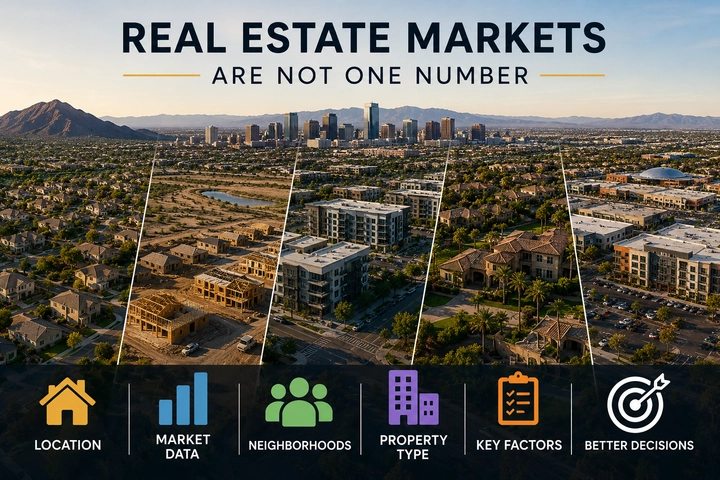
TFI provides the geographic and decision context between those extremes. The library helps you identify the relevant market boundary, understand how nearby areas differ, and recognize when broad statistics are no longer enough.
Use the library as a starting framework for deciding which information deserves closer review. Current MLS data, commercial research databases, an appraisal, and property-level due diligence still become necessary when the decision reaches a specific asset or transaction.
Why Greater Phoenix Is Not One Real Estate Market
The Greater Phoenix Area includes mature urban neighborhoods, luxury enclaves, retirement communities, employment-centered rental markets, large master-planned developments, expanding suburban corridors, rural-residential areas, and locations where water, infrastructure, land, or commute distance materially change the decision.
Two communities may be close on a map and still differ in housing age, lot size, HOA structure, development pipeline, freeway access, school options, employment orientation, taxes, and resale audience. A metro-wide median blends those differences together.
That is why TFI uses Greater Phoenix Area as the broad regional frame while preserving Phoenix in titles and queries where users are searching for the central city or the region by its most recognized name.
Geography and Property Type Must Be Evaluated Together
Location does not affect every property in the same way. A residential buyer may focus on housing stock, commute patterns, HOA obligations, schools, lifestyle, and resale considerations. A multifamily investor may focus on renter depth, competing supply, concessions, operating costs, unit mix, and financing. An industrial user may care more about freeway access, labor, truck routes, clear height, yard configuration, and distribution geography.
The market question therefore has two dimensions: where the property is located and how that property type functions within that location.
TFI's current published Insights library is strongest on residential geography. Commercial and multifamily market-report sections remain intentionally unpublished until TFI establishes the data sources, update cadence, and quality-control process required to maintain them responsibly.
How to Use the City Guides
The 37 city guides use a consistent structure so users can compare communities without starting over on every page. Each guide addresses:
- Setting, development pattern, and relationship to the broader Valley
- Common housing and neighborhood characteristics
- Lifestyle, amenities, commute, and day-to-day considerations
- HOA and property-tax context
- Local economy and employment orientation
- Schools and Arizona school-choice context
- Property and ownership considerations that vary by area
- Limitations and questions that deserve property-specific review
Use the guides to compare communities, not rank them. Peoria, Surprise, Goodyear, and Buckeye may all be West Valley options, but they differ in development age, employment access, housing mix, future supply, and geographic orientation. The same kind of distinction matters among Scottsdale, Paradise Valley, Fountain Hills, Cave Creek, Carefree, and the East Valley cities.
How to Read Market Data Without Overstating It
Market data is useful only when you know exactly what it measures. A median sale price can change depending on whether the source uses closed sales, pending contracts, or active listings; which property types and geography it includes; and whether the period is monthly, quarterly, or rolling. Rental and commercial metrics carry similar definitional limits.
Timing also matters. Closed-sale data reflects agreements negotiated weeks or months earlier. Asking rent is not the same as executed rent. Published vacancy may not capture shadow space, concessions, or a specific competitive set. A static report can describe direction while still being a poor substitute for current active competition.
For current residential statistics, users may consult sources such as Phoenix REALTORS®, ARMLS-based market tools, national portals, and local market reports. For commercial and multifamily metrics, major brokerage research platforms publish recurring reports. TFI uses those sources as market context rather than presenting third-party data as a property valuation.
From Regional Trend to Property-Level Reality
A region can be described as balanced while one price range has excessive inventory. A city can show stable prices while a neighborhood faces heavy new-construction competition. Multifamily rents can appear flat at the metro level while a particular submarket is using concessions. An office market can report elevated vacancy while a specific building class or location remains comparatively constrained.
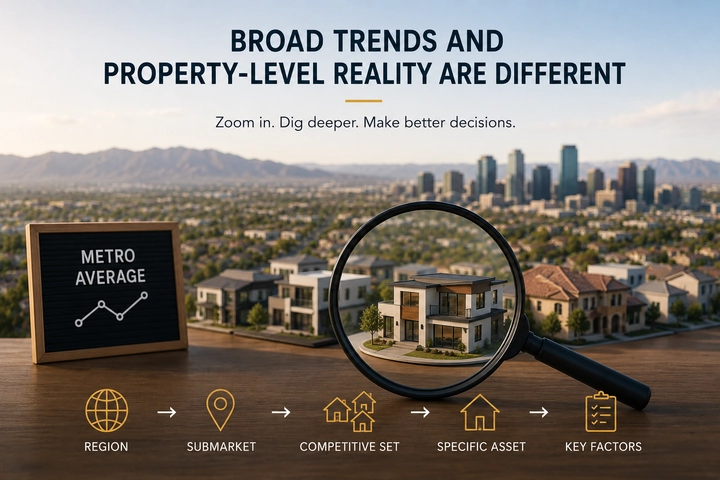
The closer a decision gets to an actual property, the more the analysis should narrow. Region becomes submarket. Submarket becomes competitive set. Competitive set becomes the specific asset, its condition, ownership structure, financing, timing, and alternatives.
When General Research Stops Being Enough
Area guides and market reports are most useful while you are getting oriented and comparing options. They stop being sufficient once you need to price, buy, sell, lease, refinance, improve, or underwrite a specific property.
A homeowner may need recent comparable sales, active and withdrawn listings, property-condition context, and a realistic view of buyer alternatives. A buyer may need to compare ownership costs, HOA obligations, taxes, financing, condition, and resale considerations. A commercial owner or investor may need rent-roll analysis, lease review, operating history, capital-expenditure planning, debt analysis, or a defined disposition strategy.
At that point, the question changes from “What is happening in the market?” to “What does the market mean for this property and this decision now?”
Published Insights and Future Expansion
The current indexable library gives you a Greater Phoenix Area residential overview, a city-guide index, and 37 validated city guides. Together, they form the active published foundation of the Insights library.
Commercial and multifamily Insights pages will be considered separately when TFI can support them with reliable data, visible reporting periods, source attribution, and a realistic maintenance schedule. Until then, TFI can provide current commercial or multifamily market context within a defined advisory, brokerage, valuation, or underwriting assignment.
Frequently Asked Questions
Does TFI publish live Greater Phoenix housing statistics?
TFI does not currently maintain a proprietary live-data platform. The Insights library provides geographic and decision context, while current statistics should be confirmed through dated market sources and property-specific research.
Are the city guides rankings of the best places to live?
No. The guides explain differences among communities so users can evaluate fit based on their own housing, commute, lifestyle, ownership-cost, school, and long-term objectives.
Can a city guide be used to value a property?
No. A city guide provides area context. Property valuation requires current comparable activity, condition, location within the city, lot and improvements, ownership factors, and the competitive market at the time of analysis.
Why are Commercial and Multifamily Insights not yet published?
Those sections require recurring data, source controls, reporting dates, and a defined update process. TFI has chosen not to publish static or unsupported market statistics merely to make the library appear larger.
Can TFI provide current market information for a specific property?
Yes. Depending on the assignment, TFI can review current residential competition, commercial leasing conditions, transaction comparables, multifamily operating context, valuation factors, or acquisition and disposition considerations.