

Commercial Leasing in the Greater Phoenix Area Requires Side-Specific Representation
A commercial lease creates different obligations and incentives for each side. A tenant needs an advocate focused on operational fit, total occupancy cost, flexibility, and downside protection. A landlord needs a representative focused on positioning, demand, credit, lease economics, occupancy, and asset value.
TFI Real Estate Advisors supports owners, investors, landlords, tenants, and developers across the Greater Phoenix Area and Arizona, with selective national reach for larger commercial, multifamily, investment, and capital-driven assignments where the scope and structure support the engagement.
Commercial leasing work may span Phoenix, Scottsdale, Tempe, Mesa, Chandler, Gilbert, Glendale, Peoria, Goodyear, Surprise, Buckeye, Queen Creek, and other Greater Phoenix Area submarkets. Location strategy varies by office, medical, industrial, flex, retail, and service use.
Tenants and landlords may rely on the same market data and documents, but they are not pursuing the same outcome. TFI therefore separates the detailed work into two service paths:

- Phoenix Commercial Tenant Representation for businesses evaluating new space, relocation, expansion, contraction, renewal, sublease, or lease restructuring.
- Phoenix Commercial Landlord Representation for owners seeking to position vacant or upcoming space, attract and qualify tenants, negotiate leases, and protect long-term property performance.
This page explains the shared leasing framework; the supporting pages address the distinct work required for each side.
Tenant Representation for Businesses Leasing Commercial Space
Tenant representation begins with the business requirement, not a list of available spaces. Location, property type, size, access, parking, loading, visibility, use restrictions, build-out, budget, timing, and future flexibility all shape the search.
A tenant broker helps the client compare alternatives, understand asking terms and effective economics, structure requests for proposal or letters of intent, and negotiate from the tenant’s perspective. The resulting lease should support the business without creating avoidable cost, operational constraints, or long-term risk.
TFI's dedicated Tenant Representation Page covers site selection, renewals, expansions, relocations, total occupancy cost, concessions, operating expenses, flexibility rights, and coordination through lease execution.
Landlord Representation for Commercial Property Owners
For a landlord, the starting point is the property and the ownership objective. Current condition, competing inventory, target tenants, market rent, concessions, improvements, downtime, brokerage exposure, credit, lease term, rollover, and the effect on value must be considered together.
Filling space is only part of the owner’s objective. A poorly structured lease can create future capital obligations, weaken income durability, complicate refinancing or sale, and transfer excessive flexibility to the tenant. Effective property leasing balances occupancy with credit quality, economics, execution probability, and long-term asset strategy.
TFI's dedicated Landlord Representation Page covers positioning, marketing strategy, tenant targeting, qualification, lease economics, negotiation, vacancy risk, renewals, and coordination with property management and legal counsel.
Lease Economics Extend Beyond the Asking Rent
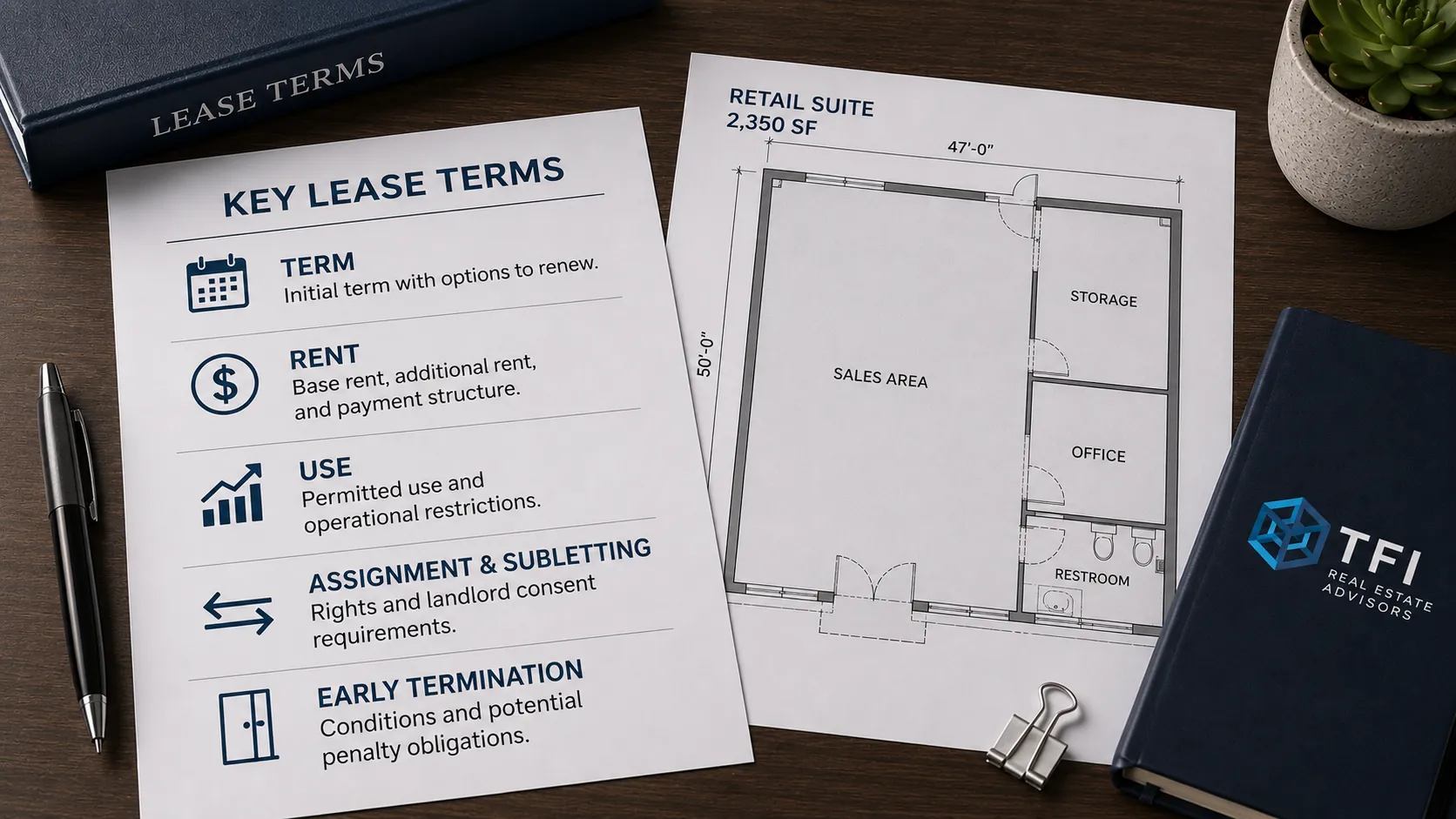
The quoted rental rate is only one part of the lease. The real economic comparison may also include:
- Base-rent escalations and renewal-rate methodology
- Operating expenses, common-area maintenance, taxes, and insurance
- Tenant-improvement allowances and landlord work
- Free rent and other concessions
- Security deposits, guarantees, and credit support
- Repair, maintenance, replacement, and compliance obligations
- Expansion, contraction, renewal, termination, assignment, and sublease rights
- Restoration obligations and end-of-term costs
For tenants, these terms determine total occupancy cost and operational flexibility. For landlords, they determine net income, capital exposure, risk allocation, and the durability of the lease as an asset.
Greater Phoenix Area Submarkets, Property Types, and Operational Fit
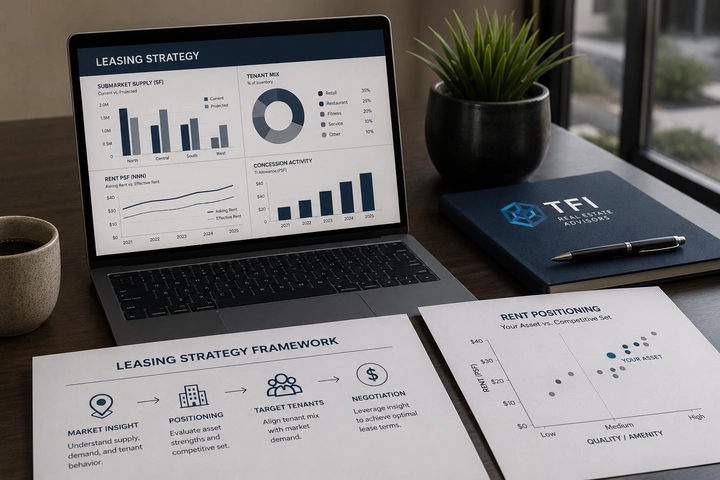
Commercial leasing conditions can change materially across the Greater Phoenix Area. Availability, rent, concessions, build-out expectations, parking, access, labor proximity, customer demographics, freeway connectivity, and competing inventory vary by submarket and property type.
A citywide average cannot determine whether a specific office, industrial, retail, medical, flex, or mixed-use location is economically or operationally appropriate. TFI evaluates leasing decisions within the relevant competitive set and in relation to the client's actual objective.
Office and Medical Office
Office and medical-office leasing may depend on parking ratios, patient or employee access, build-out, signage, floorplate efficiency, proximity to hospitals or employment centers, and the landlord's ability to deliver required improvements.
Industrial and Flex
Industrial and flex requirements can turn on clear height, loading, truck access, power, yard area, configuration, zoning, fire-suppression systems, freeway access, and the cost of adapting the building to the tenant's operations.
Retail and Service Uses
Retail and service-space decisions may involve visibility, access, traffic, demographics, co-tenancy, exclusivity, signage, use restrictions, patio or drive-through requirements, and the relationship between occupancy cost and projected revenue.
Negotiation, Documentation, and Execution Control
Leverage comes from alternatives, timing, vacancy exposure, tenant credit, property fit, competing demand, and each party’s willingness to transact. Negotiation therefore cannot stop at the rental rate; the full business package must be evaluated together so a concession in one area is not quietly recovered in another.
The broker's role is to advise on market terms, economic structure, business points, negotiation strategy, and transaction coordination. Commercial leases are legal documents, and clients should use qualified legal counsel to review and prepare lease language, advise on legal rights, and confirm that the final document reflects the negotiated business terms. TFI does not provide legal or tax advice.
Renewals, Restructuring, and Existing Lease Decisions
Many important leasing decisions do not involve a move. A tenant may renew, expand, contract, assign, sublease, or restructure; a landlord may retain the tenant, recapture space, manage rollover, or compare renewal economics with releasing the premises.
Existing occupancy can create convenience but also reduce urgency and perceived leverage. A disciplined renewal process should evaluate market alternatives and economics before the parties become dependent on a single outcome.
Multifamily Lease-Up and Stabilization Context
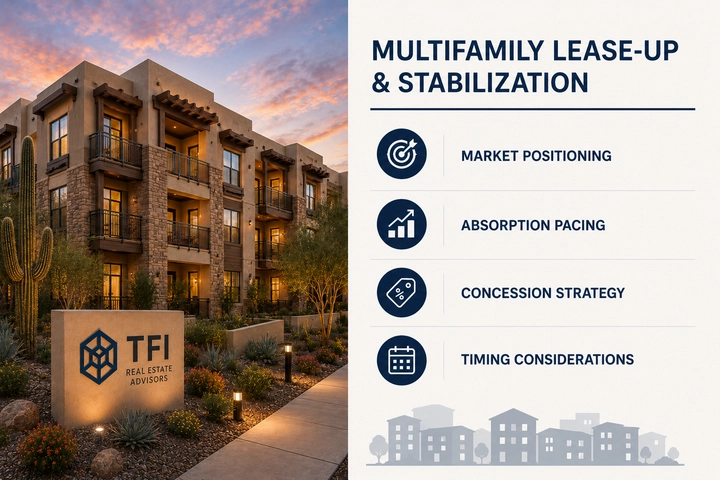
Ongoing apartment leasing is generally an operating and property-management function rather than a traditional commercial brokerage assignment. However, lease-up and stabilization strategy can affect absorption, concessions, revenue growth, and asset positioning during development, renovation, or transition.
TFI may provide higher-level advisory where multifamily leasing decisions intersect with broader ownership, development, valuation, financing, or disposition strategy. Day-to-day apartment leasing and management are evaluated separately from commercial tenant and landlord brokerage.
Greater Phoenix Area Commercial Leasing Questions and Answers
What does a commercial leasing broker do in Phoenix?
A commercial leasing broker helps a tenant or landlord evaluate market conditions, identify alternatives or prospects, compare economic terms, structure negotiations, and coordinate the transaction through lease execution. The work should be tailored to the represented client's interests rather than treated as generic property matching.
Is tenant representation different from landlord representation?
Yes. A tenant representative advocates for the business occupying space. A landlord representative advocates for the property owner leasing the space. The market information may overlap, but the duties, strategy, leverage, and desired outcome are different.
Can TFI represent either tenants or landlords?
TFI may represent tenants or landlords depending on the assignment. Representation, duties, compensation, and any potential conflicts are established and disclosed for the specific engagement before substantive work proceeds.
Does a broker replace a commercial real estate attorney?
No. A broker advises on real estate strategy, market conditions, economic terms, and negotiation. Legal counsel should review and prepare lease documents and advise on legal rights and obligations.
When should a tenant or landlord contact a leasing broker?
The process should begin before timing becomes urgent. Early engagement allows alternatives, property preparation, market positioning, financial analysis, and negotiation strategy to be developed before a lease expiration, vacancy, relocation deadline, or operating need removes leverage.
Does TFI work outside the Greater Phoenix Area?
The Greater Phoenix Area and Arizona are the core market. Selective national reach may apply for larger commercial, multifamily, investment, and capital-driven assignments where the scope, client requirements, and transaction structure support the engagement.