
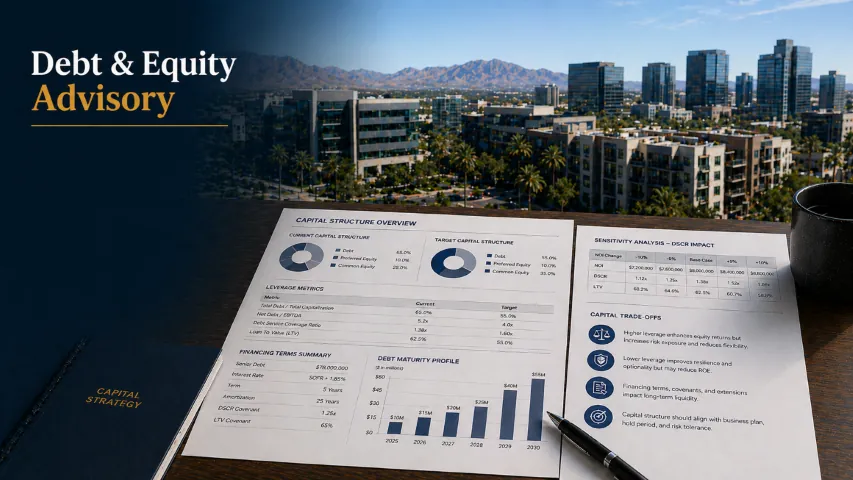

Commercial Real Estate Capital Strategy Before a Financing Decision
Capital structure determines how cash flow, control, downside exposure, liquidity, and future optionality are divided among the owner, lender, and equity participants. Begin with the property business plan—not the first financing proposal that reaches the table.
TFI Real Estate Advisors provides broker-led capital-structure and financing-decision advisory across the Greater Phoenix Area and Arizona. We help owners, investors, and developers define the need, test refinancing and recapitalization alternatives, compare economics and constraints, and connect financing to the property strategy.
TFI’s role is decision support and real estate coordination. Loan origination, debt placement, equity solicitation, securities activity, and formal legal or tax advice remain with the appropriately qualified professionals selected for the assignment.
TFI Real Estate Advisors supports owners, investors, landlords, tenants, and developers across the Greater Phoenix Area and Arizona, with selective national reach for larger commercial, multifamily, investment, and capital-driven assignments where the scope and structure support the engagement.
The capital structure should support the property business plan and ownership strategy instead of being dictated by the first available term sheet.

What TFI's Capital-Strategy Advisory Can Include
What we review depends on the property, ownership structure, timing, and decision in front of the owner. The work may include:
- Defining the ownership objective and property business plan
- Reviewing current debt, maturity dates, liquidity requirements, and refinancing exposure
- Evaluating property cash flow, income durability, lease rollover, operating risk, and valuation context
- Comparing senior debt, bridge financing, construction financing, subordinate debt, preferred equity, and common equity at a strategic level
- Assessing leverage, dilution, control rights, return priorities, and exit implications
- Stress-testing assumptions under lower income, higher costs, delayed stabilization, or changing market conditions
- Comparing refinancing, recapitalization, additional equity, partial liquidity, and sale alternatives
- Organizing property-level information for discussion with lenders, mortgage bankers, capital advisors, attorneys, CPAs, and other qualified specialists
- Connecting the capital decision to acquisition, development, leasing, valuation, or disposition strategy
This work can be useful before an acquisition, during a refinance, when a maturity is approaching, when an asset needs additional capital, or when ownership is deciding whether to hold, recapitalize, or sell.
Understanding the Commercial Real Estate Capital Stack
Understanding the capital stack makes the allocation of risk, control, return, and payment priority easier to evaluate.
At a high level, commercial and multifamily capital structures may include:
- Senior debt, which generally has first priority on cash flow and collateral
- Subordinate or mezzanine capital, which carries greater risk and cost than senior debt
- Preferred equity, which typically has defined economic rights ahead of common equity
- Common equity, which absorbs the greatest risk and participates in residual upside
Each layer carries different rights, obligations, remedies, return expectations, and sensitivities. The interaction among those layers determines how the property performs for each participant under both expected and stressed conditions.
Debt Versus Equity Trade-Offs
The choice is rarely debt or equity in isolation. Most capital decisions balance cost, control, flexibility, liquidity, timing, and risk.
Debt can preserve ownership and upside, but it introduces fixed obligations, covenants, maturity dates, and refinancing exposure. Equity can reduce leverage pressure and extend the time available to execute a business plan, but it may dilute economics, introduce approval rights, and create different return or exit priorities.
TFI helps principals evaluate these trade-offs in the context of asset performance, market conditions, hold period, and ownership objectives. The appropriate structure can change as a property moves from acquisition to renovation, lease-up, stabilization, refinancing, or sale.
Leverage, Maturity, and Sensitivity Risk
Leverage magnifies the effect of changes in income, expenses, interest rates, capitalization rates, and liquidity. A modest change in net operating income or value can materially affect debt-service coverage, refinance proceeds, covenant compliance, and equity value.
A disciplined review may consider:

- Sensitivity to income and occupancy changes
- Exposure created by near-term maturities
- Refinance proceeds under different valuation and rate assumptions
- The effect of capital expenditures, tenant improvements, and lease-up costs
- Liquidity required to execute the property business plan
- The consequences of slower stabilization or a delayed sale
This perspective supports capital structures that remain workable beyond the best-case scenario.
Acquisition, Refinance, Recapitalization, Development, or Sale
Capital questions usually arise because a larger real estate decision is already underway.
An acquisition may require a choice among permanent financing, bridge debt, seller financing, or additional equity. A stabilized property may be positioned for refinancing, while a transitional asset may need a recapitalization that provides more time and operating flexibility. A development project may require staged capital commitments and meaningful contingency reserves. In other circumstances, a sale may provide a cleaner path to liquidity and risk reduction.
TFI helps owners compare these alternatives in conjunction with the underlying real estate strategy. Related resources include Commercial Buyer Representation, Development Advisory, Commercial Valuation and Pricing Strategy, and Seller Representation.
Financing Market Conditions and Proposal Comparison
Capital availability changes with lender appetite, property type, sponsorship, leverage, location, asset performance, and the broader credit environment. Terms that are readily available in one market may tighten, reprice, or disappear in another.
Evaluate a financing proposal as a complete economic and control package. Rate and proceeds matter, but so do amortization, recourse, reserves, covenants, extension options, prepayment, closing conditions, reporting, partner rights, and the owner’s ability to adapt if the business plan changes.
TFI can help principals compare the real estate and ownership implications of competing structures so the decision reflects more than headline pricing.
Coordinating Financing and Capital-Market Execution
TFI organizes the real estate and capital-structure decision from the owner’s perspective. We clarify the business plan, identify the information needed for capital discussions, compare proposal economics and constraints, and coordinate the property strategy with the client’s selected professionals.
The owner’s lenders, mortgage bankers, capital advisers, securities professionals, attorneys, CPAs, and other specialists perform the regulated or specialized execution their roles require. TFI works alongside that team so the financing process remains connected to the property’s operating and transaction strategy.
Development Capital Versus Stabilized-Asset Financing
Development and stabilized assets require different capital frameworks and different tolerances for timing and execution risk.
Development projects generally involve uncertain timing, no current operating income, entitlement and construction exposure, staged funding, contingency requirements, and a longer path to stabilization. Stabilized assets may support more predictable underwriting, but they remain exposed to tenant rollover, operating performance, valuation changes, and future refinancing conditions.
TFI helps principals assess how capital structure should evolve across the asset lifecycle rather than assuming that one financing approach will remain appropriate from acquisition through exit.
Greater Phoenix Area, Arizona, and Select National Assignments
Within the Greater Phoenix Area, assignments may involve Phoenix, Scottsdale, Tempe, Mesa, Chandler, Gilbert, Glendale, Peoria, Goodyear, Surprise, Buckeye, Queen Creek, and surrounding communities. Capital considerations can also differ by submarket, property type, tenant profile, development phase, and operating strategy.
The Greater Phoenix Area and Arizona are TFI's core markets. Select national commercial, multifamily, investment, and capital-driven assignments may be considered where the scope, structure, client relationship, asset type, and local execution resources support the engagement.

When Capital-Strategy Advisory Is Useful
Capital strategy advisory is especially useful when:
- A loan maturity or refinancing decision is approaching
- The property requires additional capital to complete renovation, lease-up, or stabilization
- Ownership is comparing new debt with preferred or common equity
- A partner buyout, recapitalization, or partial-liquidity event is under consideration
- Development capital must be sequenced across entitlement, construction, and stabilization
- The existing capital structure is limiting leasing, renovation, or disposition options
- Ownership needs to compare a refinance, recapitalization, hold, or sale
- Multiple stakeholders require a clear decision framework
In these situations, the value of the advisory process is not a predetermined financing answer. It is a disciplined comparison of the available paths and their consequences for the property and ownership group.
Frequently Asked Questions About Commercial Real Estate Capital Strategy
What information should an owner assemble for a capital-strategy review?
Useful information may include the rent roll, trailing operating statements, current-year budget, loan documents, maturity schedule, capital-expenditure plan, lease abstracts, property valuation context, ownership objectives, and the proposed business plan. The required information depends on whether the decision involves an acquisition, refinance, recapitalization, development, or sale.
Can TFI help compare refinancing, new equity, and a property sale?
Yes. TFI can evaluate how each path affects liquidity, control, leverage, timing, risk, and future optionality. A property-specific BOV/BPO Request or Valuation and Pricing Review may also help establish the real estate assumptions behind the comparison.
How does TFI work with lenders, mortgage bankers, and equity professionals?
TFI defines and evaluates the property-level capital decision, helps organize the information and assumptions behind it, and can compare the real estate consequences of competing proposals. The selected lender, mortgage banker, capital adviser, securities professional, attorney, CPA, or other specialist performs the regulated or specialized execution required for the transaction.
Is more leverage always better when property values are rising?
No. Higher leverage can increase equity returns when the business plan performs as expected, but it also magnifies income, maturity, covenant, and refinancing risk. The appropriate leverage level depends on the durability of cash flow, hold period, capital needs, and ownership risk tolerance.
What property types can be considered?
The analysis may apply to multifamily, office, medical office, industrial, flex, retail, mixed-use, land, development sites, and other commercial property types where the assignment fits TFI's experience and advisory scope.
Does TFI work outside the Greater Phoenix Area?
The Greater Phoenix Area and Arizona are the core markets. Select national assignments may be considered for larger commercial, multifamily, investment, institutional, or capital-driven matters where the scope and structure support responsible engagement.