
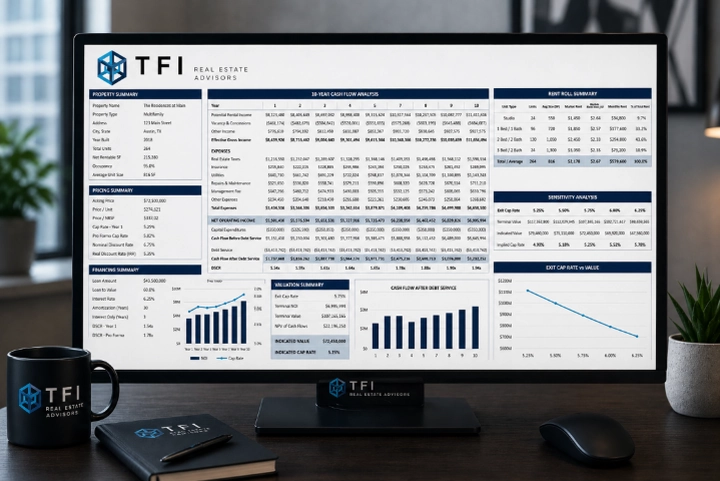

Commercial Property Valuation in the Greater Phoenix Area Is a Decision Framework
Owners usually ask what a commercial or multifamily property is worth because a larger decision is pending. The practical question may be whether to sell, refinance, recapitalize, improve, reposition, or keep holding—not simply what number can be placed on the asset today.
TFI Real Estate Advisors provides broker-led commercial property valuation and pricing strategy for owners across the Greater Phoenix Area and Arizona. The analysis connects property performance with the way current buyers, lenders, and capital sources are likely to interpret the asset. It is designed to help an owner establish a defensible decision range before committing to a transaction or capital strategy.
TFI Real Estate Advisors supports owners, investors, landlords, tenants, and developers across the Greater Phoenix Area and Arizona, with selective national reach for larger commercial, multifamily, investment, and capital-driven assignments where the scope and structure support the engagement.
Valuation and pricing work may involve properties in Phoenix, Scottsdale, Tempe, Mesa, Chandler, Gilbert, Glendale, Peoria, Goodyear, Surprise, Buckeye, Queen Creek, and other Greater Phoenix Area markets. The relevant competitive set depends on the property type, use, income profile, and submarket.
Valuation Strategy, a BOV/BPO, and a Formal Appraisal Are Different Tools
Commercial real estate uses the word valuation broadly, but the available services do not serve the same purpose:
- Valuation and pricing strategy interprets income, risk, buyer behavior, liquidity, financing conditions, and likely execution outcomes to support an ownership decision.
- A broker opinion of value or broker price opinion (BOV/BPO) is a property-specific market pricing opinion prepared by a licensed real estate broker. Owners who need that narrower deliverable can Request a Commercial BOV/BPO.
- A formal appraisal is prepared by a qualified appraiser for purposes that may include lending, litigation, tax, estate, partnership, or regulatory requirements.
Broker valuation and a formal appraisal serve different purposes. When the intended use requires an appraisal, the appropriate next step is to engage a qualified commercial appraiser. For a market-facing decision—such as whether to sell, refinance, recapitalize, reposition, or hold—broker valuation and pricing strategy can show how buyers and lenders are likely to interpret the asset.
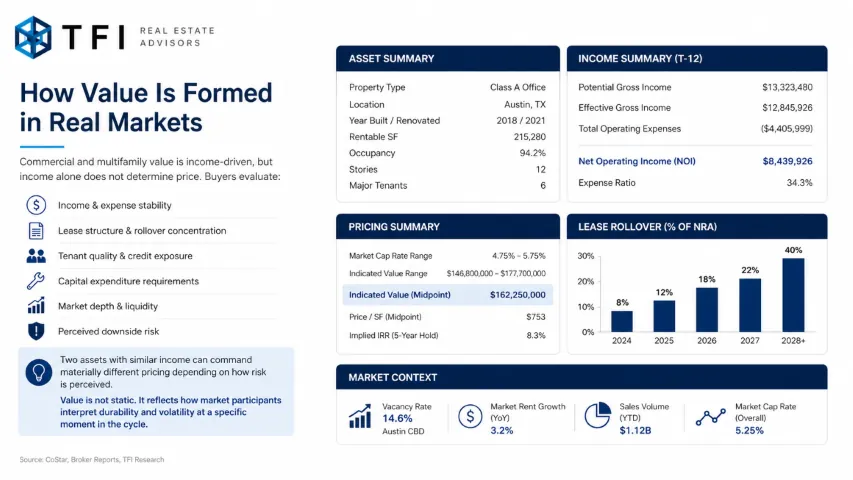
How Commercial Property Value Is Formed Across Greater Phoenix Area Markets
Income is central to commercial and multifamily value, but income alone does not determine the price.
Buyers look at the stability of net operating income and expenses, lease rollover, tenant credit, future capital requirements, market depth, and downside exposure. Two assets with similar current income can command very different pricing because the market may view the durability of that income differently.
A defensible valuation therefore reflects both present performance and the risks a buyer expects to inherit.
How Buyers Actually Underwrite Commercial Property
Commercial buyers rarely rely on a headline cap rate or trailing income alone. They normalize expenses, compare in-place and stabilized net operating income, model vacancy and credit loss, reserve for capital needs, review rollover and renewal probability, and test the exit cap rate.
Small changes in those assumptions can move value considerably. A 50-basis-point change in the exit cap rate, a different rent-growth forecast, or a revised capital plan may change the price a buyer can support.
Owners who understand that underwriting process are better prepared to interpret market feedback and set expectations before the property is priced.
Cap Rates, Yield, and Risk Perception
Cap rates are often discussed as fixed benchmarks. In practice, they reflect the market’s view of risk and the competition for capital.
Stable, diversified income and a deep buyer pool generally support lower cap rates. Concentrated income, near-term rollover, limited liquidity, or property-specific uncertainty generally push required returns higher. Interest rates and investor sentiment also matter, but they do not affect every asset equally.
The useful question is not simply where cap rates traded in the past. It is why buyers would apply a particular rate to this property today.
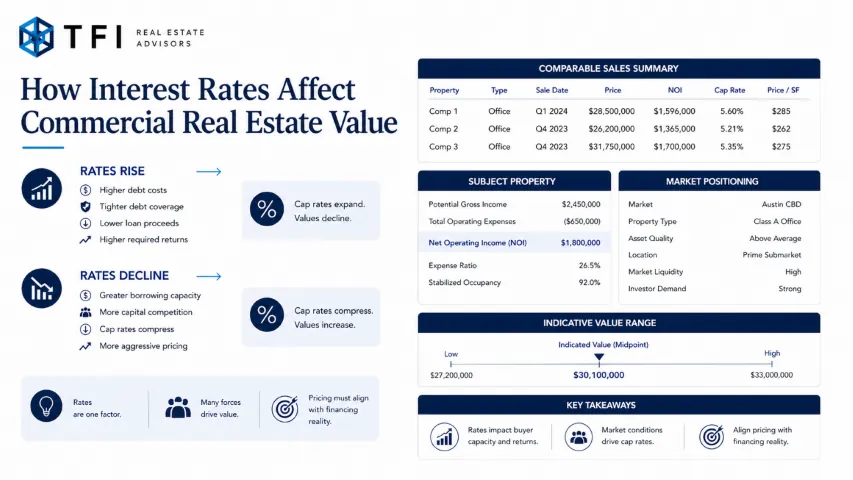
How Interest Rates Affect Commercial Real Estate Value
Interest rates directly affect commercial and multifamily valuation, although the relationship is not one-for-one.
When borrowing costs rise, debt-service coverage tightens, loan proceeds may fall, and buyers often require a higher return. When borrowing costs decline, purchasing capacity and competition may improve. Market liquidity, inflation expectations, lender appetite, and investor confidence determine how much of that change reaches property pricing.
A pricing strategy that ignores the financing environment can quickly separate from what buyers and lenders are able to support.
Value vs Price vs Proceeds
Value, price, and proceeds are related but distinct.
- Value reflects how the market interprets risk and income durability.
- Price is what a specific buyer agrees to pay under negotiated conditions.
- Proceeds represent what the owner retains after timing, costs, and execution factors.
A property can have strong theoretical value but produce weak proceeds if pricing strategy undermines leverage. Conversely, disciplined pricing can enhance competitive tension and improve net outcomes even in moderate markets.
Owners often focus on headline value without considering how pricing strategy affects leverage and momentum.
The Role of Comparable Sales in Commercial Valuation
Comparable sales are useful only when the comparison is economically sound. The property type, use, lease structure, tenant quality, submarket, transaction timing, and liquidity environment should be reasonably similar.
A peak-cycle sale may not support current pricing in a tighter capital market, and a distressed or highly unusual transaction may not represent ordinary market behavior. Reported price alone is not enough; the assumptions, financing, and condition of the transaction matter.
Comparable sales provide context, not a guarantee.
Greater Phoenix Area Submarket Context Can Materially Change Value
A Phoenix address does not establish a commercial property’s competitive position. Freeway access, visibility, surrounding uses, parking, loading, permitted use, condition, and proximity to customers or labor can change value between nearby properties.
The relevant buyer pool also matters. An investor, owner-user, developer, and redevelopment buyer may evaluate the same site very differently. Competing inventory, new construction, lease rates, concessions, vacancy, and absorption should therefore be measured within the property’s actual submarket and use category.
That is why citywide averages, generalized cap rates, and automated estimates rarely provide a defensible commercial valuation by themselves.
Pricing Strategy Before Disposition
Pricing is a market-positioning decision—not a declaration of what the owner hopes to receive.
A price that materially exceeds current underwriting can extend market time, reduce qualified engagement, and increase the likelihood of a later retrade. A deliberately competitive price may create stronger attention, but it still needs to reflect the owner’s risk tolerance and process strategy.
The starting range should account for current liquidity, the likely buyer pool, recent transactions under similar conditions, lease rollover, future capital needs, and the owner’s preferred balance between price and certainty. Once the market responds, seller leverage can change quickly, so the response plan should be established before launch.
Bid–Ask Spread and Market Psychology
In transitional markets, valuation friction often appears as a widening gap between seller expectations and buyer underwriting. Owners may remain anchored to earlier transactions while buyers price current financing costs, risk, and return requirements.
When that gap is too wide, offers fall below expectations, negotiations stall, and assets remain available long enough to create additional concern. Understanding the bid–ask spread helps an owner decide whether to adjust pricing, improve the property’s position, or wait for a different execution window.
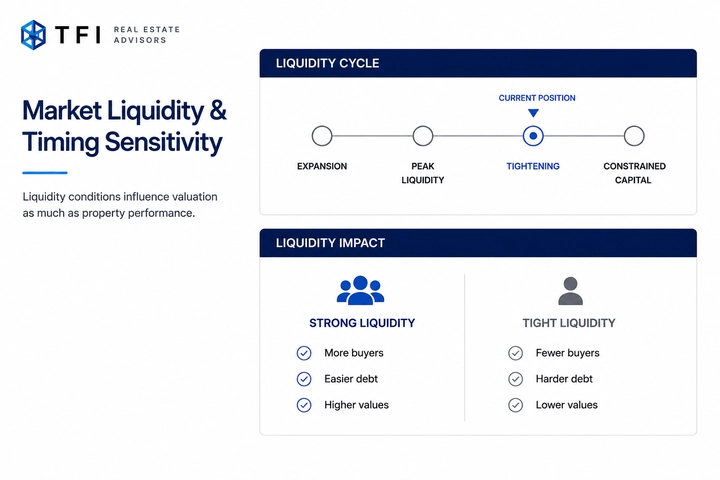
Market Liquidity and Timing Sensitivity
Liquidity can affect value as much as the property’s current performance. A sound asset may still face price pressure when financing tightens and the qualified buyer pool narrows.
When capital is widely available, buyer pools expand and competitive tension can support tighter pricing. When capital becomes selective, buyer pools narrow, underwriting becomes more conservative, and repricing occurs faster.
An asset that performed well in an expansionary period may still face price sensitivity when financing and investor demand change. The valuation should reflect the market in which the property will actually be offered.
Liquidity Tiers and Asset Perception
Capital markets often sort assets into informal risk tiers. Stable properties with durable income generally attract the broadest buyer pool. Assets requiring lease-up, operational improvement, redevelopment, or substantial capital attract buyers seeking a higher return and able to tolerate more uncertainty.
As liquidity tightens, capital usually concentrates in the more stable tiers. Owners therefore need to understand how the market is likely to classify the asset, not only how ownership describes it internally.
Common Valuation Mistakes
Valuation problems often begin with expectation misalignment rather than arithmetic. Frequent issues include:
- Anchoring to outdated comparable sales
- Assuming trailing performance will persist without adjustment
- Ignoring lender underwriting shifts
- Underestimating capital expenditure requirements
- Overestimating buyer appetite for rollover risk
These mistakes often surface during due diligence, leading to renegotiation or transaction failure.
Addressing them early supports smoother execution and preserves leverage.
Repricing Velocity and Market Feedback
The market usually signals a pricing problem through weak qualified inquiry, limited tours, low initial offers, or unusually heavy contingencies. The owner needs predetermined checkpoints for interpreting that feedback.
An early, evidence-based adjustment can preserve momentum. Waiting until the property has accumulated market time may make buyers more skeptical and reduce negotiating leverage. A pricing plan should therefore include clear checkpoints before marketing begins.
Commercial and Multifamily Property Types Require Different Valuation Logic
The weight placed on income, comparable sales, replacement cost, land value, lease structure, and buyer profile varies by property type. TFI's broker-level valuation and pricing work may involve:
- Multifamily and apartment properties
- Office and medical office buildings
- Industrial, warehouse, and flex properties
- Retail and service-commercial properties
- Mixed-use and multi-tenant assets
- Net-leased investment properties
- Owner-user buildings
- Commercial land and development sites
A multifamily property with operational upside is not evaluated the same way as an owner-user office building, a single-tenant net-leased asset, or vacant development land. The analysis must reflect the property's actual income structure, use, condition, and likely buyer pool.
When Commercial Valuation and Pricing Advisory Is Appropriate
Valuation and pricing advisory is most useful before a sale, refinance, recapitalization, major capital improvement, or hold decision—especially when ownership expectations need to be reconciled with changing market conditions.
The work may lead to a property-specific BOV/BPO Request or a formal appraisal, depending on the intended use. Its purpose is to establish a realistic market and decision context before the owner selects the final deliverable or transaction path.
Valuation in Refinance and Recapitalization Contexts
Valuation and pricing strategy also matters when the owner is refinancing or recapitalizing. Current value affects loan proceeds, required equity, partner discussions, cash-out potential, and the range of structures that may be available.
In a tighter credit environment, an asset that once supported aggressive leverage may need more conservative assumptions. A broker-led market review can help ownership prepare for those conversations, while the formal appraisal and financing work remains with the appropriate qualified professionals.
Frequently Asked Questions About Commercial Property Valuation
Is commercial property valuation the same as an appraisal?
No. A formal appraisal is prepared by a qualified appraiser for a defined intended use. Broker valuation and pricing strategy focuses on current market interpretation, likely buyer underwriting, pricing, and execution. The two products are identified and used separately.
What is the difference between this page and a BOV/BPO?
This page explains the strategic framework behind commercial and multifamily value. A BOV/BPO is a property-specific broker pricing opinion. Owners seeking a direct review can Submit a Commercial BOV/BPO Request.
How is a multifamily property valued?
Multifamily valuation generally begins with in-place and stabilized net operating income, but buyers also evaluate rent positioning, occupancy, concessions, operating expenses, unit mix, deferred maintenance, capital needs, financing, and exit assumptions. Price per unit and comparable sales provide context but do not replace operating analysis.
Why do different buyers assign different values?
Buyers operate under different capital structures, return thresholds, operating capabilities, tax positions, and risk tolerances. Liquidity conditions and financing availability also influence what each buyer can support.
Can pricing strategy influence final proceeds?
Yes. Pricing affects buyer engagement, competitive tension, negotiation leverage, time on market, retrade risk, and execution certainty. The highest initial asking price is not automatically the strategy that produces the strongest net outcome.
Does a higher asking price create more negotiation room?
Not necessarily. If the asking price falls outside the range that qualified buyers can support, it can reduce engagement and weaken leverage rather than create it.
Related Commercial Valuation and Disposition Resources
- Request a Commercial BOV/BPO for a property-specific broker pricing review.
- Review Phoenix Commercial Property Seller Representation when a disposition decision is moving toward execution.
- Review Phoenix Multifamily Advisory for apartment-specific ownership, acquisition, and disposition considerations.
- Review Commercial Real Estate Capital Strategy when valuation is tied to refinancing, recapitalization, or capital-stack decisions.
How to Evaluate Whether Pricing Is Defensible
Before committing to a price, test whether it remains coherent under conservative exit assumptions, current financing constraints, and realistic buyer depth. Comparable sales should be similar in economics and timing, not merely property type.
If the number depends on perfect rent growth, unusually favorable financing, or a single ideal buyer, it may not withstand scrutiny. Defensible pricing does not require pessimism; it requires assumptions that a credible buyer can verify.