


Tenant Representation Is Advocacy, Not Just a Property Search
Available listings are only the visible part of the decision. A space can look suitable and still create unacceptable occupancy cost, build-out exposure, parking limits, use restrictions, operational inefficiency, or future inflexibility.
A tenant representative advocates for the business that will occupy the space. We begin with the business plan and translate it into real estate criteria that can be applied consistently across competing properties and renewal alternatives.
TFI Real Estate Advisors supports owners, investors, landlords, tenants, and developers across the Greater Phoenix Area and Arizona, with selective national reach for larger commercial, multifamily, investment, and capital-driven assignments where the scope and structure support the engagement.
Tenant searches may cover Phoenix, Scottsdale, Tempe, Mesa, Chandler, Gilbert, Glendale, Peoria, Goodyear, Surprise, Buckeye, Queen Creek, and other Greater Phoenix Area markets. The geographic scope is driven by the business’s customers, employees, access needs, property requirements, and budget.
When Businesses Use a Greater Phoenix Area Tenant Broker
Tenant representation can be appropriate for:
- A new business or location entering the Greater Phoenix Area market
- A company relocating within the Greater Phoenix Area or elsewhere in Arizona
- Expansion into additional or larger space
- Contraction, consolidation, or footprint reduction
- A lease renewal where the tenant wants market context and negotiation support
- An assignment, sublease, or early-exit strategy
- Office, industrial, retail, medical, flex, or specialty-use requirements
- Multi-location or portfolio decisions where lease expirations and occupancy costs need coordination
Begin before the business becomes dependent on one building or one renewal outcome. Time creates alternatives; urgency usually transfers leverage to the landlord.
Defining the Operational Requirement
The business determines the correct property—not the listing description. We help define requirements such as:
- Preferred submarkets and customer, employee, vendor, or freeway access
- Square footage, layout, growth capacity, and timing
- Parking, loading, clear height, power, visibility, signage, or specialized improvements
- Zoning, permitted use, and operational constraints requiring professional verification
- Build-out scope and responsibility
- Target occupancy cost and capital available for relocation or improvements
- Lease term, renewal, expansion, contraction, assignment, and sublease priorities
Clear requirements reduce wasted tours and make property comparisons more defensible.
Market Search, Site Selection, and Property Comparison
A useful search compares available properties with the competitive context around them. Asking rent alone does not reveal the full economic or operational difference between alternatives.
TFI may help tenants review:
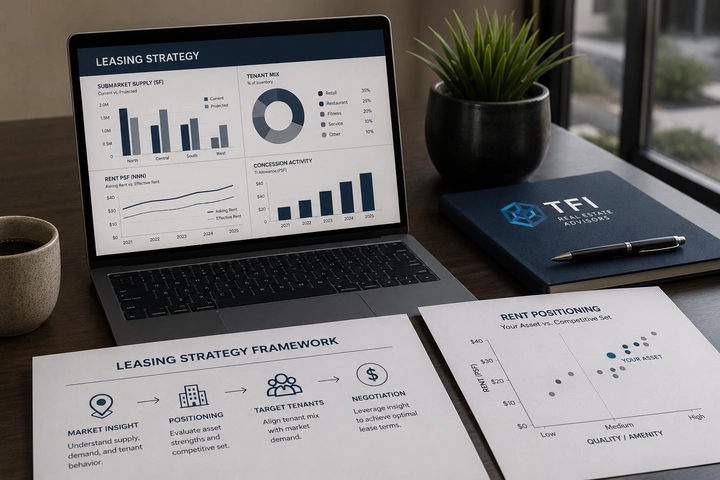
- On-market availability and relevant alternatives
- Submarket vacancy, demand, and competing inventory
- Property condition and apparent functional fit
- Quoted rent, operating expenses, escalations, and concessions
- Tenant-improvement allowances and landlord-delivery obligations
- Estimated build-out, relocation, and occupancy timing
- Landlord ownership, decision process, and execution considerations
Tours should validate the criteria, not replace the analysis. The objective is to narrow the market to alternatives that can realistically support the business and its economics.
Total Occupancy Cost and Effective Lease Economics
Commercial rent may be quoted in different formats and exclude material expenses. Compare the full financial obligation, not just the face rate.
The analysis may include:
- Base rent and scheduled increases
- Common-area maintenance, taxes, insurance, and other pass-throughs
- Utilities, janitorial, maintenance, and repair obligations
- Tenant-improvement contributions and out-of-pocket build-out cost
- Free rent and other concessions
- Security deposit, guarantee, and credit-support requirements
- Moving, technology, furniture, permitting, and downtime costs
- Renewal, restoration, surrender, and end-of-term obligations
A lower asking rate can be more expensive after expenses and capital requirements are considered. TFI focuses negotiations on the complete business package.
Letters of Intent and Lease Negotiation Strategy
The proposal or letter-of-intent stage establishes the economic and operational framework before the lease is drafted. Rent, concessions, improvements, delivery condition, term, options, flexibility, guarantees, and timing should be negotiated as one connected package.
A disciplined process compares landlord proposals against each other and against the tenant's renewal or ownership alternatives. TFI helps tenants identify where leverage exists, which terms have the greatest long-term effect, and where apparent concessions may be offset by other obligations.
Renewals, Expansions, Contractions, and Restructuring
Remaining in place may be the right decision, but the current landlord should not be the only source of market information. A credible renewal strategy compares current economics, relocation costs, capital needs, and available alternatives.
Tenant representation may also involve:
- Expansion rights or additional premises
- Contraction or give-back discussions
- Assignment and sublease strategy
- Early termination or negotiated surrender
- Relocation rights within a project
- Portfolio planning and staggered lease expirations
These decisions should be evaluated against the underlying business plan, not solely against the convenience of the current location.
Property-Type Considerations
Office and Medical Office
Office and medical tenants may need to evaluate parking, access, visibility, floorplate efficiency, patient flow, build-out, signage, proximity to hospitals or employment centers, and the cost of specialized improvements.
Industrial and Flex
Industrial and flex users may require loading, clear height, truck circulation, yard area, power, zoning, fire suppression, manufacturing capability, freeway access, and configuration that supports workflow and inventory.
Retail and Service Uses
Retail and service tenants may depend on traffic, demographics, access, visibility, signage, co-tenancy, exclusivity, use protection, patio or drive-through capability, and occupancy cost relative to expected revenue.
Due Diligence and Coordination Through Lease Execution
Before committing, verify the assumptions that can affect use, cost, or delivery through the appropriate professionals. Depending on the requirement, that may include zoning, contractor pricing, space planning, inspections, permitting, utilities, insurance, financial analysis, and legal review.
TFI coordinates the real estate process and negotiated business terms. Commercial leases are legal documents, and tenants should retain qualified legal counsel to review and prepare lease language and advise on legal rights and obligations. TFI does not provide legal, tax, engineering, architectural, or environmental advice.
Tenant Representation Questions and Answers
What does a commercial tenant broker do in Phoenix?
A tenant broker helps a business define its space requirement, search and compare properties, evaluate market and lease economics, negotiate proposals and business terms, coordinate due diligence, and manage the real estate process through lease execution.
Is the landlord's listing broker representing me?
Ordinarily, the listing broker's client is the landlord. A tenant should understand who represents each party, what duties apply, and whether the tenant needs separate representation focused on its own business and lease objectives.
How is commercial tenant representation compensated?
Compensation depends on the engagement and transaction. In many listed lease transactions, the landlord or listing brokerage offers a commission that may compensate a tenant representative, but the terms, any tenant obligation, and potential conflicts should be disclosed and confirmed in the representation agreement.
Can a tenant broker help with a lease renewal?
Yes. A renewal can be negotiated against current market alternatives, relocation cost, landlord vacancy risk, required improvements, and the tenant's future space needs. The tenant does not have to move for representation to create value.
When should I begin looking for commercial space?
Begin early enough to define requirements, evaluate alternatives, negotiate terms, complete diligence, design or price improvements, obtain approvals, and coordinate occupancy without allowing the current lease expiration or operating deadline to control the decision.
Does TFI help businesses buy instead of lease?
Yes. When ownership may be a realistic alternative, TFI can compare leasing against owner-user acquisition considerations and provide Phoenix Commercial Buyer Representation.
Does a tenant broker replace an attorney?
No. A broker handles real estate strategy, market analysis, economic terms, and transaction coordination. Legal counsel should advise on the lease document and legal obligations.
Where does TFI provide tenant representation?
The Greater Phoenix Area and Arizona are the core market. Selective national reach may apply for larger commercial, multifamily, investment, and capital-driven assignments where the scope and structure support the engagement. See the broader Commercial Leasing Advisory framework for both tenant and landlord leasing decisions.