


How TFI Develops Family Office and Private Capital Relationships
TFI connects real estate advisory, brokerage execution, underwriting, and private investment structure. A family office or private capital group may begin with direct property exposure, a property-level joint venture, a co-investment, a programmatic relationship, or a potential TFI-sponsored structure tied to a suitable opportunity.
TFI Real Estate Advisors provides the broker-led real estate work: market analysis, acquisition and disposition strategy, property underwriting, due diligence coordination, leasing context, valuation, and transaction execution. Tesseract Financial Investments is the related private investment entity through which TFI-sponsored funds, syndications, joint ventures, or other private structures may be formed when an opportunity and formal offering process support them.
The relationship should match the capital partner’s mandate and the real estate assignment. Some conversations begin with a defined property; others begin with geography, property type, check size, risk, governance, decision rights, reporting, and the operating relationship the capital partner wants. A discussion does not imply that an offering, investment inventory, or capital commitment exists.
Understanding the Capital Mandate
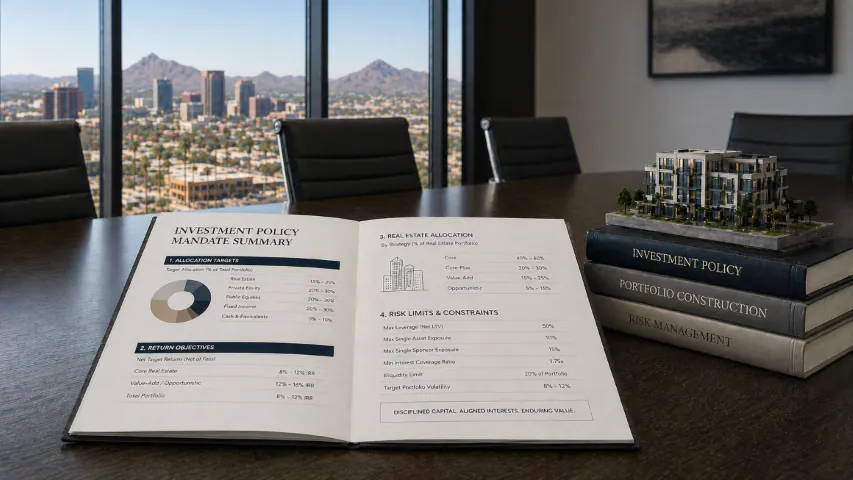
Family offices and private capital groups usually evaluate direct real estate within a defined mandate covering target returns, acceptable risk, property types, geography, hold period, liquidity, leverage, check size, governance rights, and reporting standards.
A clear mandate allows TFI and the capital partner to determine whether a property, program, or relationship is worth advancing before substantial time and expense are committed. It also helps distinguish a genuine fit from an opportunity that is attractive in isolation but inconsistent with the portfolio's broader objectives.
Mandate clarity is especially important when capital is expected to be deployed across multiple assets or market cycles. A repeatable relationship requires more than agreement on one transaction; it requires alignment on how opportunities will be screened, approved, managed, reported, and ultimately exited.
Direct Investments, Co-Investments, Joint Ventures, and Programmatic Relationships
Real estate capital relationships can take several forms. A family office may own a property directly and use TFI for advisory and brokerage execution; a capital partner may invest with an operator through a property-level joint venture; a co-investment may supplement a larger fund or program; and a programmatic relationship may establish criteria for a series of acquisitions.
Co-GP and LP structures may also be considered where the legal, economic, operational, and governance requirements support them. The appropriate structure depends on the business plan, risk allocation, capital needs, control expectations, sponsor contribution, reporting obligations, and anticipated exit.
TFI approaches structure as a practical extension of the real estate strategy. The goal is to establish a relationship in which the capital, operator, decision rights, and property business plan reinforce one another.
What TFI Brings to the Capital Relationship
TFI’s value begins with direct real estate judgment. Partnership terms and capital structure only work when the property assumptions are credible, so we connect the capital conversation to market conditions, operations, leasing risk, acquisition basis, capital expenditures, financing, and exit alternatives.
The engagement may include defining acquisition criteria, reviewing a prospective property or portfolio, organizing underwriting assumptions, comparing investment structures, identifying major decision points, coordinating property and market diligence, and helping the parties translate the business plan into a workable governance and reporting framework.
The model is principal-led and directly accessible. Capital partners work with senior real estate decision-makers rather than being routed through a large production platform. When an assignment requires specialized securities, tax, legal, lending, accounting, appraisal, engineering, or local-market expertise, TFI coordinates with the appropriate professionals so the real estate strategy remains integrated with the broader process.
Portfolio Allocation and the Role of Real Estate
For an institution or family office, real estate should serve a defined portfolio role—such as current income, inflation sensitivity, capital preservation, long-term appreciation, tax-aware ownership, or diversification from other operating and financial assets.
The intended role of real estate influences property selection, leverage, liquidity, hold period, governance, and the balance between direct ownership and externally managed investments. A portfolio built for durable income should not be structured the same way as one pursuing development, repositioning, or opportunistic return.
TFI evaluates the real estate component from the perspective of property performance, ownership structure, liquidity, and execution. Broader securities allocation and personalized investment-management advice are coordinated with the capital partner's registered investment adviser, wealth manager, or other qualified financial professional.
Portfolio Construction and Concentration Management
At scale, portfolio construction matters as much as the merits of one property. Exposure can accumulate across property types, markets, tenants, lenders, maturity dates, development programs, and operating strategies; several attractive investments can still create a fragile portfolio when they share the same demand driver or capital timing.
TFI helps capital partners and operating principals examine how a proposed investment changes the portfolio's income profile, liquidity, leverage, geographic exposure, and future capital requirements. Concentration may be intentional when the investor has a durable market or operating advantage, but it should be visible, understood, and supported by the available liquidity and governance framework.
Underwriting and Capital-Partner Due Diligence
Family office and private capital diligence must extend beyond the projected return. Capital partners commonly test property basis, market demand, income durability, lease rollover, operating assumptions, capital requirements, financing, downside scenarios, exit logic, sponsor contribution, decision process, and the quality of the supporting information.
A serious diligence process should make the assumptions visible. It should distinguish known facts from estimates, identify the variables that have the greatest effect on performance, and show how the business plan responds if leasing, costs, financing, valuation, or timing move against the base case.
Capital partners also evaluate the people and systems responsible for execution. Relevant experience, decision discipline, reporting capability, property oversight, and the ability to coordinate specialized professionals all influence whether an opportunity is repeatable rather than merely possible.
Sponsor Readiness, Relevant Experience, and Repeatability
Track-record review should look beyond a headline return. The original underwriting, realized and unrealized results, use of leverage, capital events, difficult decisions, and the extent to which performance came from market movement, property operations, or sponsor execution all matter.
TFI approaches these conversations with factual disclosure. The objective is to show what experience is directly relevant, what systems and resources are available for the proposed assignment, and where additional operating or specialist capability must be assembled. Readiness is demonstrated through the quality of the process, the relevance of the experience, and the accuracy of the information—not by stretching a limited history into a broader platform claim.
Related TFI resources include Commercial & Multifamily Real Estate Underwriting, Investment Strategy & Portfolio Advisory, and Family Office & Sophisticated Owner Commercial Real Estate Advisory.
Governance, Decision Rights, and Economic Alignment
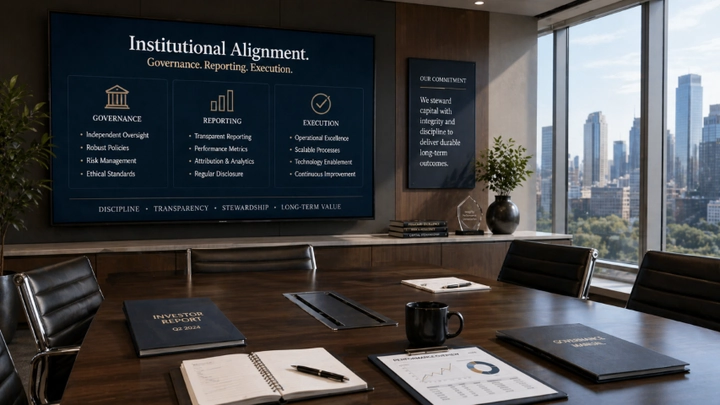
Governance determines how the relationship functions after capital is committed. Approval thresholds, reserved matters, budgets, financing, major leases, capital expenditures, related-party activity, distributions, additional capital, and disposition authority should be clear before an unexpected event tests the structure.
Economic alignment matters just as much. Fees, promotes, profit-sharing, sponsor co-investment, preferred returns, and distribution waterfalls should support the intended behavior across both favorable and difficult scenarios. The strongest structures reward long-term value creation and disciplined stewardship rather than short-term activity.
Good governance does not eliminate disagreement. It creates a clear method for making decisions, resolving conflicts, and protecting the relationship when circumstances change.
Reporting Standards and Transparency
Family office and private capital relationships generally require reporting that connects financial results to the property business plan. Useful reporting may include operations, leasing, capital expenditures, financing status, budget variances, valuation context, material risks, and decisions expected during the next period.
Reporting should be proportionate to the size and complexity of the investment. The objective is not to create paperwork for its own sake. It is to give capital partners enough timely information to understand performance, evaluate risk, fulfill their own oversight obligations, and participate in decisions where the governing documents require them to do so.
Transparency also requires early communication when the business plan changes. Difficult information is most useful while options remain available.
Capital Deployment Pacing and Scale Management
Deploying capital at scale requires pacing. Moving too quickly can weaken underwriting, stretch operating capacity, create concentration, or compromise property quality; moving too slowly can leave committed capital inefficiently deployed or miss the conditions the strategy was designed to capture.
TFI evaluates deployment in relation to the available opportunity set, execution capacity, financing environment, property pipeline, and the capital partner's allocation schedule. Scale should expand access and consistency without reducing decision quality.
Programmatic relationships can improve efficiency when the parties have aligned criteria and a repeatable review process. They should not become a reason to approve properties that fail the original mandate.
Risk Management and Downside Planning
Institutional-quality decision-making gives meaningful weight to what happens when the base case is wrong. Tenant concentration, lease rollover, construction or renovation costs, entitlement timing, operating complexity, interest rates, loan maturities, capital calls, market liquidity, and a delayed exit can all change the outcome.
Downside planning considers how much flexibility exists within the capital structure and operating plan. It also addresses who has authority to change course, what additional capital may be required, and whether the partnership can preserve optionality without forcing a premature sale or recapitalization.
A well-structured relationship does not avoid all risk. It identifies the material risks, allocates them deliberately, and creates a process for managing them.
Long-Term Capital Relationships
Family office and private capital relationships are usually built across multiple decisions, not one closing. Trust develops through candid underwriting, consistent execution, reliable reporting, and disciplined behavior when conditions change.
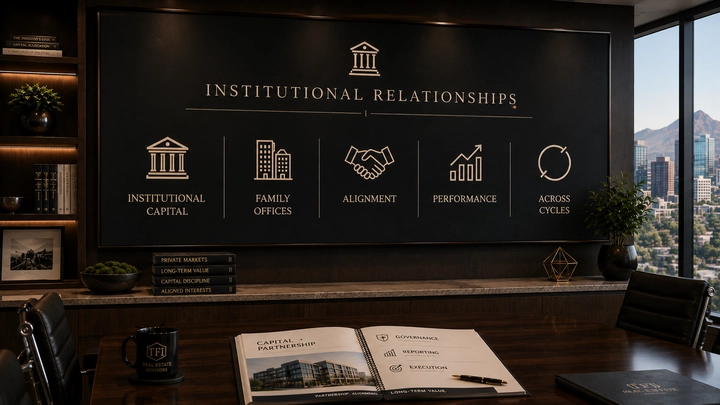
An initial assignment may be deliberately limited while the parties learn how each other evaluates risk, communicates, and makes decisions. A relationship can expand as confidence is earned and the strategy continues to fit both the capital mandate and TFI's execution capabilities.
Long-term alignment is demonstrated through conduct, not simply stated in marketing language.
How This Relationship Page Fits Within TFI
This page addresses relationship development, mandate fit, direct-investment structures, governance, reporting, and the expectations that apply to family office and private capital relationships.
Family Office & Sophisticated Owner Commercial Real Estate Advisory addresses property-level, transaction, and portfolio execution for sophisticated owners. Commercial Real Estate Capital Strategy addresses the real estate implications of financing and capital-structure alternatives. Investment Strategy & Portfolio Advisory focuses on direct real estate within an investor’s holdings and the decisions to acquire, hold, improve, refinance, recapitalize, or sell. Private Real Estate Partnership Framework explains sponsor responsibilities, governance, economics, diligence, liquidity, and risk when a formal partnership opportunity exists. The Private Real Estate Investment Risks & Disclosures and Investor Consultation Questionnaire pages provide additional risk, boundary, and relationship-fit information.
Keeping these functions distinct allows investors, owners, and capital partners to begin with the page that matches their actual decision.
Geographic and Assignment Scope
TFI's real estate market foundation is the Greater Phoenix Area and Arizona. Family office and private capital relationships may extend nationally when a larger commercial, multifamily, investment, or capital-driven assignment has a defined mandate, appropriate local execution resources, and a structure that supports responsible engagement.
National reach does not replace local diligence. For assignments outside Arizona, TFI evaluates how market knowledge, licensing, brokerage relationships, property expertise, and specialist resources will be assembled before accepting the work.
When a Family Office or Private Capital Relationship May Fit
A family office or private capital relationship may fit when the strategy has sufficient scale, a clearly defined business plan, documented underwriting, meaningful sponsor alignment, disciplined governance, and reporting that supports ongoing oversight.
It may also fit when a capital partner wants direct real estate exposure but prefers to work through a relationship that integrates market advisory, transaction execution, property-level analysis, and operating context.
The first step is a fit discussion focused on the mandate, opportunity, structure, decision process, and expectations on both sides of the relationship.
Frequently Asked Questions About Family Office and Private Capital Real Estate Relationships
Who may be appropriate for a family office or private capital relationship with TFI?
TFI may work with family offices, private capital groups, sophisticated individual investors, real estate owners, and operating partners where the relationship fits TFI’s real estate experience, the property strategy, the contemplated structure, and the ability of the assembled team to execute responsibly.
Is this page for capital providers, real estate sponsors, or both?
The primary focus is alignment between capital providers and real estate opportunities or operating relationships. TFI may also evaluate conversations with owners or sponsors seeking a strategic relationship, but the first question is whether the property strategy, experience, structure, capital need, and timing fit the relevant mandate.
Does TFI raise capital for unrelated third-party sponsors?
TFI's core work centers on its own real estate advisory relationships and TFI-sponsored investment structures. When an assignment involves third-party securities placement, capital solicitation, or other regulated activity, that work must be performed through appropriately registered and qualified professionals. TFI can help keep the underlying real estate analysis and execution strategy connected to that process.
What information is useful for an introductory capital conversation?
Useful information includes the investment or operating mandate, target property types and markets, anticipated check size, risk and return objectives, hold period, leverage parameters, governance expectations, reporting requirements, decision authority, timing, and whether the discussion concerns a specific property or a broader relationship.
What investment structures may be considered?
Depending on the opportunity and formal legal documentation, structures may include direct property ownership, property-level joint ventures, co-investments, co-GP or LP relationships, syndications, funds, and programmatic capital arrangements. No structure is selected until the underlying real estate, economics, governance, legal requirements, and investor qualifications have been evaluated.
Does this website offer an investment or security?
No. Website content is educational and describes TFI's platform and approach. Any private investment opportunity would be presented only through its formal offering and subscription documents, required disclosures, investor-qualification process, and applicable legal framework. See the Investor Disclosures page for additional context.
Does TFI work outside Arizona?
Yes, selectively. The Greater Phoenix Area and Arizona remain TFI’s core real estate markets. National family office, private capital, commercial, multifamily, and capital-driven assignments may be considered when the mandate, scale, structure, property type, and local execution plan support the engagement.