


What This Page Covers—and What It Does Not
Use this page to identify recurring risks and review questions in private real estate investments, property-level joint ventures, syndications, co-investments, and similar relationships. It is educational context for evaluating how private real estate may fit your objectives and how a specific opportunity should be reviewed.
It is not a private placement memorandum, subscription agreement, operating agreement, legal opinion, tax analysis, suitability determination, accredited-investor verification, or offer to sell a security. TFI is not presenting a current investment offering through this page. If a properly structured opportunity exists in the future, its formal documents, disclosures, eligibility requirements, and applicable law will control.
Private Real Estate Risk Operates at Three Levels
A useful review separates risk into three connected levels:
- Property and business-plan risk: the real estate, market, tenants, physical condition, capital requirements, operating assumptions, and exit plan.
- Structure and sponsor risk: financing, governance, fees, conflicts, decision rights, reporting, key-person dependency, and execution capability.
- Investor-specific risk: liquidity needs, concentration, time horizon, ability to absorb loss, tax circumstances, and the role of the investment within the investor's broader holdings.
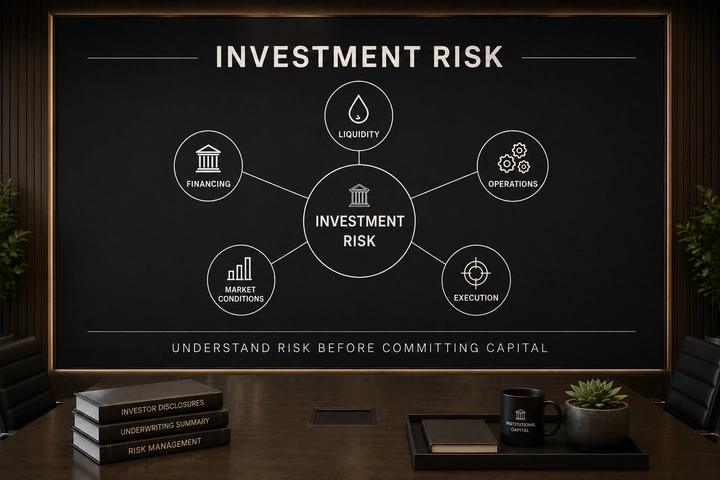
A strong property does not automatically create a suitable investment structure. Likewise, favorable legal terms cannot eliminate weak property economics or an investor's need for liquidity. The three levels should be evaluated together.
No Assurance of Results or Capital Preservation
Projected returns, distributions, appreciation, refinance proceeds, hold periods, and exit values all depend on assumptions that may fail. Rent growth can slow, occupancy can decline, expenses can rise, financing can tighten, renovation costs can exceed budget, and a sale can occur later and at a lower value than modeled.
Past performance does not guarantee future results. No underwriting model can assure that an investment objective will be achieved, that distributions will occur as projected, or that invested capital will be preserved. An investor should be financially and emotionally prepared for delayed distributions, reduced returns, extended hold periods, and partial or total loss.
Illiquidity, Hold Periods, and Transfer Restrictions
Private real estate interests generally do not trade on a public market. Governing documents may restrict transfers, require sponsor consent, provide rights of first refusal, or limit sales. Even when a transfer is legally permitted, there may be no willing buyer or reliable market price.
A projected hold period is an estimate, not a maturity date. Property performance, loan terms, market liquidity, tax considerations, and buyer demand may cause the investment to be held longer than expected. Capital committed to a private investment should not be money the investor expects to use for near-term living expenses, emergencies, debt service, or other foreseeable obligations.
Capital Calls, Reserves, and Distribution Risk
Your initial contribution may not be the full capital exposure. Operating deficits, tenant improvements, leasing commissions, repairs, insurance deductibles, construction overruns, lender requirements, or other unplanned needs can require additional funds.
The governing documents should explain whether capital calls are mandatory, how shortfalls are allocated, and what happens if an investor does not contribute. Potential consequences may include dilution, penalties, loans from other members, loss of voting rights, forced transfer provisions, or other remedies.
Distributions are also uncertain. Cash may be retained for reserves, lender covenants, capital projects, working capital, or future risks even when the property produces positive operating income.
Leverage, Interest Rates, and Refinancing Exposure
Debt can improve equity returns when the property performs as expected, but it also magnifies losses and reduces flexibility. Investors should understand the loan amount, maturity, amortization, interest-rate structure, guarantees, covenants, extension options, prepayment provisions, and lender remedies.
Refinancing is not assured. Higher interest rates, lower appraised value, weaker income, tighter underwriting standards, or reduced lender appetite may require additional equity or prevent a planned refinance. A loan maturity that occurs before the business plan is complete can create substantial risk even when the underlying property remains viable.
Property, Market, Insurance, and Regulatory Risk
Every investment is exposed to property-specific and local-market conditions. Tenant rollover, customer concentration, new supply, deferred maintenance, environmental conditions, utility constraints, zoning, access, parking, taxes, and competing properties can materially change performance.

Insurance availability and cost can also change. Coverage exclusions, deductibles, casualty losses, natural hazards, and business-interruption limits should be evaluated for the property and location. Government actions involving zoning, land use, taxation, environmental compliance, rent regulation, building standards, or other requirements may increase costs or limit the business plan.
TFI's core market is the Greater Phoenix Area and Arizona, with selective national reach for larger or strategic assignments. Local experience can improve the analysis, but it does not eliminate market or property risk.
Sponsor, Key-Person, and Execution Risk
Private real estate outcomes depend heavily on the people responsible for acquisition, financing, operations, leasing, construction, reporting, and disposition. The sponsor’s experience should be relevant to the property type, market, strategy, and scale being proposed.
Key questions include who will make day-to-day decisions, what happens if a principal becomes unavailable, which responsibilities are delegated, and whether the team has sufficient time and resources to execute the plan. Value-add, development, lease-up, and turnaround strategies generally create greater execution dependency than stabilized ownership.
Experience reduces some avoidable mistakes; it does not prevent cost overruns, tenant defaults, market changes, litigation, financing problems, or other adverse events.
Fees, Economics, Valuation, and Conflicts of Interest
Investors should understand every material form of sponsor or affiliate compensation, including acquisition, disposition, financing, development, construction-management, property-management, asset-management, guaranty, refinancing, and other fees. Timing and payment priority can affect both alignment and cash available to investors.
The distribution waterfall should be reviewed through actual numerical examples. Preferred returns, return of capital, catch-up provisions, promote tiers, fees, reserves, and tax allocations can produce results that are not obvious from a summary description.
Conflicts may arise when a sponsor or affiliate performs multiple roles, allocates opportunities among different relationships, provides services to the property, or participates in decisions affecting both sponsor compensation and investor outcomes. The documents should identify material conflicts and explain the approval or governance process used to address them.
Private-property valuations are estimates. Appraisals, broker opinions, internal models, and third-party reports may use different assumptions and may not reflect a price obtainable in an actual sale.
Information, Reporting, and Independent Verification
Private investments generally provide less standardized and less frequent information than registered securities. Financial statements may be unaudited, reports may use sponsor-defined formats, and material developments can occur between reporting periods.
Investors should understand the proposed reporting schedule, accounting basis, access to records, valuation methodology, budget process, material-event communication, and tax-document timing. They should also identify which information comes from the sponsor and which has been independently prepared or verified.
The SEC's Investor.gov guidance notes that private placement memoranda and other offering materials are generally not reviewed by a regulator and may not always present benefits and risks in a balanced manner. Independent diligence remains necessary. Investors can review the official Investor.gov bulletin on private placements for additional questions to ask.
Accredited-Investor Status and Offering Eligibility
Some private offerings are limited to accredited investors or apply different qualification and verification standards depending on the exemption. The SEC recognizes financial and professional pathways for individuals and separate standards for entities. Confirm the current criteria through the SEC’s official Accredited Investors resource and the documents for the specific offering.
Accredited-investor status is an eligibility classification. It does not establish that an investment is appropriate for a particular person, reduce the risk of loss, or replace independent review. TFI's Investor Consultation Questionnaire is an initial relationship and real estate intake; it is not an accredited-investor questionnaire or formal eligibility verification.
Tax, Legal, and Securities Considerations
Private real estate may involve depreciation, passive-activity rules, taxable income without matching cash distributions, state filing obligations, debt-financed distributions, partnership allocations, entity-level issues, and tax consequences on refinance or disposition. The result depends on the investor, entity, property, and governing documents.
Real estate ownership and private capital relationships may also involve securities, entity, contract, fiduciary, title, environmental, lending, and other legal issues. TFI provides broker-led real estate advisory and transaction execution while coordinating with the investor's legal, tax, lending, investment, engineering, appraisal, title, and other professionals as appropriate.
Questions to Resolve Before Capital Is Committed
A disciplined review should address at least the following:
- What property or assets will the investment own, and how will investor capital be used?
- What assumptions drive income, expenses, capital expenditures, financing, and exit value?
- What can cause the business plan to fail or take longer than expected?
- What relevant experience do the sponsor and operating team have?
- What debt terms, guarantees, covenants, maturities, and refinancing risks apply?
- What fees and affiliated-party compensation will be paid, and when?
- How are decisions approved, and which rights belong to investors?
- When may capital calls occur, and what happens if an investor does not fund?
- How are distributions calculated, and when may cash be retained?
- What conflicts exist, and how are they disclosed and managed?
- What reporting, records, valuations, and tax documents will investors receive?
- What transfer restrictions, withdrawal limits, and exit assumptions apply?
- Which statements are sponsor projections, and which information has independent support?
- How does the investment affect the investor's liquidity, concentration, and broader portfolio?
TFI's Private Real Estate Partnership Framework explains how governance, economics, responsibilities, liquidity, reporting, and exit provisions fit together. The Underwriting & Deal Analysis page addresses property assumptions, sensitivities, financing, and downside analysis.
Offering and Governing Documents Control
Depending on the structure, an investor may receive a private placement or offering memorandum, subscription agreement, operating or partnership agreement, property and financial information, and other disclosures. Read those documents together rather than relying on a website, presentation, summary, model, or conversation.
The governing documents establish the actual rights, obligations, economics, transfer restrictions, voting provisions, capital-call requirements, and dispute procedures. Any inconsistency should be resolved before signing or funding. Investors should have sufficient time to ask questions and review the documents with their own qualified professionals.
No Current Offer or Solicitation
Nothing on this page is an offer to sell or a solicitation to purchase a security, a commitment to form a partnership, or a representation that an investment opportunity is available. TFI does not maintain a public marketplace of live offerings through this website.
Any future TFI-sponsored or aligned private real estate relationship would proceed only when an appropriate property, strategy, team, legal structure, investor relationship, and formal documentation exist. Participation would remain subject to applicable law, eligibility, disclosures, diligence, and acceptance under the governing process.

Frequently Asked Questions
Does this page replace a private placement memorandum or operating agreement?
No. This page provides general education. Any actual opportunity must be evaluated through its own offering, subscription, governing, property, financial, and disclosure documents. Those documents—not this webpage—control the relationship.
Can an accredited investor still lose the entire investment?
Yes. Accredited status determines eligibility for certain private offerings; it does not reduce property, leverage, sponsor, liquidity, market, or execution risk. Private investments can result in partial or total loss.
Are projected returns or distributions guaranteed?
No. Projections depend on assumptions involving operations, financing, capital costs, market conditions, and exit value. Actual timing and results may differ materially.
Can an investor usually sell a private real estate interest early?
Often not. Transfers may be restricted by the governing documents and securities laws, and there may be no active market or reliable price. Investors should plan for an extended and uncertain holding period.
What should an investor review beyond the property itself?
The sponsor, team, financing, fees, conflicts, governance, decision rights, capital calls, reporting, valuation methods, distribution waterfall, transfer restrictions, tax treatment, and downside scenarios all matter.
Does TFI currently have an investment offering available?
This page does not represent a current offering or available investment inventory. Any future opportunity would be presented only through its formal process and documents when an appropriate structure and relationship exist.
Which professionals should an investor consult?
The appropriate team may include the investor's attorney, CPA or tax adviser, registered investment adviser, lender, insurance professional, title and escrow professionals, engineer, environmental consultant, appraiser, and other specialists required by the property and structure.