


Selling Commercial Property in the Greater Phoenix Area Is a Capital Event
A disposition changes the balance sheet and the owner’s future options. Pricing, timing, and preparation affect not only proceeds, but also reinvestment flexibility and the risk retained after the sale.
Owners often begin with market timing or a target valuation. Buyers, lenders, and equity partners begin with risk. They discount unclear income, weak documentation, deferred capital, and uncertain lease assumptions before those concerns are ever stated in an offer.
TFI Real Estate Advisors represents commercial property owners across the Greater Phoenix Area and Arizona. We advise on office, industrial, retail, medical, mixed-use, land, and multifamily dispositions, connecting preparation, pricing, buyer targeting, negotiation, diligence, and closing.
TFI Real Estate Advisors supports owners, investors, landlords, tenants, and developers across the Greater Phoenix Area and Arizona, with selective national reach for larger commercial, multifamily, investment, and capital-driven assignments where the scope and structure support the engagement.
Seller assignments may involve properties in Phoenix, Scottsdale, Tempe, Mesa, Chandler, Gilbert, Glendale, Peoria, Goodyear, Surprise, Buckeye, Queen Creek, and other Greater Phoenix Area communities. The strategy is tailored to the property type, buyer pool, submarket, and ownership objective.

Commercial Investment Sales Begin with Buyer Underwriting
To sell effectively, you need to understand how buyers will underwrite the asset. They are not buying a building in isolation; they are buying a cash-flow profile, an allocation of risk, and a credible exit narrative.
Underwriting discounts are applied before an offer is made. Buyers evaluate rollover exposure, tenant credit, capital expenditure risk, expense volatility, and market liquidity to determine how much uncertainty must be priced into a deal. When the asset story is unclear or overly optimistic, buyers protect themselves through price reductions, structure, or contingencies.
We help sellers anticipate these adjustments and position assets so underwriting assumptions remain credible. When risks cannot be eliminated, they are disclosed and framed transparently so buyers price them correctly upfront rather than using them as leverage later in the process.
What a Greater Phoenix Area Commercial Property Seller Broker Actually Does
Marketing matters, but seller representation begins earlier. Value is often protected through preparation, pricing discipline, buyer targeting, and control of the process.
For an owner deciding how to sell a commercial building in Phoenix, effective disposition advisory includes:
-
Strategic planning before launch
-
Market positioning aligned with buyer expectations
-
Pricing ranges grounded in underwriting reality
-
Buyer qualification to reduce execution risk
-
Negotiation discipline to preserve leverage
-
Process oversight through diligence and closing
That preparation allows the seller to direct the process instead of reacting defensively after negotiations begin.
Depending on the property and ownership objective, the process may begin with a broker price opinion or valuation review before a formal listing decision. Owners who are still evaluating value can Request a Commercial BPO / BOV.
Preparing a Commercial Building for Sale
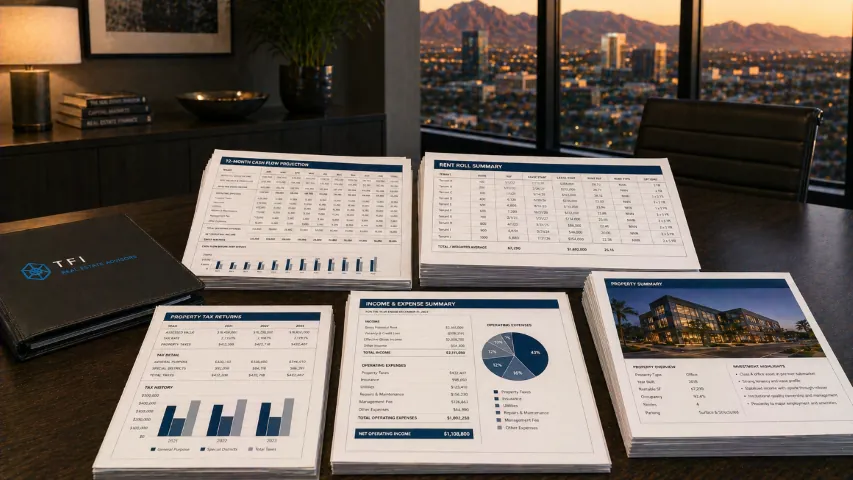
Preparation is one of the most reliable ways to strengthen a commercial disposition. Organized financials, complete lease documentation, and a coherent operating narrative reduce uncertainty and improve buyer confidence.
We work with sellers to normalize historical income and expenses, identify non-recurring items, evaluate tenant rollover concentration, and assess lease structures for clarity and enforceability. Capital expenditures, deferred maintenance, and near-term obligations are reviewed so they can be disclosed accurately and positioned appropriately.
When corrective actions or lease modifications can materially improve value, those options are evaluated against cost, timing, and execution risk. Preparation is always weighed against market conditions and seller objectives.
Aligning Ownership, Partners, and Advisors
Before going to market, ownership groups, partners, lenders, and advisers need alignment on pricing, timing, tax awareness, decision authority, and acceptable outcomes.
Misalignment often results in rejected offers, stalled negotiations, or failed escrows. We help sellers establish decision authority, define pricing boundaries, and align stakeholders so the process moves forward efficiently and decisively.
Greater Phoenix Area Commercial Property Pricing and Market Positioning
Pricing should be defensible. Comparable sales, active competition, financing conditions, lease quality, capital needs, and perceived risk all shape what qualified buyers can support.
Overpricing can stall momentum and weaken credibility. Underpricing may generate activity but risks leaving value unrealized. We advise sellers on establishing defensible pricing ranges that reflect how buyers will actually underwrite the asset rather than how owners hope it will be valued.
Market positioning is equally important. How an asset is framed, which buyer profiles are targeted, and how the investment story is communicated influence how pricing is perceived and defended during negotiation.
Commercial Investment Sales: Buyer Targeting and Qualification
Not every buyer offers the same probability of closing. Capital structure, experience, financing readiness, decision authority, and fit with the asset’s risk profile all matter.
We help sellers identify and target buyers most likely to value the asset appropriately and execute within the desired timeline. Buyer qualification reduces the risk of retrades, extended diligence periods, and failed escrows that erode value.
Qualification focuses on buyer experience, equity sources, lender relationships, and alignment with the asset’s risk profile.
Process Control and Negotiation Discipline
An unstructured sale process gives buyers room to retrade, shift terms, and create avoidable friction. We manage information flow, offer timing, and negotiation dynamics so leverage is not surrendered unnecessarily.
Negotiation is approached with a clear understanding of buyer motivation, underwriting constraints, and available alternatives. The highest headline price is not always the best outcome if execution risk is elevated. Our objective is to balance pricing with certainty of close, protecting net proceeds while minimizing avoidable concessions.
Managing Due Diligence and Closing Risk
Due diligence is where preparation is tested. Missing documents, unclear disclosures, and unresolved property or lease issues can quickly weaken confidence and delay closing.
We coordinate diligence requests, maintain communication between parties, and help resolve issues efficiently. Clear expectations, organized information, and disciplined timelines are essential to keeping transactions on track and preventing late-stage surprises that erode value or jeopardize closing.
Stabilized Versus Transitional Asset Sales
Stabilized assets are typically underwritten on in-place income and perceived risk profile. Transitional assets require buyers to believe in a future business plan.
We help sellers position each appropriately. Transitional assets benefit from clear articulation of upside, realistic assumptions, and credible execution paths. Stabilized assets benefit from demonstrating income durability, downside protection, and operational consistency. Positioning is tailored to buyer expectations rather than generic marketing narratives.
Commercial Building Sales Versus Multifamily Dispositions
While the disposition process shares similarities, buyers evaluate commercial and multifamily assets differently.
Commercial buyers often focus on tenant credit quality, lease structure, and rollover timing. Multifamily buyers place greater emphasis on operational efficiency, unit-level pricing, expense control, and renovation execution. Preparation, positioning, and disclosure are tailored accordingly to align with how each buyer pool underwrites risk.
Tax Awareness and Reinvestment Considerations
For many sellers, tax implications materially affect net outcomes. Capital gains, depreciation recapture, and state-level considerations should be evaluated alongside pricing and timing decisions.
TFI coordinates with the seller’s tax advisors so sale timing, structure, and reinvestment considerations can be evaluated alongside the real estate strategy. Tax advice remains with the seller’s qualified tax professionals.
Market Cycles, Liquidity, and Timing Decisions
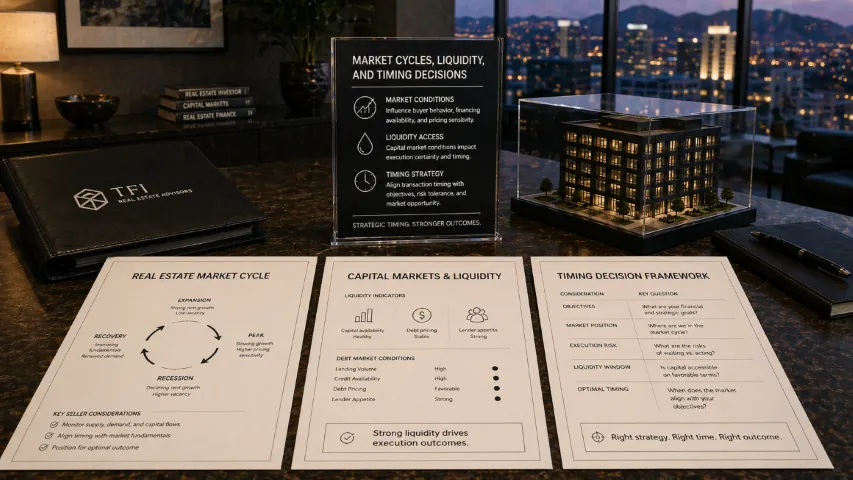
Market conditions influence buyer behavior, financing availability, and pricing sensitivity. Sellers who understand where the market sits in the cycle are better positioned to choose strategy and timing deliberately.
We help sellers evaluate whether to transact immediately, prepare for a future sale, or adjust expectations based on capital markets, supply dynamics, and buyer sentiment. Timing decisions are framed around liquidity, execution risk, and seller objectives rather than short-term market noise.
Seller Questions and Answers
What does a commercial property seller broker do in Phoenix?
A commercial seller’s broker advises on value, preparation, pricing, market positioning, buyer targeting, negotiation, diligence, and transaction management. Across the Greater Phoenix Area, the broker should also understand the relevant submarket, property type, active buyer pool, financing environment, and local comparables.
How do I sell my commercial building in Phoenix?
Start with a property-specific review of leases, income and expenses, physical condition, capital needs, ownership objectives, and likely buyer demand. From there, establish a defensible pricing range, determine whether broad or controlled exposure is appropriate, prepare diligence materials, qualify buyers, negotiate terms, and manage the transaction through closing.
How do you determine the right asking price?
Pricing is supported by comparable sales, market conditions, lease quality, and risk factors such as rollover and capital requirements. The goal is to establish a defensible range that attracts qualified buyers while preserving leverage.
How can sellers reduce the risk of retrades?
Retrade risk is reduced through strong upfront preparation, clear disclosures, realistic pricing, organized diligence materials, and buyer qualification. Process control is essential.
What causes commercial escrows to fail?
Common causes include financing issues, misaligned expectations, unexpected physical or lease risks, and lack of execution discipline during diligence and negotiation.
Should sellers consider off-market transactions?
Off-market transactions can be appropriate when discretion is important or the likely buyer universe is narrow, but pricing and expectations must remain realistic. Not every asset benefits from an off-market approach. See our Off-Market Commercial and Multifamily Advisory framework for the trade-offs between controlled distribution and broader exposure.
How early should a seller begin preparing for a sale?
Preparation ideally begins months before a sale process starts. Early preparation allows issues to be addressed proactively and improves negotiating leverage once the property is brought to market.