

Request a Home Value Review
Use the form below to request an initial broker-led review. Include the property address, notable improvements or condition issues, your approximate timing, and whether you are evaluating a sale, relocation, refinance, estate decision, or simply want a clearer understanding of current value.
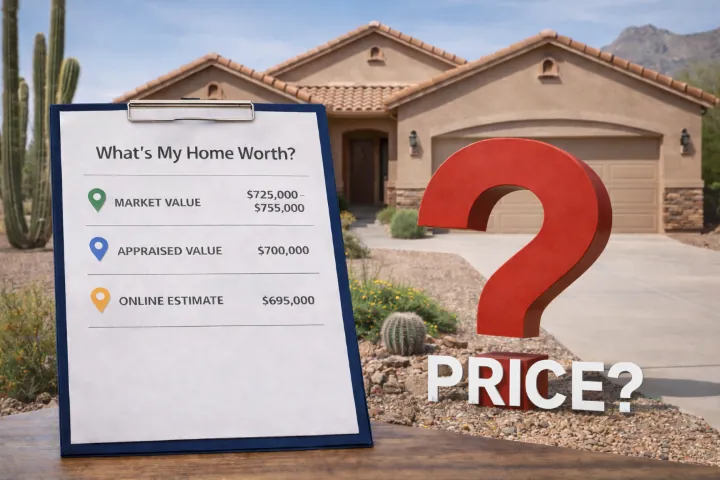
Not certain whether you need an online estimate, a Comparative Market Analysis, or a formal appraisal? Read the in-depth guide below for the differences and the situations each tool can address. You may also submit the request now, and TFI can help identify the most useful next step.
Home Value Is a Current Market Question
When you ask what your home is worth, you are usually asking about current market value: the price range qualified buyers may support under present conditions. The answer depends on the home itself and the alternatives those buyers can purchase at the same time.
Interest rates, inventory, competing listings, buyer demand, seasonality, neighborhood activity, and property presentation can all influence value. A home’s probable value can therefore change even when the property itself has not.
A broker-led review connects the available market evidence to the decision you are considering instead of handing you a number without context.
Online Estimate, Comparative Market Analysis, and Appraisal
Each valuation tool answers a different question.
An automated home value estimate uses public records, prior sales, and statistical modeling to produce a quick reference point. It can be useful for general orientation, but it may not fully recognize current condition, renovations, solar obligations, lot differences, views, functional layout, neighborhood boundaries, or the way buyers compare the home with active alternatives.
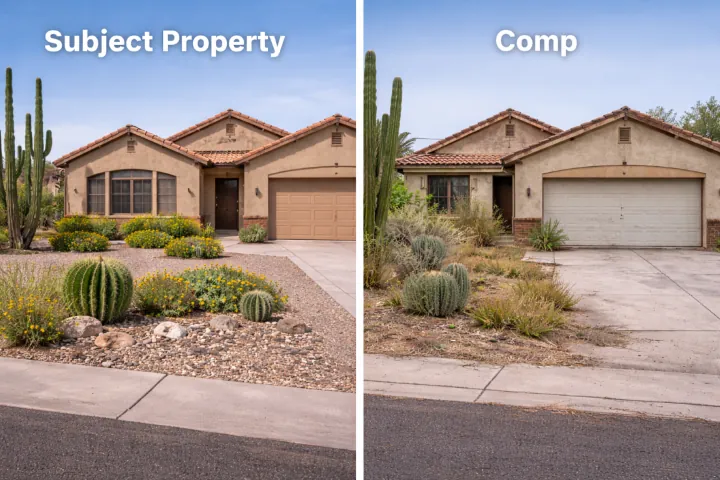
A Comparative Market Analysis, commonly called a CMA, is prepared by a real estate professional. It evaluates recent sales, active and pending competition, property-specific differences, market direction, and likely buyer response. A CMA is commonly used to discuss market value and listing-price strategy.
A formal appraisal is prepared by a licensed or certified appraiser for a defined purpose. A lender may require an appraisal for financing, and an appraisal may also be appropriate for certain legal, tax, estate, divorce, or other formal matters. A broker CMA is not an appraisal and should not be presented as one.

Why Zillow and Other Automated Estimates Can Miss the Mark
Zillow’s Zestimate and similar automated tools can be useful as a quick reference, but the number is only as reliable as the data and modeling behind it. An algorithm may not recognize a recent renovation, deferred maintenance, a superior or inferior lot, a solar obligation, an unusual floor plan, a boundary difference, or the way current buyers are reacting to competing homes.
Not every automated estimate is wrong. The problem is that a precise-looking number can imply more certainty than the underlying information supports. A property-specific review explains the evidence, the probable range, and the factors that could move the result.
What a Broker-Led Home Value Review Includes
The scope depends on the property and the owner’s objective, but a useful review may consider:
- Recent comparable sales and how closely they match the subject property
- Active and pending listings competing for the same buyers
- Price reductions, days on market, concessions, and failed listings
- Neighborhood, school-boundary, lot, view, location, and access differences
- Property condition, deferred maintenance, renovations, and presentation
- Floor-plan functionality, bedroom and bathroom configuration, and usable square footage
- Pool, solar, HOA, age-restricted, condominium, or community-specific factors
- Current inventory, buyer demand, interest-rate sensitivity, and market momentum
- The owner’s timing, desired level of preparation, and likely selling strategy
The result should give you a defensible range, explain what supports it, identify what could move it, and show how buyers are likely to interpret the property relative to competing choices.
What Affects Home Value Most
Buyers do not evaluate a home in isolation. They compare location, available alternatives, condition, functionality, and current demand.
Location includes the neighborhood, immediate surroundings, traffic, views, school boundaries, and nearby uses. Price position depends on what else a buyer can purchase for the same amount. Condition, floor plan, lot, major systems, HOA obligations, solar terms, pool, and community characteristics all influence how the home compares.
No single feature operates in isolation. The market responds to the complete package and to what else buyers can choose at that moment.

What a Comparative Market Analysis Actually Does
A CMA evaluates how the home compares with relevant sold, pending, and active properties. It does not claim one perfect number. It identifies a probable market range and explains how different price positions may affect buyer response.
A useful CMA accounts for differences in condition, upgrades, lot, location, layout, amenities, and timing. It also reviews current competition, pending activity, price reductions, concessions, and failed listings rather than relying only on closed sales.
The final range should be supported by evidence and explained in terms you can use.
Why Pricing Strategy Matters When Selling
Pricing shapes how buyers discover and interpret a home. Most search within defined ranges and compare every property with the competing homes visible at that moment.
A well-supported starting price can attract the correct buyer pool, generate stronger early activity, preserve negotiating leverage, and reduce the risk of extended market time. It also creates a more credible basis for appraisal and financing after an offer is accepted.
An aspirational price may feel protective, but it can send the strongest buyers to better-positioned alternatives before they ever visit the home.

Why Overpricing Backfires
Overpricing can suppress showing activity during the period when a new listing receives its greatest attention. As market time grows, buyers may assume the seller is unrealistic or the property has a problem, even when the home itself is sound.
Later price reductions do not always recover the lost momentum. The strongest pricing strategy creates enough credibility to attract qualified buyers while preserving room for negotiation.
How Buyers Compare Homes Before Scheduling a Showing
Price is often the first filter. Buyers then compare photos, condition, layout, location, monthly ownership costs, HOA obligations, solar terms, and expected repairs.
They are deciding what else the same money can buy, whether the home offers a clear advantage, which near-term costs come with it, and whether the asking price fits the condition and location. Market value is therefore relative. Even a desirable home can underperform when buyers see stronger alternatives at the same price.
Why Timing Influences Value
Market value changes with supply and demand. A home offered when inventory is limited and buyer activity is strong may receive a different response than the same home listed when competing supply is abundant.
Timing affects urgency, negotiating leverage, concessions, market time, the relevance of older comparable sales, and the risk of appraisal or financing friction. That is why a current review is more useful than a prior sale, an old CMA, or an automated estimate that may not reflect today’s competition.
Greater Phoenix Area Home Value Coverage
TFI Real Estate Advisors serves homeowners throughout the Greater Phoenix Area, including Phoenix, Scottsdale, Paradise Valley, Tempe, Mesa, Chandler, Gilbert, Glendale, Peoria, Surprise, Goodyear, Avondale, Buckeye, Queen Creek, Fountain Hills, Cave Creek, and surrounding communities.
Value can vary materially by neighborhood, school boundary, community, property type, age, condition, HOA structure, lot characteristics, and current inventory. A citywide average cannot substitute for reviewing your specific home and its immediate competitive market.
When to Request a Home Value Review
A home value review can clarify the decision when you are:
- Considering listing the home now or within the next year
- Comparing a traditional sale with a Cash-Offer Alternative
- Coordinating a sale and another purchase
- Planning a relocation
- Evaluating improvements before selling
- Reviewing equity for financial planning or a refinance discussion
- Handling probate, inheritance, divorce, or another life transition
- Questioning an automated estimate or unsolicited offer
- Trying to understand why a prior listing did not sell
For the full seller-representation process, review Selling a Home in the Greater Phoenix Area. A value review may be the first step, but pricing, preparation, marketing, negotiation, inspection, appraisal, and closing strategy shape the final outcome.
Frequently Asked Questions About Home Value
Is the value review an appraisal?
No. TFI provides broker-led market analysis and pricing guidance through licensed real estate brokerage services. A formal appraisal is prepared by an appropriately licensed or certified appraiser and may be required for lending, legal, tax, estate, divorce, or other formal purposes.
Is an online home estimate accurate enough to set a list price?
An online estimate can provide general context, but a listing-price decision should account for property condition, renovations, active competition, recent buyer behavior, neighborhood-level differences, and the owner’s timing and strategy.
What information should I provide?
The property address is the starting point. It is also helpful to identify major improvements, known repairs, solar or HOA obligations, current occupancy, approximate timing, and the decision you are considering.
Do I need to be ready to sell?
No. You may request a review before deciding whether to sell, hold, renovate, refinance, relocate, or pursue another option. The purpose is to improve the decision before you commit to a transaction.
Can you estimate value without seeing the home?
An initial range may be possible using available records, photographs, comparable activity, and owner-provided information. An interior review or more detailed discussion may be necessary when condition, renovations, layout, or unique features materially affect value.
How quickly can home value change?
Value can change as mortgage rates, inventory, buyer demand, competing listings, and neighborhood activity change. The most useful analysis is tied to current market evidence and the owner’s expected timing.