

Commercial Property Leasing Is an Asset Strategy
A signed lease can create years of income, expense obligations, capital exposure, and operating restrictions. Tenant quality and lease structure can materially affect cash flow, financing, valuation, saleability, and future flexibility.
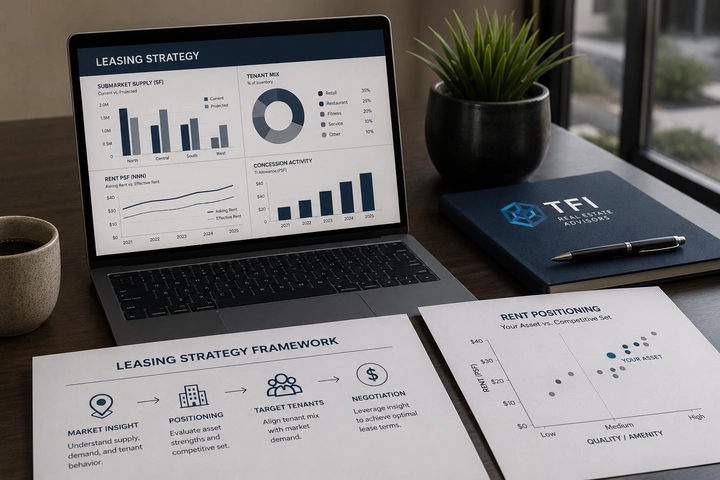
Landlord representation should begin with the asset plan, not a generic marketing campaign. The owner needs to decide which tenants fit the property, what economics are supportable, how much capital to commit, how vacancy compares with concession risk, and which lease structure supports the intended hold, refinance, or sale.
TFI Real Estate Advisors supports owners, investors, landlords, tenants, and developers across the Greater Phoenix Area and Arizona, with selective national reach for larger commercial, multifamily, investment, and capital-driven assignments where the scope and structure support the engagement.
Landlord representation may involve properties in Phoenix, Scottsdale, Tempe, Mesa, Chandler, Gilbert, Glendale, Peoria, Goodyear, Surprise, Buckeye, Queen Creek, and other Greater Phoenix Area communities. Positioning is based on the property, competing inventory, target tenants, and ownership plan.
When Owners Use a Greater Phoenix Area Landlord Representative
Landlord representation can apply to:
- Vacant office, industrial, retail, medical, flex, or mixed-use space
- Upcoming lease expirations and rollover planning
- Tenant renewals, expansions, contractions, or restructures
- New construction, redevelopment, or repositioned space entering lease-up
- Properties where current asking terms are not producing qualified activity
- Ownership groups evaluating whether to lease, sell, hold, or reposition
- Assets requiring coordinated leasing and property-management perspective
The earlier that strategy is established, the more options the owner retains. Waiting until the space is vacant or the tenant controls the renewal timeline can increase downtime and reduce leverage.
Property Positioning and Competitive Market Analysis
The property competes with a specific set of alternatives—not a Phoenix-wide average. Positioning must reflect the submarket, property type, condition, functionality, access, visibility, parking, loading, tenant improvements, available space, and competing concessions.
TFI helps owners evaluate:

- Competing available properties and recent leasing evidence
- Asking rent, effective rent, escalations, and expense structures
- Tenant-improvement and landlord-work expectations
- Free rent, brokerage, and other transaction costs
- Property strengths, limitations, and likely objections
- Target tenant profiles and operational fit
- Timing, downtime, absorption, and rollover exposure
A credible market position should attract attention without conceding more economics or flexibility than the market requires.
Marketing and Tenant Targeting
Effective landlord representation combines broad exposure where it adds value with targeted outreach to the brokers, businesses, industries, and tenant profiles most likely to use and value the premises.
Marketing should communicate the property's actual advantages, permitted or plausible uses subject to verification, delivery condition, economics, access, improvements, and location. It should also make it easy for qualified prospects and cooperating brokers to understand the opportunity and obtain the information needed to evaluate it.
Activity alone is not the objective. The owner needs qualified prospects with realistic use, timing, financial capacity, and decision authority.
Tenant Qualification and Credit Risk
A strong rental rate does not offset a tenant that cannot perform. Qualification should address the business, use, operating history, financial capacity, guaranty structure, build-out capital, permitting dependencies, and probability of opening and remaining in operation.
Different tenant profiles require different levels of diligence and credit support. The appropriate structure may involve deposits, guarantees, letters of credit, prepaid rent, landlord-work conditions, milestones, or other protections developed with the owner's legal and financial advisors.
TFI helps owners assess the commercial implications of a proposal. Legal counsel, accountants, lenders, and other professionals should address matters within their disciplines.
Rent, Concessions, Tenant Improvements, and Net Economics
The asking rent is not the owner’s economic return. Evaluate the proposal after considering:
- Base rent and scheduled increases
- Expense recoveries and caps
- Free rent and delayed commencement
- Tenant-improvement allowances and landlord work
- Brokerage commissions and legal costs
- Downtime and carrying costs
- Repair, maintenance, replacement, and compliance obligations
- Options, termination rights, assignment, and sublease provisions
- Credit support and collection risk
A higher face rate can produce a weaker outcome when concessions, capital, downtime, or tenant risk are excessive. TFI evaluates the complete economic package and how the proposed lease affects both current cash flow and longer-term asset value.
Proposal, Letter-of-Intent, and Lease Negotiation
The proposal and letter-of-intent stages establish the business framework for the lease. Negotiate the terms as a connected package rather than treating each issue in isolation.
Landlord leverage may depend on competing interest, tenant alternatives, vacancy duration, property fit, timing, credit, and the owner's willingness to invest capital. TFI helps owners evaluate trade-offs, respond consistently, and protect agreed economic and operational objectives as negotiations progress.
Commercial leases are legal documents. TFI advises on market conditions, business terms, real estate strategy, and transaction coordination; qualified legal counsel should prepare or review lease language and advise the owner on legal rights, remedies, disclosures, and risk. TFI does not provide legal or tax advice.
Renewals, Rollover, and Tenant Retention
Evaluate an existing tenant before the renewal deadline compresses the decision. Retention may avoid downtime, improvements, and brokerage cost, but the renewal still needs to reflect market economics, credit, performance, future property plans, and the value of flexibility.
Rollover strategy may include:
- Early renewal discussions where certainty has value
- Market testing and comparison against replacement demand
- Expansion, contraction, or relocation within the property
- Restructuring rent, term, options, or expense provisions
- Recapture or termination decisions
- Coordination of staggered expirations across a multi-tenant asset
The correct outcome is property-specific. Retaining every tenant is not always optimal, and pursuing a market increase without regard to replacement cost can also destroy value.
Leasing Strategy Across Property Types
Office and Medical Office
Office and medical leasing may require analysis of parking, floorplate, build-out, access, signage, patient flow, operating expenses, tenant-improvement exposure, and the competitive position of the building within its submarket.
Industrial and Flex
Industrial and flex leasing is often driven by loading, clear height, power, yard area, truck access, configuration, freeway proximity, zoning, and the cost of adapting the premises to the tenant's operations.
Retail and Service Properties
Retail and service leasing may depend on access, visibility, traffic, demographics, co-tenancy, tenant mix, exclusivity, signage, use restrictions, percentage-rent provisions, and the relationship between occupancy cost and tenant sales potential.
Leasing, Repositioning, or Selling the Property
A vacancy may expose a larger ownership decision. Releasing the space should be compared with renovation, subdivision, change of use, an owner-user or investment sale, and longer-term repositioning.
TFI can connect the leasing analysis to Commercial Seller Representation, Valuation and Pricing Strategy, or a Commercial BPO / BOV Request when the owner needs to compare alternatives before committing capital or accepting a lease.
Landlord Representation Questions and Answers
What does a commercial landlord representative do in Phoenix?
A landlord representative advises the property owner on market positioning, asking terms, marketing, tenant targeting, proposal analysis, credit considerations, negotiation, and transaction coordination through lease execution.
How do I lease my commercial property in Phoenix?
Begin with a property-specific review of condition, functionality, current or upcoming vacancy, competing inventory, likely tenant demand, market economics, capital requirements, and ownership objectives. Then establish positioning, marketing, qualification, negotiation, and execution procedures before pursuing prospects.
Should I accept the tenant offering the highest rent?
Not automatically. The complete outcome depends on credit, use, improvements, concessions, expenses, guarantees, timing, lease flexibility, probability of opening, and long-term effect on the property. The highest face rate can carry the greatest execution or collection risk.
How can a landlord reduce vacancy time?
Realistic positioning, complete property information, responsive brokerage, targeted outreach, appropriate property preparation, competitive economics, and disciplined follow-up can improve execution. Some vacancies also require physical or strategic changes rather than additional advertising.
Can TFI help with a tenant renewal?
Yes. Renewal strategy can include market analysis, economic comparison, negotiation, expansion or contraction, credit review, and evaluation of retaining the tenant versus releasing the premises.
Does landlord representation include property management?
Brokerage and property management are separate scopes, although operating information and management coordination can materially improve leasing decisions. The required services and responsibilities should be established for the specific property and assignment.
Does a landlord broker replace legal counsel?
No. A broker advises on market strategy, economic terms, and transaction coordination. The owner should use qualified legal counsel for lease drafting, legal rights, remedies, and risk allocation.
Where does TFI provide landlord representation?
The Greater Phoenix Area and Arizona are the core market. Selective national reach may apply for larger commercial, multifamily, investment, and capital-driven assignments where the scope and structure support the engagement. See the broader Commercial Leasing Advisory page for the shared leasing framework.