


What Mortgage Preapproval Actually Does
A mortgage preapproval moves you beyond a rough affordability estimate and into a lender-reviewed financing range. The lender evaluates your income, employment, credit, debts, assets, and intended transaction, then may issue a letter stating that you appear eligible for financing up to a specified amount under stated assumptions and conditions.
The Consumer Financial Protection Bureau describes a preapproval letter as the lender's tentative willingness to lend up to a certain amount. It is not a guaranteed loan offer. Final approval still depends on complete underwriting, updated borrower information, the property, appraisal, title, insurance, and satisfaction of lender conditions.
Preapproval is useful because it can:

- Establish a more realistic home-search range
- Identify financing issues before a contract creates deadlines
- Help the buyer compare loan structures and cash requirements
- Show a seller that a lender has begun reviewing the buyer
- Reduce avoidable financing surprises during escrow
Prequalification and Preapproval Are Not Universal Terms
Lenders do not always use prequalification and preapproval in exactly the same way. One lender’s prequalification may involve a credit report and documentation, while another may use the term for a quick estimate based largely on self-reported information.
Instead of relying on the label alone, ask:
- Was credit reviewed?
- Were income, employment, assets, and debts documented?
- Was an automated underwriting system or underwriter involved?
- What assumptions are built into the letter?
- What conditions remain before final approval?
- How long will the letter be treated as current?
A stronger letter usually reflects more verified information, but no preliminary letter eliminates final underwriting or property risk.
What Lenders Commonly Review
A lender typically reviews several connected parts of the borrower’s financial profile before issuing or updating a preapproval. The exact documentation and standards depend on the loan program, lender, borrower, and transaction.
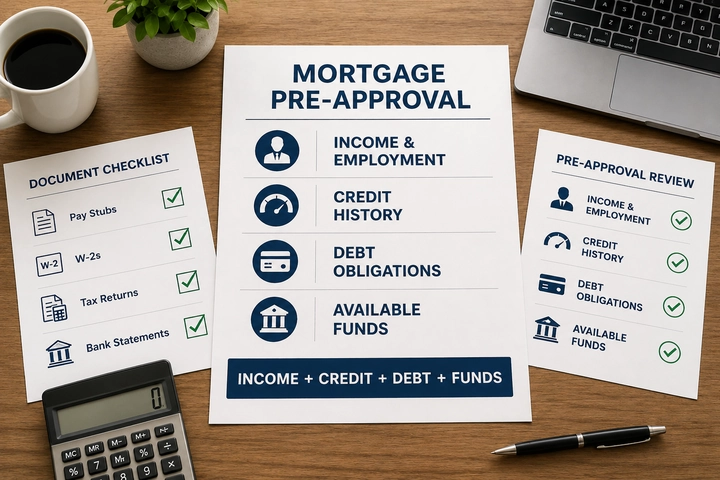
Income and Employment
The lender evaluates whether documented income is sufficient, stable, and likely to continue under the applicable loan guidelines. Salaried, hourly, commission, bonus, self-employment, rental, retirement, and other income sources may require different documentation and analysis.
Credit History
The credit report and scores help the lender evaluate payment history, balances, credit utilization, public records where applicable, and other indicators of repayment risk. Credit can affect eligibility, interest-rate pricing, mortgage insurance, required reserves, and available loan programs.
Existing Debt
Auto loans, student loans, credit cards, personal loans, support obligations, and other recurring debts affect the debt-to-income analysis. A buyer may have enough income to qualify while still deciding that the resulting payment is not personally comfortable.
Assets and Cash to Close
The lender may review funds for the down payment, closing costs, reserves, earnest money, and other required contributions. Large or recent deposits may need to be explained and documented. Gift funds, sale proceeds, retirement-account funds, and business assets can have additional rules.
The Proposed Property and Transaction
A preapproval is usually prepared before a specific property is under contract. Final financing therefore depends on the property type, occupancy, appraisal, title, insurance availability, HOA or condominium review where applicable, and the actual purchase terms.
Documents Buyers May Need
Requirements vary, but buyers are commonly asked for identification, income records, tax documents where applicable, bank or investment statements, employment information, debt information, and explanations or supporting documents for unusual items.
Organizing records early is particularly important for self-employed borrowers, buyers using business funds, buyers receiving gifts, purchasers with multiple properties, and households with variable or nontraditional income.
A document checklist is not the same as an underwriting decision. Buyers should provide complete and accurate information and ask the lender before moving money or changing the way funds are held.
How the Preapproval Process Usually Moves
The exact sequence varies by lender, but a buyer will generally complete an application or intake, authorize a credit review, provide requested financial documents, answer follow-up questions, and receive either a letter, a conditional response, or a request for additional information. Some lenders rely primarily on automated review at this stage; others involve an underwriter or perform a more detailed manual assessment.
Timing depends on the lender, the completeness of the file, and the borrower’s circumstances. Straightforward salaried files may move quickly, while self-employment, variable income, multiple properties, recent credit events, gift funds, business assets, or unexplained deposits can require additional review. Buyers should ask the lender what has actually been verified, what remains outstanding, and how much lead time the lender needs before an offer or updated letter.
A preapproval letter is still tentative. The CFPB’s preapproval guidance explains that the letter is based on assumptions and is not a guaranteed loan offer.
Approval Amount vs. Comfortable Purchase Budget
The amount a lender may approve answers a credit question: what loan appears to fit the lender’s guidelines? It does not answer the buyer’s broader financial question: what payment and cash commitment preserve an acceptable lifestyle, reserve level, and margin for risk?
The complete ownership budget can include:
- Mortgage principal and interest
- Property taxes
- Homeowners and supplemental insurance
- Mortgage insurance where applicable
- HOA or condominium charges
- Utilities
- Maintenance and repairs
- Transportation and location-related costs
The CFPB’s monthly-payment guidance emphasizes these broader costs. Buyers should set their own comfort range before the approved maximum becomes the default search target.
Compare Lenders, Loan Structures, and Cash Requirements
Preapproval from one lender does not prevent a buyer from comparing alternatives. Interest rate is important, but it is not the only variable. Buyers should compare lender fees, points, mortgage insurance, rate-lock terms, cash to close, loan features, service quality, communication, and the assumptions used in each proposal.
The CFPB’s Loan Estimate explainer helps consumers compare the standardized disclosures received after applying for a mortgage.
Direct Lender or Mortgage Broker
A buyer may work directly with a bank, credit union, mortgage company, or another lender, or may work with a mortgage broker who seeks loan options from multiple lenders. A loan officer commonly represents one lending institution; a mortgage broker commonly works with more than one lender. Neither structure is automatically better. The useful comparison is the actual loan, cost, service, communication, timing, and professional responsibility offered in the buyer’s circumstances.
The CFPB recommends contacting multiple lenders and explains how mortgage loan officers and brokers may be compensated. Buyers should ask whom the professional represents, which lenders or products are available, how compensation works, and whether the professional can meet the contract timeline.
Mortgage-rate shopping generally requires credit inquiries. The CFPB states that multiple mortgage credit checks are treated as one inquiry for scoring purposes when the last check occurs within 45 days of the first, although individual scoring models and circumstances can differ. Buyers should still ask each lender when and how credit will be checked.
Common Loan Families
The lender should determine which programs are available and appropriate. Common categories include:
Conventional Financing
Conventional loans are not insured by FHA or guaranteed by VA or USDA. Eligibility, down payment, mortgage insurance, reserves, and property requirements vary by borrower, lender, product, and transaction.
FHA Financing
FHA-insured loans may provide an option for qualified buyers with lower down payments or credit profiles that do not fit a conventional product. Borrowers should compare mortgage-insurance costs and property requirements rather than assuming FHA is automatically less expensive.
VA Financing
VA-guaranteed loans are available to eligible veterans, service members, and certain surviving spouses. Program eligibility does not remove lender underwriting, property requirements, closing costs, or the need to compare terms.
USDA Rural Housing Financing
USDA Rural Development programs may offer no-down-payment financing to qualified buyers purchasing eligible properties in designated rural areas, subject to household-income, property, lender, and program requirements. Eligibility is not determined by an Arizona mailing address or a buyer’s preference alone; the property location and household must satisfy the applicable program rules. Buyers considering an outlying or rural community should confirm current eligibility with an approved lender and the official USDA Single Family Housing program.
Jumbo and Other Portfolio Financing
Loans above conforming limits or outside standard agency guidelines may involve stronger reserve, credit, income, appraisal, or property requirements. Banks and other lenders may also offer portfolio products with guidelines specific to that institution.
Using the Preapproval in an Offer
A preapproval letter can strengthen an offer by showing that a lender has reviewed the buyer at some level. The letter should be consistent with the offer price and financing terms without unnecessarily disclosing more borrowing capacity than the transaction requires.
The real estate broker and lender should coordinate before an offer is submitted to confirm:
- The letter is current
- The property type and occupancy appear eligible
- The down payment and requested concessions fit the program
- The closing timeline is realistic
- Any appraisal or underwriting concern is understood
Preapproval improves credibility; it does not eliminate financing contingencies or make the offer equivalent to cash.
Keep Financing Stable Through Closing
The lender may reverify credit, employment, income, assets, and debts before closing. Buyers should consult the lender before:

- Opening or closing credit accounts
- Financing a vehicle, furniture, or other major purchase
- Changing employment or compensation structure
- Moving large amounts of money
- Accepting unexplained deposits
- Co-signing for another borrower
- Changing the intended occupancy or use of the property
A decision that seems unrelated to the home purchase can change the underwriting result.
Refreshing the Preapproval
Preapproval letters and supporting documents become stale. The refresh schedule is lender-specific and can depend on credit-report age, income documents, asset statements, market conditions, rates, and changes in the buyer’s circumstances.
Buyers should keep the lender updated during the search and request a refreshed review before making an offer if the letter is old, the target price changed, or the financial profile is no longer the same.
Frequently Asked Questions
Does preapproval guarantee that I will receive the mortgage?
No. It is a preliminary lender assessment. Final approval depends on full underwriting, updated borrower information, the property, appraisal, title, insurance, and satisfaction of all conditions.
Will getting preapproved hurt my credit?
A lender may use a hard credit inquiry, which can have a limited effect on a credit score. Mortgage-shopping inquiries made within the applicable rate-shopping window are generally grouped for scoring purposes. Ask the lender whether the initial review uses a soft or hard inquiry.
How long is a preapproval valid?
There is no universal expiration period. Lenders set their own requirements, and credit reports, income documents, asset statements, rates, and buyer circumstances can require an update. The letter itself should state or imply the applicable timing and conditions.
Should I get the highest preapproval amount possible?
The lender may need enough information to establish eligibility, but the buyer’s search range should be based on a comfortable total ownership budget—not automatically the maximum amount a lender may approve.
Can I change lenders after my offer is accepted?
Sometimes, but the contract, financing deadlines, appraisal timing, seller expectations, and closing date must be considered. A buyer should discuss a proposed change with the real estate broker and replacement lender before creating a performance problem.
Does TFI issue mortgage preapprovals?
No. TFI Real Estate Advisors provides buyer preparation, property guidance, and transaction coordination. A qualified lender or mortgage professional evaluates credit and issues the financing decision.
Continue Learning
Previous: Buying a Home in Arizona
Next: Arizona Home Inspections
Related service: Financing Preparation and Lender Coordination
Back to: Consumer Real Estate Education