


Deed Fraud and Seller Impersonation Are Related but Different
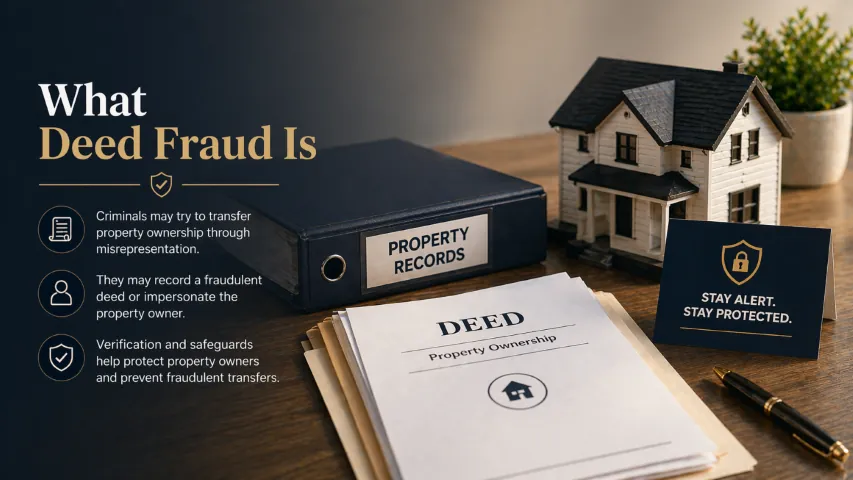
A property-fraud problem can begin in two different places. Deed fraud may involve a forged or false document recorded against the property, while a fake seller scheme may start earlier, when a criminal impersonates the owner and tries to list, contract, or sell it.
Both schemes take advantage of public ownership information and the fact that many legitimate transactions are handled remotely. Public records are essential to real estate, but a name and mailing address in those records do not prove that the person contacting a broker, buyer, lender, or title company is the true owner.
How Fake Seller Scams Develop
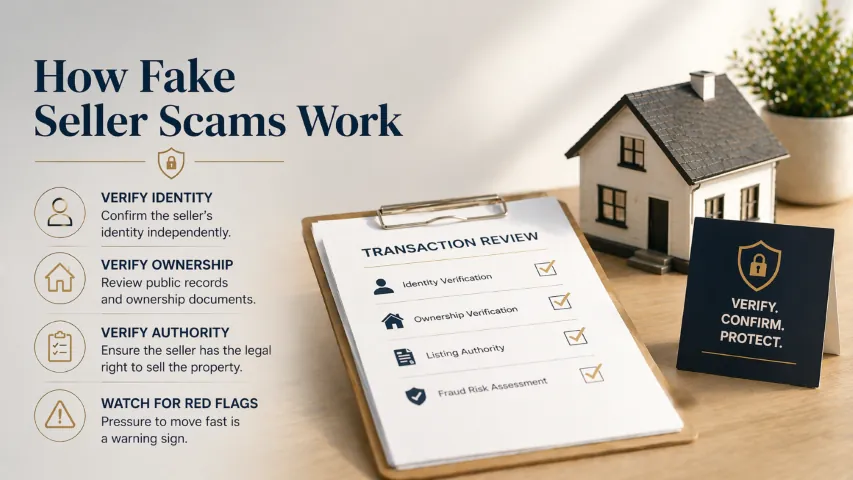
An impersonator may locate a vacant parcel, rental, second home, inherited property, or free-and-clear asset; identify the owner through public records; create false identification or email accounts; and contact a broker or buyer while claiming to be out of state or unavailable for an in-person meeting.
The criminal may push for a quick cash sale, avoid a video call, resist notarization or enhanced verification, accept an unusually low price, insist on communicating only by email or text, or direct proceeds to an account with no logical connection to the owner. No single fact proves fraud, but a cluster of inconsistencies deserves investigation.
Properties That May Receive More Attention
Fraud attempts often focus on property that can be marketed without an occupant immediately challenging the listing. Vacant land, vacant homes, seasonal residences, long-held rentals, inherited property, entity-owned assets, and property without a mortgage may receive more attention from impersonators.
That does not mean those properties are inherently unsafe. It means ownership verification should reflect the circumstances. A remote seller of a vacant parcel may legitimately want a fast transaction; the broker, title company, and buyer still need a process that confirms identity, authority, and disbursement instructions.
What Real Estate and Title Professionals Review
Professionals may compare identification with public records and prior transaction documents, confirm the owner's contact information through independent sources, conduct a video or in-person meeting, examine entity or trust authority, verify notaries, confirm tax and utility details, and ask transaction-specific questions that an impersonator may not know.
Title and escrow companies also review the chain of title, recorded liens, vesting, legal description, signatures, notarization, and payoff or proceeds instructions. A suspicious transaction may be paused while additional documentation is obtained.
The level of verification should match the warning signs. The objective is to investigate legitimate risk without creating unnecessary friction for a genuine owner and transaction.
How Arizona Property Owners Can Reduce Risk
Owners should keep mailing and contact information current with the county assessor, recorder, HOA, lender, insurance company, and property manager where applicable. Vacant and seasonal property should be inspected, secured, and monitored. Owners can also enroll the exact names of individuals, trusts, LLCs, or other title-holding entities in available county recording-alert systems.
TFI's Arizona Property Title Monitoring Guide explains those alerts and their limitations. Alerts provide notice after a document is recorded; they do not pre-approve or block a filing.

Arizona's 2026 Deed-Fraud Safeguards
Arizona enacted Senate Bill 1479 as Chapter 31 on April 9, 2026. The Arizona Legislature lists September 12, 2026, as the session's general effective date. A separate provision requires each county assessor to make a voluntary owner-notification system available no later than January 1, 2027. Until the applicable dates arrive and local implementation is confirmed, owners should not assume that every new safeguard is already operating.
Beginning on the general effective date, the law adds several controls. A person submitting a document in person at a recorder's office or recording kiosk generally must present valid photo identification, subject to exemptions for specified escrow, title, banking, legal, and governmental submitters. The law also requires a notary-journal thumbprint for deeds, quitclaim deeds, deeds of trust, other documents affecting real property, and powers of attorney, with limited exceptions. It changes the knowing recording of a forged, groundless, materially false, or otherwise invalid real-property document from a class 1 misdemeanor to a class 5 felony. The affidavit of legal value will also require telephone contact information for the buyer and seller and may include email addresses.
The assessor notification requirement is different from an existing recorder-based program such as Maricopa Title Alert. The assessor system is designed to notify an enrolled owner when the assessor receives notice of a change in ownership or the owner's mailing address. A recorder alert is generally name-based and provides notice after a document is recorded. Neither system determines whether a document is valid, and neither replaces transaction-level identity verification, title review, or prompt legal action.
If a Suspicious Listing or Recording Appears
An owner who discovers an unauthorized listing should contact the brokerage and listing service immediately, preserve screenshots and communications, and notify the title company or platform involved. If an unfamiliar document has been recorded, the owner should obtain a copy from the county recorder and contact an Arizona real estate attorney promptly.
Depending on the facts, the response may involve law enforcement, the county recorder, title insurer, escrow company, lender, notary, brokerage regulators, identity-theft reporting, or a court action to restore clear title. TFI can help address the real estate and transaction side, but legal title correction belongs with qualified counsel.
Deed Fraud, Title Defects, and Title Monitoring
These subjects overlap but are not identical. A fraudulent deed can create a Title Defect. Title monitoring may alert the owner after a suspicious recording. Seller-verification controls may stop an attempted sale before a deed is recorded.
A layered approach—accurate ownership records, county alerts, property oversight, identity verification, title review, secure closing procedures, and prompt legal action—offers more practical protection than relying on a single product marketed as a complete solution.
Frequently Asked Questions
Can someone really sell property they do not own?
A criminal can attempt to impersonate an owner and may even obtain a contract, but legitimate brokerage, title, escrow, notary, buyer, and lender verification is designed to identify the problem before closing. Successful fraud can still occur, which is why layered verification matters.
Are vacant properties more vulnerable?
They may receive more attention because no occupant is present to notice a sign, showing, or unauthorized activity. Vacant land, second homes, rentals, and inherited property also may be managed remotely.
Does the county recorder verify that every deed is legitimate?
Recording offices generally review documents for recording requirements; they are not conducting the same identity, authority, and legal-validity investigation as a court or transaction team. A document's presence in public records does not guarantee that it was lawfully authorized.
What should an owner do after receiving an unfamiliar title alert?
Obtain and review the recorded document, confirm that it is not connected to a legitimate loan, release, lien, estate, or ownership event, and contact the recorder and an Arizona real estate attorney promptly if it appears unauthorized.
Does title insurance prevent deed fraud after purchase?
Title insurance and recording alerts serve different purposes, and policy coverage depends on the policy and facts. Owners should consult their title insurer or attorney about a specific claim.
Advisory Note
This guide provides general real estate education and is not legal, title-insurance, cybersecurity, or identity-theft advice. Suspected forgery, impersonation, unauthorized recording, or title theft should be reported promptly to the appropriate legal, law-enforcement, title, insurance, and recording authorities.