


Off-Market Is a Controlled Transaction Strategy
In commercial real estate, off-market generally means the property is not broadly advertised through public listing platforms or a wide broker campaign. The owner and broker instead control distribution and direct the opportunity to selected counterparties.
The phrase can describe a confidential assignment, a quiet pre-market test, a direct owner-to-buyer discussion, a narrowly circulated offering, or a property that has not yet launched publicly. Each situation carries a different level of representation, exposure, documentation, and execution risk.
Off-market is not secret inventory, a guaranteed discount, or an automatic path to a premium price. It is a transaction strategy that should serve a defined ownership objective.
TFI approaches the strategy primarily from the owner's disposition decision while also maintaining a pathway for qualified buyers whose acquisition criteria may fit a specific private assignment.
Owners seeking a conventional sale process can review our Commercial Seller Representation page. Owners who first need property-specific pricing context can Request a Commercial BOV/BPO. Buyers seeking broader acquisition representation can review our Commercial Buyer Representation page.
When Off-Market Transactions May Make Sense
A controlled process may be appropriate when specific conditions are present and the reason for limiting exposure is clear.
Potential situations include:
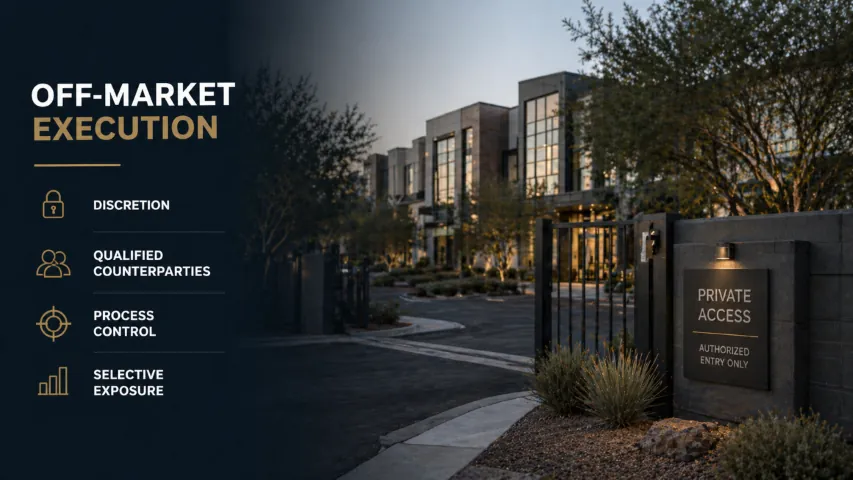
- Ownership structures that benefit from discretion
- Sensitive tenant, employee, customer, or operating-business considerations
- Partnership, estate, family, litigation, or governance circumstances
- A narrow and identifiable buyer universe
- A portfolio or larger asset suited to targeted institutional or private-capital outreach
- An owner seeking credible market feedback before committing to a broad launch
- Unusual timing, financing, lease, development, or ownership complexity
- A property where public speculation could create operational or negotiating problems
In these cases, controlled exposure can help manage risk, disruption, timing, and information flow while preserving as much pricing leverage and closing certainty as the circumstances allow.
When Broad Market Exposure Is Usually Stronger
Off-market execution is not inherently superior. Broad exposure often creates stronger price discovery, more competition, clearer feedback, and better alternatives if a preferred buyer fails to perform.
A public process may be the better choice when maximizing price is the owner’s primary objective, the buyer universe is broad, competitive bidding is important, and the property can be marketed without meaningful operational disruption. It is also useful when ownership expectations need to be tested against the full market.
Under those conditions, limiting exposure can give a single buyer too much leverage and reduce the seller’s options. The strategy should follow the owner’s objectives and the property’s likely buyer pool.
Pricing Realism and Limited Feedback Loops
Mispricing is one of the central risks in a controlled process. With fewer tours, offers, and objections, unsupported expectations can persist and the transaction may stall quietly rather than fail in a visible way.
TFI reviews recent comparable sales, income quality, lease rollover, tenant concentration, physical condition, near-term capital needs, financing conditions, buyer return requirements, development competition, and the number of parties realistically capable of closing. The weight given to each factor depends on the property.
A private process works best when the pricing range is supported before buyers are approached and ownership has agreed on how it will respond if the initial outreach does not produce credible interest.
Buyer and Seller Qualification
Because an off-market process limits exposure, qualification matters more—not less.
On the ownership side, confirm decision authority, pricing expectations, timing, information restrictions, and acceptable alternatives. On the buyer side, evaluate:
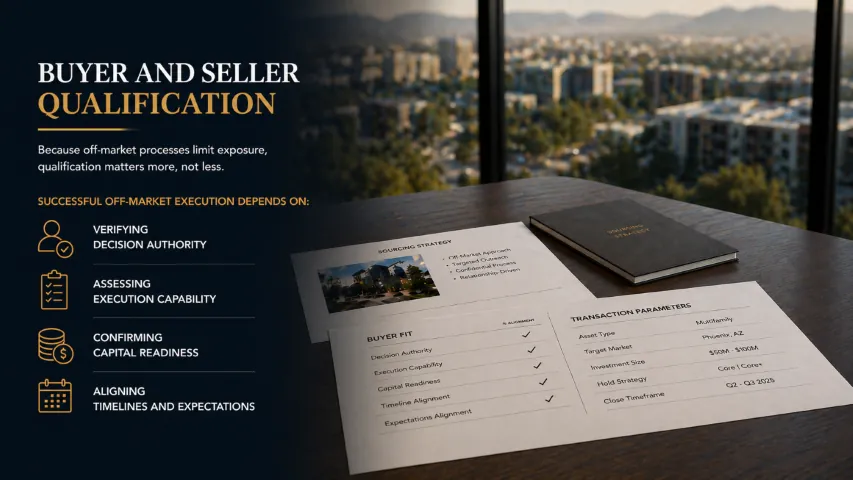
- Target property types and markets
- Typical transaction size
- Investment or owner-user criteria
- Equity and financing readiness
- Decision-making authority
- Acquisition timing
- Relevant transaction experience
- Willingness to protect confidential information
Unqualified counterparties create disproportionate risk because there are fewer alternatives if execution falters. TFI’s buyer work is assignment-based: a buyer may be considered when its criteria, capital capacity, experience, timing, and confidentiality expectations align with an owner’s private-sale process.
Confidentiality and Information Control
Confidentiality is often the reason for choosing an off-market process, but it must be managed deliberately. Information control depends on sequencing, qualification, and context—not a promise of absolute secrecy.
The parties should decide what information can be shared, when it will be released, who receives access, whether a confidentiality agreement is appropriate, how property visits and diligence materials will be staged, and which communications require ownership approval.
Sharing too much too early can weaken leverage. Sharing too little can undermine trust and delay diligence. The process should provide qualified buyers enough information to evaluate the opportunity while protecting sensitive details as far as reasonably possible.
How TFI Structures a Controlled Process
A disciplined private sale still requires the core work of a professionally managed disposition. Distribution may be narrower, but the analysis, documentation, qualification, negotiation, and diligence standards should remain rigorous.
Depending on the assignment, the process may include:
- Clarifying ownership objectives and constraints. Define the reason for limited exposure, required timing, decision authority, confidentiality concerns, and acceptable alternatives.
- Establishing pricing and transaction context. Review operations, leases, physical condition, capital needs, comparable transactions, financing conditions, and likely market reception.
- Defining the buyer universe. Target counterparties based on property type, size, geography, strategy, capital capacity, and demonstrated ability to close.
- Preparing controlled marketing and diligence materials. Provide enough information for serious evaluation while staging sensitive material appropriately.
- Managing outreach, confidentiality, and access. Use qualification, controlled distribution, data-room access, and defined communication protocols where appropriate.
- Evaluating offers beyond price. Consider capital source, financing dependence, diligence, deposit structure, contingencies, closing history, and decision authority.
- Maintaining alternatives and process discipline. Establish deadlines, decision points, and a contingency plan if limited outreach does not produce an acceptable result.
Clear timelines and decision authority help prevent private processes from drifting or quietly failing.
Off-Market, Pre-Market, and Public Marketing
These approaches optimize for different outcomes.
Controlled off-market process
The property is presented to a limited group of selected buyers without broad public promotion. This prioritizes discretion and process control but can reduce competition and market feedback.
Quiet pre-market testing
A small number of credible buyers may be approached before a broader launch. This can test assumptions or identify an exceptional direct opportunity, but ownership should define when the property will move to a wider process if the early outreach is inconclusive.
Broadly marketed disposition
The property is presented to a wider qualified audience through broker networks, direct outreach, listing platforms, and coordinated marketing. This generally supports stronger price discovery and competition but provides less privacy.
Neither approach is inherently superior. The appropriate strategy should follow the owner's objectives, the asset, the market, and the probable buyer universe.
Institutional and Principal Context
Off-market transactions are common among family offices, funds, institutional owners, developers, and sophisticated principals managing complex properties or portfolios. In those settings, governance, timing, tenant sensitivity, partnership considerations, and transaction sequencing may outweigh the benefits of maximum exposure.
Limited distribution does not reduce underwriting scrutiny. Sophisticated buyers still price lease risk, capital needs, financing, operations, and execution conservatively. Private processes succeed when expectations, authority, documentation, and counterparties are aligned.
Execution Risks Unique to Off-Market Processes
A limited process can leave the seller with fewer alternatives, allow negotiations to continue without competitive pressure, and create greater dependence on one buyer or intermediary. That makes a late retrade, information leak, or misunderstanding about authority more consequential.
TFI clarifies representation, compensation, information-sharing expectations, and potential conflicts before the assignment advances. Legal, tax, accounting, securities, and formal appraisal matters remain with the appropriately qualified professionals.
Commercial and Multifamily Property Types
A controlled-distribution strategy may be considered for:
- Multifamily and apartment properties
- Office and medical-office buildings
- Industrial, warehouse, and flex properties
- Retail and service-commercial assets
- Single-tenant net-leased properties
- Mixed-use properties
- Land and development opportunities
- Small portfolios or multi-asset assignments
- Owner-user commercial buildings
The appropriate strategy depends on the asset and buyer universe. A process that works for a larger apartment property may be inappropriate for a small owner-user building that needs broad local exposure.
Greater Phoenix Area, Arizona, and Select National Assignments
TFI Real Estate Advisors supports owners, investors, landlords, tenants, and developers across the Greater Phoenix Area and Arizona, with selective national reach for larger commercial, multifamily, investment, and capital-driven assignments where the scope and structure support the engagement.
Controlled-sale assignments may involve properties in Phoenix, Scottsdale, Tempe, Mesa, Chandler, Gilbert, Glendale, Peoria, Goodyear, Surprise, Buckeye, Queen Creek, and other Greater Phoenix Area communities. The appropriate outreach strategy depends on the asset, confidentiality needs, probable buyer pool, and ownership objective.
The Greater Phoenix Area and Arizona remain the core market. Select national work is considered where the client relationship, asset size, complexity, property type, counterparties, and licensed local execution resources can be aligned responsibly.
Common Misconceptions About Off-Market Transactions
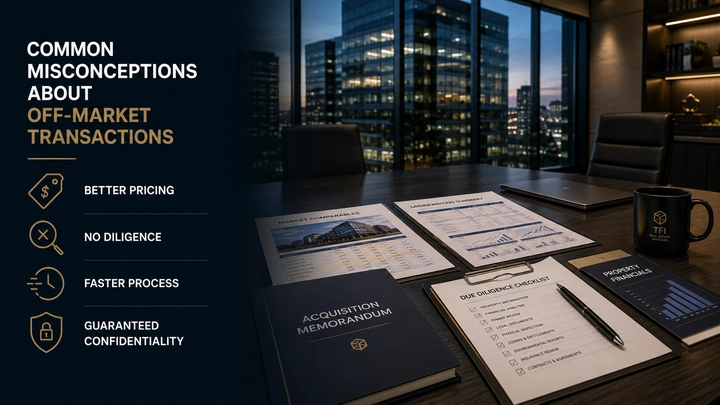
Off-market does not automatically mean a higher price, a faster closing, reduced diligence, or complete confidentiality. Buyers still underwrite the property, information can still travel, and a weak process may take longer than a well-run public campaign.
The value of an off-market strategy comes from controlled exposure and a clearly defined objective—not from avoiding ordinary market and transaction realities.
Frequently Asked Questions About Off-Market Commercial Real Estate
Can TFI help me sell a commercial property confidentially in the Greater Phoenix Area?
Yes, when a controlled-distribution strategy is appropriate for the asset and ownership objectives. The first step is to evaluate why confidentiality is needed, who the likely buyers are, how value will be supported, and what alternatives ownership has if limited outreach is unsuccessful.
Can buyers submit criteria for off-market opportunities?
Yes. Qualified buyers can provide specific acquisition criteria and evidence of capital readiness. Submission does not guarantee access to an opportunity; distribution remains subject to the owner's instructions, the brokerage relationship, confidentiality requirements, and the buyer's fit for the assignment.
Can an off-market transaction reduce disruption?
It can. Limited outreach may reduce public speculation, tenant concern, employee disruption, or operating-business exposure when information flow and property access are managed carefully.
Do off-market transactions close more often?
Not necessarily. Pricing realism, qualification, diligence, decision authority, financing, and execution quality matter more than whether the property was publicly marketed.
Is off-market execution appropriate for a first-time seller or buyer?
Potentially, but the process requires clear representation, realistic expectations, disciplined information control, and qualified professional support. Limited exposure should not be selected merely because it appears simpler or more exclusive.
Will an off-market sale produce a higher price?
It may, but there is no automatic premium. A highly qualified buyer may value speed, access, or strategic fit, while limited competition can also reduce seller leverage.
Should I request a BOV/BPO before deciding to sell off-market?
Often, yes. A property-specific broker opinion can help ownership compare likely pricing, buyer demand, and execution alternatives before limiting exposure. A BOV/BPO is not a formal appraisal.
Does TFI work on off-market multifamily transactions?
Yes. Multifamily assignments require particular attention to rent rolls, operating history, unit condition, concessions, bad debt, capital needs, financing assumptions, and the buyer pool. Our Multifamily Advisory page explains the broader asset-class approach.