


Greater Phoenix Is a Collection of Distinct Real Estate Markets
“The Phoenix housing market” is useful shorthand for a broad regional trend. It is much less useful when you are evaluating an individual property or transaction. The Greater Phoenix Area stretches across a wide desert region, and its cities and communities developed at different times, around different employment centers, with different housing stock, street patterns, densities, amenities, and growth pressures.
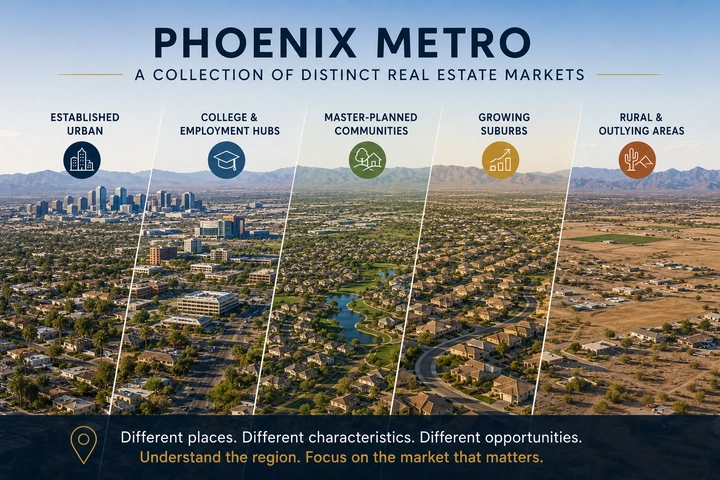
A buyer comparing Tempe with Buckeye is not simply choosing between two points on the same market map. A seller in an established Central Phoenix neighborhood may face a different competitive set from a seller in a newer master-planned community in the West Valley. Scottsdale, Surprise, Chandler, Peoria, Paradise Valley, Mesa, and Queen Creek can all participate in the same broad regional cycle while behaving differently at the neighborhood and property level.
The central idea is straightforward: start with the region, but do not stop at the region. The Valley makes more sense when you treat it as a collection of connected markets rather than one uniform place.
How the Valley Grew Helps Explain the Housing You See Today
Greater Phoenix Area housing patterns are closely tied to the way the region expanded over time. Older parts of Phoenix, Glendale, Mesa, and Tempe contain established street grids, mature neighborhoods, mid-century housing, infill, and decades of redevelopment layered together. Farther from the historic core, large portions of the Valley were built during later waves of suburban expansion and often feature larger planned subdivisions, contemporary road networks, homeowner associations, and newer community amenities.
At the edges of the metropolitan area, growth can become more visibly tied to available land, freeway expansion, utility infrastructure, new schools, commercial development, and master planning. A community that appears geographically distant today may be part of an active growth corridor, while an established neighborhood closer to the urban core may have very limited new land but more redevelopment and infill pressure.
Housing age therefore tells only part of the story. The more useful questions are how an area developed, what was built there, what continues to be built nearby, and how those patterns affect ownership, maintenance, commute access, and future competition.
Central Phoenix and the Urban Core
Central Phoenix and the surrounding urban core contain some of the Valley's widest variation in housing age, architecture, lot patterns, and neighborhood character. Historic districts, mid-century neighborhoods, established subdivisions, condominium communities, urban infill, and newer redevelopment can exist within relatively short distances of one another.
Here, the useful comparison is often highly neighborhood specific. Major streets, redevelopment patterns, proximity to employment and cultural districts, school boundaries, lot characteristics, and even a few blocks of location can materially change how a property competes. A broad Phoenix citywide statistic tells you very little when the homes being compared sit in fundamentally different parts of a city this large and varied.
This section is intentionally regional rather than neighborhood-by-neighborhood. For a deeper look at the city itself, use the City of Phoenix Guide. The purpose of the metro overview is to show how Central Phoenix fits into the wider Valley.
The East Valley
The East Valley generally includes communities such as Tempe, Mesa, Chandler, Gilbert, Queen Creek, Apache Junction, and nearby areas extending toward Pinal County. It is not a single suburban market. The East Valley includes older established housing, major employment corridors, university influence, large master-planned communities, newer fringe development, retirement-oriented housing, and areas where desert or mountain geography becomes more visible.
Tempe's location and development pattern differ substantially from outer Queen Creek or San Tan Valley. Chandler and Gilbert have experienced extensive suburban growth, but their neighborhoods vary by development period, access, lot size, school boundary, and proximity to employment. Mesa is geographically large enough to contain multiple residential environments of its own. Apache Junction and communities farther east introduce different questions involving distance, desert setting, land patterns, and access.
When you compare the East Valley, ask which part of the East Valley supports the decision rather than assuming the region has one dominant housing profile.
The West Valley
The West Valley includes a broad range of communities and growth patterns extending through Glendale, Peoria, Surprise, Avondale, Goodyear, Litchfield Park, Buckeye, Tolleson, and surrounding areas. Like the East Valley, the label is geographically useful but analytically incomplete.
Some West Valley neighborhoods are long established and closely integrated into the central urban area. Others are part of newer suburban and master-planned growth corridors. The northern portions of Peoria and areas influenced by Loop 303 can feel very different from older communities farther south. Goodyear and Buckeye include extensive newer development, but distance, freeway access, employment geography, community planning, and future surrounding construction can materially affect the ownership experience.
The West Valley also shows why a Greater Phoenix Area decision should not be reduced to mileage from Downtown Phoenix. Your employment, family, recreation, or daily activity may already be centered in the western part of the region. In that case, a West Valley property can be central to your actual life even when it looks peripheral on a traditional map of Phoenix.
Scottsdale, Paradise Valley, and the Northeast Valley
Scottsdale, Paradise Valley, Fountain Hills, Cave Creek, Carefree, Rio Verde, and the broader northeast portion of the Valley introduce another set of real estate patterns. Luxury housing is an important part of the regional identity, but the area should not be understood only through a luxury-market lens.
Scottsdale itself stretches across multiple submarkets with different development ages, housing types, densities, and buyer profiles. Paradise Valley is defined by a distinctly different land and luxury environment. Fountain Hills, Cave Creek, and Carefree bring topography, desert setting, and lower-density patterns more visibly into the location decision. Areas farther northeast may place greater emphasis on distance, road access, property characteristics, and the relationship between development and open desert.
These markets are a good example of why a median price alone can create a distorted picture. Property type, view, lot, condition, renovation quality, community, location within the city, and immediate competitive set can have an outsized influence on value and buyer response.
Outer Communities and the Metro Fringe
Communities at or beyond the developed edge of the Valley require a somewhat different decision framework. New River, Wittmann, Morristown, Wickenburg, Tonopah, Waddell, Rio Verde, and other less urbanized areas may involve larger parcels, lower-density settings, more visible desert or agricultural land, and greater variation in infrastructure and nearby development.
In these areas, a buyer may need to pay closer attention to road access, utility configuration, water source or service, septic systems, flood considerations, parcel characteristics, future development, and the practical distance to employment, services, schools, and daily needs. Those issues are property specific and should be verified rather than assumed from the community name alone.
The metro fringe is also where growth expectations can be misread most easily. “Future growth” is not automatically a benefit, and “rural” does not automatically mean isolated forever. Planned roads, nearby subdivisions, industrial development, commercial projects, and infrastructure investment can change the context around a property. The relevant question is what is known, what is proposed, what is speculative, and how each factor affects the owner's actual objective.
Employment Centers and Commute Geography Matter More Than a Single Downtown
The Greater Phoenix Area is a decentralized region. Downtown Phoenix is an important employment, government, cultural, and educational center, but it is not the only point around which residential decisions are organized. Employment concentrations and major business corridors are distributed across Phoenix, Scottsdale, Tempe, Chandler, the West Valley, and other parts of the metropolitan area.
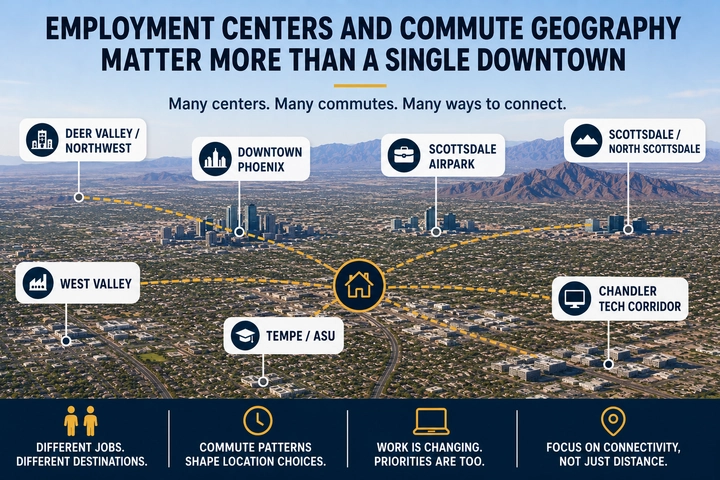
That changes the way location should be evaluated. Someone working regularly in Chandler may view the East Valley very differently from someone whose work is concentrated near Deer Valley, North Scottsdale, Downtown Phoenix, or the West Valley. A household with two commuters may be solving for competing travel patterns. Remote work may reduce commute frequency but increase the importance of home office space, neighborhood environment, and access to daily services.
The practical question is not simply, “How far is this home from Downtown Phoenix?” It is, “How does this location connect to the places this household actually needs to reach?”
Freeways, Distance, and the Reality of Valley Travel
The Phoenix area's freeway network helps connect a very large metropolitan region. Interstate 10 and Interstate 17, Loop 101, Loop 202, Loop 303, State Route 51, and US 60 influence how people move between major parts of the Valley. Regional transportation planning continues because travel demand and development patterns continue to change across the metropolitan area.
For residential decisions, freeway access can matter—but proximity to a freeway is not the same as an easy commute. Direction of travel, interchange access, peak congestion, local arterial streets, construction, and the final miles between the freeway and a destination can all change the daily experience. The Maricopa Association of Governments tracks regional traffic volume and congestion delay across major freeways and some arterial roads, which underscores that travel conditions are a regional planning issue rather than a simple distance calculation.
A useful area comparison should therefore consider both map distance and actual travel patterns. Ten additional miles on one route may function differently from a shorter trip through a constrained corridor. Before choosing a location primarily around commute expectations, test the route at the times and on the days that matter to you.
New Construction and Established Areas Create Different Trade-Offs
The Greater Phoenix Area gives buyers access to both established neighborhoods and active new-home development. Neither is automatically better. They simply create different ownership considerations.
Newer communities may offer contemporary floor plans, current energy standards, planned amenities, and lower immediate renovation needs. They may also involve active construction, evolving commercial services, smaller or less mature landscaping, builder competition, HOA structures, and uncertainty about how surrounding land will ultimately develop.
Established areas may offer mature landscaping, completed surroundings, known travel patterns, larger lots in some neighborhoods, and a more visible resale history. The trade-off can be older building systems, prior renovations of varying quality, deferred maintenance, and greater differences in condition between competing homes.
The better comparison is not “new versus old.” It is whether the physical property, community pattern, maintenance profile, and future surroundings fit the buyer's priorities and risk tolerance.
HOAs, Property Taxes, and Ownership Costs Vary by Property and Location
Ownership costs should not be inferred from a city name. The Greater Phoenix Area includes properties with no HOA, single-association communities, master-planned developments with multiple layers of association costs, condominium structures, age-restricted communities, and neighborhoods with different community facilities or ownership obligations.

Property-tax context can also vary by parcel and taxing jurisdiction. The amount shown on a prior tax bill does not necessarily tell a buyer everything about future ownership cost, and a citywide average is not a substitute for reviewing the actual property. Insurance, utilities, solar obligations, special property features, and maintenance requirements can further change the comparison between two homes with similar purchase prices.
For that reason, TFI's city guides discuss HOA and property-tax context without presenting a single static number as though it applies uniformly across an entire community. A property-level decision requires property-level review.
How to Compare Greater Phoenix Area Cities and Communities
There is no universally “best” city or suburb in the Greater Phoenix Area. Lists that rank one community above another often compress very different priorities into a single score. A more useful comparison begins with the household or ownership objective.
Consider the decision in layers:
- Daily geography: Where are work, family, schools, healthcare, recreation, and recurring commitments?
- Housing needs: What property types, lot patterns, ages, layouts, and ownership structures fit?
- Community pattern: Is the preference for established neighborhoods, newer master planning, urban access, lower-density desert settings, or something in between?
- Cost structure: How do purchase price, HOA obligations, taxes, insurance, utilities, and expected maintenance compare?
- Time horizon: Is the property expected to serve a short-term transition, a long-term household need, a seasonal use, or an investment objective?
- Current market reality: What inventory, recent sales, buyer competition, seller competition, and property-specific conditions exist now?
This framework usually gives you a better answer than a generic search for the “best Phoenix suburb.” The right area is the one whose trade-offs make sense for the actual decision.
Explore the Greater Phoenix Area City Guide Library
TFI's residential city guide library covers 37 Phoenix-area and nearby Arizona communities. Each guide is designed to narrow the discussion from broad metro geography into local context, including housing and neighborhood patterns, lifestyle considerations, HOA and property-tax context, local economy, schools and Arizona school choice, and practical fit considerations.
The guides are starting points—not substitutes for current property analysis. Market conditions, inventory, pricing, rent, taxes, HOA costs, and competitive position can change at a much narrower level than a city boundary.
Frequently Asked Questions
What cities are considered part of the Greater Phoenix Area?
Greater Phoenix commonly refers to Phoenix and the surrounding communities across Maricopa County and portions of Pinal County. The practical real estate boundary depends on the decision, because employment, commute, housing, infrastructure, and market competition do not stop neatly at a municipal line.
Is there one best suburb for someone moving to Phoenix?
No. A useful comparison begins with the household's budget, commute geography, housing needs, school or healthcare priorities, preferred development pattern, ownership costs, and time horizon. A ranking can organize data, but it cannot decide which trade-offs fit a specific household.
How current are the housing statistics in the city guides?
The city guides emphasize durable geographic and ownership context rather than presenting undated market numbers as permanent facts. Current prices, inventory, competition, taxes, HOA costs, and property conditions should be verified for the specific location and decision.
Should buyers compare cities or neighborhoods first?
Begin with regional and city-level geography to narrow the search, then move quickly to neighborhoods and individual properties. Phoenix, Scottsdale, Mesa, Glendale, Peoria, and other large communities contain materially different submarkets within the same city boundary.
Can TFI help compare areas before a buyer is ready to tour homes?
Yes. TFI can help organize the comparison around daily geography, housing type, budget, ownership costs, development pattern, and long-term objectives before the search is narrowed to current listings and specific properties.