


An Investment Property Is a Business and a Capital Commitment
You can evaluate a primary residence partly through lifestyle and personal preference. An investment property requires another layer of discipline: income, expenses, financing, risk, management, and the investment's fit within your broader financial position.
Potential returns can come from rental income, appreciation, principal reduction, operational improvement, and tax treatment. None is guaranteed. A property can rise in value while producing weak cash flow, or produce income while requiring more capital and management than expected.
A disciplined investor asks two questions separately:

- Is this a sound property and transaction under realistic assumptions?
- Is this investment appropriate for my liquidity, experience, time horizon, concentration, and ability to absorb loss?
A good deal for one investor can be a poor fit for another.
Choose the Participation Path Before Choosing a Property
There is no single real estate-investing model.
Direct Rental Ownership
An investor owns the property and controls financing, leasing, repairs, capital improvements, refinancing, and sale. The control is valuable, but the investor also bears vacancy, tenant, maintenance, legal, insurance, market, and management risk.
Single-family homes and small multifamily properties are familiar entry points, but familiarity should not be confused with simplicity. Each property is an operating business with customers, recurring obligations, and capital needs.
Owner-Occupied or House-Hack Strategies
Living in part of a property while renting another unit or permitted area can reduce housing cost and provide operating experience. The investor must still evaluate financing rules, occupancy requirements, zoning, insurance, privacy, tenant relations, and the effect of vacancies or repairs on the household budget.
Larger Multifamily and Commercial Property
Larger properties are generally analyzed through income, leases, expenses, capital needs, financing, market supply, and exit assumptions. They may support professional management and economies of scale, but typically require more capital, specialized diligence, and tolerance for leasing and refinancing risk.
Publicly Traded Real Estate Exposure
Publicly traded REITs can provide liquid exposure to real-estate companies without direct property management. They trade like securities and can fluctuate with capital markets as well as property fundamentals. Investor.gov's REIT overview explains that publicly traded, non-traded, and private REITs have materially different liquidity, disclosure, valuation, and fee characteristics.
Private or Fractional Participation
A private partnership, syndication, private REIT, DST, or other pooled structure may provide access to larger assets and delegated management. The investor gives up direct control and may face long holding periods, transfer restrictions, fees, conflicts, limited information, capital calls, and dependence on the sponsor.
Private real estate interests may be securities. Education about real estate does not replace review of the offering documents, sponsor, property, governing agreements, tax consequences, and eligibility requirements with qualified legal, tax, and investment professionals.
Define the Objective and the Buy Box
Before you review listings, define what the investment is expected to accomplish.
Possible objectives include current income, long-term growth, inflation sensitivity, portfolio diversification, value creation, future owner occupancy, tax-deferred exchange planning, or acquisition of a property that supports an operating business. Those objectives involve different property types, leverage, locations, and holding periods.
A buy box translates the objective into criteria such as market, property type, price, condition, unit count, tenant profile, minimum income coverage, renovation tolerance, financing, management model, and acceptable risk. It prevents the investor from changing standards merely because a particular property is available.
Understand the Income Statement Before Discussing Returns
The asking rent is not cash flow. A basic analysis moves through several layers.
Potential and Effective Income
Begin with supportable rent and other recurring income. Then account for vacancy, collection loss, concessions, downtime, and any income that depends on unusual assumptions.
Operating Expenses
Expenses can include property taxes, insurance, utilities paid by the owner, management, repairs, maintenance, landscaping, pool service, HOA charges, licensing, accounting, legal costs, turnover, leasing, and administration. The correct categories depend on the property and lease structure.
Net Operating Income
Net operating income (NOI) is effective property income minus operating expenses before debt service, income taxes, depreciation, and owner-specific financing costs. NOI is a property-performance measure, not the investor's final cash flow.
Debt Service, Capital Expenditures, and Cash Flow
Loan payments are deducted after NOI. Major replacements—roof, HVAC, paving, building systems, appliances, unit renovations, or other capital items—also require funding even when accounting presentations treat them differently from routine operating expenses.
Cash flow should therefore be tested after debt service and with a realistic reserve for capital needs. A property that works only when vacancy, management, repairs, and replacements are ignored does not have conservative cash flow.
Use Metrics Without Letting Them Replace Judgment
Capitalization rate is generally NOI divided by price or value. It helps compare unleveraged income yield but does not reflect debt, future capital expenditures, or all differences in risk and growth.
Cash-on-cash return compares annual pre-tax cash flow with the investor's cash invested. It can change dramatically with financing and does not capture appreciation, principal reduction, taxes, or sale proceeds.
Debt-service coverage ratio compares property income with required debt payments under the lender's definition. It can indicate financing cushion but does not eliminate lease, expense, capital, or market risk.
Internal rate of return and equity multiple are often used for multi-year or private investments. They depend heavily on timing, future sale value, refinancing, and distribution assumptions. A precise projection is not the same thing as a reliable outcome.
Leverage Amplifies Both Outcomes
Borrowing allows the investor to control a larger asset with less equity. That can improve equity returns when property performance exceeds the cost and constraints of the debt. It can also magnify losses and reduce flexibility.
Evaluate:
- Interest rate, amortization, maturity, and reset risk
- Required down payment and closing cash
- Recourse and guarantees
- Reserve and covenant requirements
- Prepayment provisions
- Refinance assumptions
- Whether the property can survive lower income or higher expenses
- Whether the investor can carry the debt during vacancy, renovation, or delayed stabilization
A short-term loan supporting a long-term business plan creates a refinancing decision even when the property performs well.
Underwrite More Than the Best Case
The initial analysis should test what happens when assumptions are wrong.
Useful sensitivities include lower rent, slower leasing, higher vacancy, repairs, insurance changes, property-tax changes, delayed renovations, higher interest rates, lower sale value, and a longer holding period. The point is not to predict every event. It is to determine which assumptions control the result and whether the investor has enough margin to respond.
TFI's separate Underwriting and Deal Analysis Page explains the more detailed property-level process used for acquisition and portfolio decisions.
Complete Property, Market, and Operational Due Diligence
Due diligence should match the property and strategy. It may include:
- Physical inspections and specialist evaluations
- Title, survey, zoning, legal use, permits, and access
- Leases, rent rolls, tenant files, deposits, delinquencies, and concessions
- Historical income and expenses
- Insurance availability, deductibles, claims, and exclusions
- Property taxes and reassessment exposure
- HOA or association obligations
- Environmental, accessibility, building-system, and life-safety issues
- Competing supply, rents, concessions, employment, and demand drivers
- Management, vendor, repair, and leasing assumptions
- Financing and appraisal requirements
- Exit alternatives and likely buyer pool
In the Greater Phoenix Area, investors should also consider heat-related operating demands, HVAC and roof condition, water and landscape systems, pool obligations, insurance, solar agreements, HOA rules, short-term-rental restrictions, new-construction competition, and the distance between the property and the person responsible for operations.
Management Is Part of the Investment
Self-management can reduce a cash expense but consumes time and requires systems for leasing, fair housing, screening, deposits, maintenance, emergencies, accounting, notices, renewals, and compliance. Professional management is an expense and an agency relationship that requires oversight; it does not eliminate ownership responsibility.
The underwriting should include a market management cost even when the investor initially plans to self-manage. That reveals whether the property remains viable if the investor's time, location, or capacity changes.

Time Horizon, Liquidity, and Exit Matter at Acquisition
Direct real estate is illiquid. Selling can take time and require brokerage, closing, repair, tax, and financing costs. Private interests can be even less liquid and may restrict transfers entirely.
You should understand the likely holding period, the circumstances that could force an earlier sale, and the buyers who may exist at exit. The plan may include holding for income, improving and selling, refinancing, exchanging, transferring within an estate plan, or combining several options. Each depends on future facts and professional advice.
Consider Portfolio Fit and Concentration
A property can be attractive on its own while creating too much exposure to one market, property type, tenant, loan maturity, operating partner, or source of income. The investor should evaluate the investment alongside the household or business balance sheet, emergency liquidity, retirement assets, existing real estate, and other obligations.
Broader securities allocation and individualized investment advice belong with an appropriately registered investment adviser or other qualified professional. TFI focuses on the real estate property, transaction, underwriting, and ownership decision.
Common Beginner Mistakes
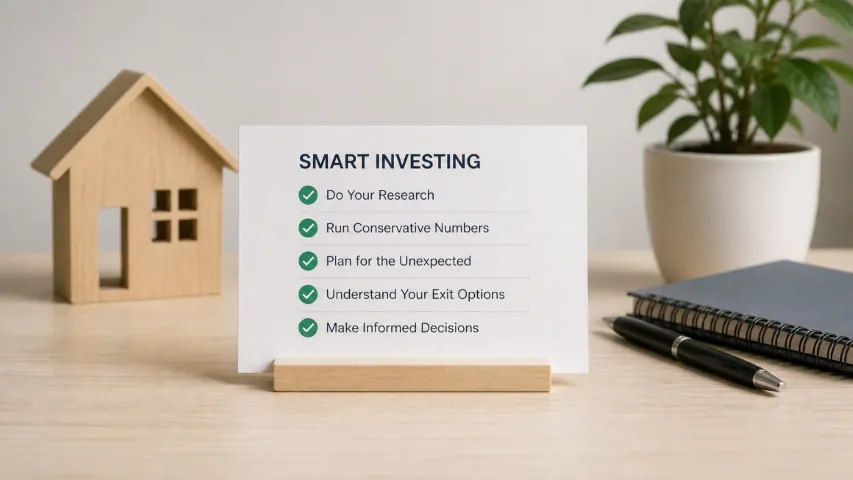
Common mistakes include relying on projected appreciation to rescue weak current economics, using seller-provided numbers without verification, ignoring management and vacancy, treating cosmetic renovation as predictable value creation, underestimating capital expenditures, using all available cash for acquisition, accepting short loan maturities without a refinance plan, and investing passively without reviewing the sponsor and governing documents.
Rules of thumb can be screening tools, but they are not underwriting. A property that passes a rent-to-price rule can still fail because of taxes, insurance, condition, financing, management, tenant risk, or capital needs.
Signs You May Be Ready to Move Beyond Education
You are better prepared when you can describe the objective, participation style, market, property criteria, expected holding period, capital available without impairing personal reserves, financing path, management plan, and downside you can tolerate.
Waiting may be rational when high-cost personal debt, unstable income, insufficient emergency reserves, an imminent major life event, a need for near-term liquidity, or discomfort with operating responsibility would make the investment fragile.
The Investment Readiness Assessment is a short, noindex intake that can organize those considerations. It is not a suitability determination, accreditation test, or investment recommendation.
Frequently Asked Questions
How much money is needed to begin investing in real estate?
It depends on the strategy, property, financing, closing costs, repairs, and reserves. The down payment is only one requirement. A responsible plan also preserves personal emergency liquidity and property operating and capital reserves.
Is a rental property passive income?
Direct rental ownership is generally an operating activity even when a manager handles day-to-day work. The owner still makes capital, financing, insurance, management, leasing, and disposition decisions. Public or private pooled investments can be more passive operationally but introduce market, sponsor, fee, liquidity, and control risks.
What is the difference between cash flow and NOI?
NOI is property income after operating expenses but before debt service and owner-specific items. Cash flow generally reflects what remains after debt payments and other relevant cash uses. Capital expenditures and reserves should be considered even when they are not included in a simple NOI calculation.
Is a higher cap rate always better?
No. A higher cap rate can reflect higher risk, weaker location, shorter leases, lower growth expectations, deferred maintenance, tenant concerns, or operational complexity. Compare the assumptions and property risk, not only the percentage.
Should a first investment be local?
Local ownership can make market learning and property oversight easier. Out-of-state ownership may provide different economics but increases dependence on local professionals and systems. Geography should be evaluated with management capability, market knowledge, travel, and risk—not as a universal rule.
What should I review before a passive real estate investment?
Review the sponsor, track record, property and market, business plan, leverage, fees, distributions, conflicts, reporting, transfer restrictions, capital calls, downside scenarios, governing documents, and exit assumptions. Use independent legal, tax, and investment advice appropriate to the offering and your circumstances.
Continue Learning
Previous: Pricing Strategy
Next: Investment Readiness Assessment
Experienced investors seeking property or portfolio guidance can use the Investor Consultation Questionnaire.
Back to: Consumer Education Hub