


Request a Cash Offer
Provide the property, ownership, condition, and timing information below so the request can be evaluated with useful context. Submitting the form does not require you to accept an offer.
TFI helps you understand the direct-sale option and compare it with a traditional listing or another strategy. If you are still deciding whether a cash offer fits, continue to the in-depth guide below after submitting—or review the guide first and return to the form when ready.
Understanding Cash Offers and Comparing Your Options
A cash offer is a purchase proposal that does not depend on the buyer obtaining a conventional mortgage. Direct buyers, investors, and iBuyer-style companies may use cash or committed capital to reduce financing uncertainty and shorten the transaction timeline.
A cash transaction can provide speed and certainty, but those benefits usually carry an economic cost. The offer may reflect repairs, resale risk, carrying costs, transaction costs, the buyer’s required return, and the limited competition created by selling directly to one purchaser.
The real comparison is between the direct offer’s expected net proceeds and certainty and what the property could reasonably produce through broader market exposure after accounting for preparation, time, concessions, commissions, carrying costs, and closing risk.

How TFI Helps Evaluate a Cash-Sale Path
TFI provides broker-led analysis of your available real estate options. Depending on the property and circumstances, that may include:
- Reviewing the property’s condition, location, ownership, occupancy, and timing
- Assessing recent comparable sales and current competition
- Identifying the likely buyer universe and marketability of the property
- Helping obtain or review a direct cash-sale proposal when an appropriate pathway is available
- Comparing offer price, fees, closing costs, contingencies, inspection rights, and timing
- Estimating how a traditional listing or selective preparation strategy may differ
- Reviewing proof of funds, buyer identity, assignment language, earnest money, and closing structure
- Coordinating with title, escrow, attorneys, tax professionals, or other advisors as needed
The objective is to help you choose deliberately rather than accept or reject an offer without a market-based comparison.
When a Cash Offer Can Be a Strong Fit
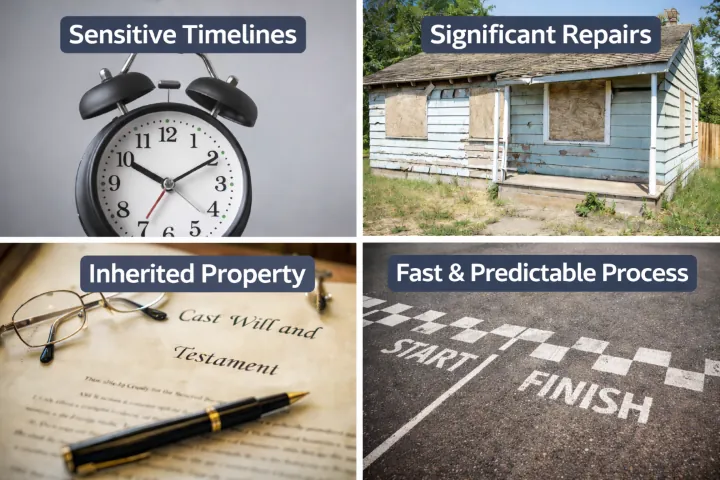
A direct cash sale may be useful when the seller prioritizes speed, simplicity, or closing certainty. Common situations include:
- A property requiring substantial repairs or cleanout
- An inherited, probate, vacant, or remotely managed home
- A tenant-occupied or difficult-to-show property
- A time-sensitive relocation, divorce, financial transition, or other life event
- A prior listing that did not sell
- A seller who wants to avoid extensive preparation, repeated showings, or a financing contingency
- A property whose condition limits conventional buyer financing
A cash offer is not automatically the best path. A well-positioned home with sufficient preparation time and broad buyer appeal may produce stronger proceeds through traditional marketing.
How Direct Cash Offers Are Typically Priced
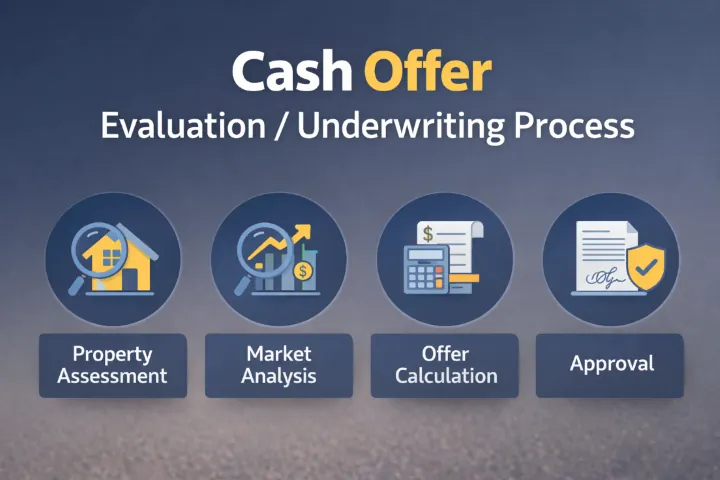
Cash buyers generally underwrite the property based on expected resale or rental value, repairs, carrying costs, transaction costs, market risk, and the return required for committing capital.
Factors commonly affecting the offer include:
- Property condition and repair scope
- Location, lot, floor plan, age, and improvements
- Market demand and likely resale time
- Occupancy, access, title, HOA, solar, or lien issues
- The seller’s requested closing timeline and possession terms
- Inspection, cancellation, and assignment rights
- The buyer’s expected holding and financing costs
An early estimate may change after the buyer verifies condition, title, occupancy, or other property information. A credible process should tell you which assumptions are preliminary and what could change the final amount.
Cash Offer Versus Traditional Listing
A direct sale and a traditional listing are designed to optimize different outcomes.
| Consideration | Direct Cash-Sale Path | Traditional Market Listing |
|---|---|---|
| Market exposure | Usually one buyer or a limited buyer group | Broad exposure to qualified buyers |
| Preparation | Often minimal or as-is | May include repairs, cleaning, staging, and photography |
| Showings | Often limited | Usually required |
| Financing risk | Reduced when funds are verified | Depends on the buyer and lender |
| Closing timeline | Potentially shorter and more flexible | Depends on marketing time and contract terms |
| Price discovery | Limited by direct negotiation | Supported by broader buyer competition |
| Likely proceeds | Often discounted for convenience and buyer risk | May be higher, but with more time, cost, and uncertainty |
The appropriate choice depends on your objectives, the property, the market, and the value you place on time and certainty.
Transparency and Seller Safeguards
A strong cash-offer review should make the transaction structure understandable before you commit.
Key questions include:
- Who is the actual buyer?
- Is the buyer purchasing directly or planning to assign the contract?
- Has proof of funds been provided?
- What earnest money will be deposited, and when does it become nonrefundable?
- What inspection, cancellation, or price-adjustment rights remain?
- Who pays title, escrow, HOA, transfer, repair, and other closing costs?
- Are there service fees, commissions, or other deductions from the stated price?
- When can the seller close, move, and deliver possession?
- Which title and escrow company will handle the transaction?
Pressure, vague terms, weak proof of funds, unexplained deductions, or a large reduction after you are committed should receive careful scrutiny.
Comparing Net Proceeds—not Just the Offer Price
The highest stated price is not always the best offer, and the fastest offer is not always the best decision. Compare:
- Gross price and expected net proceeds
- Repairs and preparation costs
- Commissions, fees, credits, and closing costs
- Mortgage, lien, HOA, solar, or other payoff requirements
- Carrying costs during the sale period
- Probability of closing
- Inspection and appraisal exposure
- Timing, possession, and moving requirements
TFI can also help the owner compare a direct offer with Traditional Seller Representation, a Broker-Led Home-Value Review, or a relaunch strategy for a Home That Previously Did Not Sell.
Greater Phoenix Area Cash-Offer Requests
TFI reviews residential cash-offer requests throughout the Greater Phoenix Area, including Phoenix, Scottsdale, Tempe, Mesa, Chandler, Gilbert, Glendale, Peoria, Surprise, Goodyear, Buckeye, Queen Creek, and surrounding communities.
The form also allows owners to identify multifamily, commercial, or land property when a broader direct-sale review is needed. The property type, condition, value, ownership, and available buyer pathways determine whether a cash-offer process is practical.
Frequently Asked Questions
Is submitting a cash-offer request binding?
No. A request allows the property and circumstances to be reviewed. You decide whether to accept, reject, or compare any resulting proposal with another sale strategy.
Does TFI purchase every property directly?
TFI provides broker-led review and helps evaluate available direct-sale pathways. Offer availability and structure depend on the property type, condition, value, location, ownership, timing, and the buyers active for that type of property.
Will a cash offer be lower than the property’s market value?
Often, a direct investor or company offer is lower than the price the property might achieve through broad market exposure because the buyer is pricing repairs, carrying costs, risk, and profit while providing convenience and certainty. The size of the difference depends on the property and the terms.
Can I sell the property as-is?
Many direct buyers will consider properties in current condition. Known material facts and legally required disclosures still matter, and the contract should clearly explain the buyer’s inspection and cancellation rights.
How quickly can a cash sale close?
Some cash transactions can close substantially faster than a financed sale when title is clear, funds are verified, access is available, and the parties agree on terms. The actual timeline depends on due diligence, title, liens, probate or trust authority, occupancy, and the seller’s preferred closing date.
Should I compare more than one cash offer?
When practical, comparison can help the seller evaluate price, terms, buyer credibility, fees, assignment rights, and closing certainty. A traditional listing estimate can also provide useful context even when the seller ultimately chooses a direct sale.
Which properties can be submitted?
The request form accommodates residential property and can also identify multifamily, office, retail, industrial, and land assets for review. Offer availability and the appropriate process vary by property type.
Which areas does TFI serve?
TFI’s residential cash-offer work is centered on the Greater Phoenix Area and Arizona, with additional review possible where the property and assignment fit the available buyer and advisory relationships.