


How TFI Evaluates a Private Real Estate Partnership Framework
A private real estate partnership can provide access to properties, operating strategies, and transaction sizes that may be difficult to pursue alone. It works best when the real estate opportunity, sponsor capabilities, investor expectations, legal agreements, capital plan, and decision rights are built around the same business plan.
TFI does not begin with the structure or the capital raise. The underlying property must first make sense. Acquisition basis, income durability, physical condition, tenant or resident risk, capital requirements, financing, market position, execution, and exit assumptions determine whether a potential partnership deserves further consideration.
Depending on the opportunity and relationship, TFI may help evaluate or organize a property-level joint venture, syndication, fund, co-investment, or other private real estate arrangement. Any actual investment opportunity is governed by its formal offering and governing documents, investor-eligibility requirements, disclosures, risks, and applicable securities laws. This page is educational and does not represent a current offer to sell or solicitation to purchase a security. Investors can also review Private Real Estate Investment Risks & Disclosures and complete the Investor Consultation Questionnaire when evaluating whether a future relationship may fit.
What a Private Real Estate Investment Partnership Is
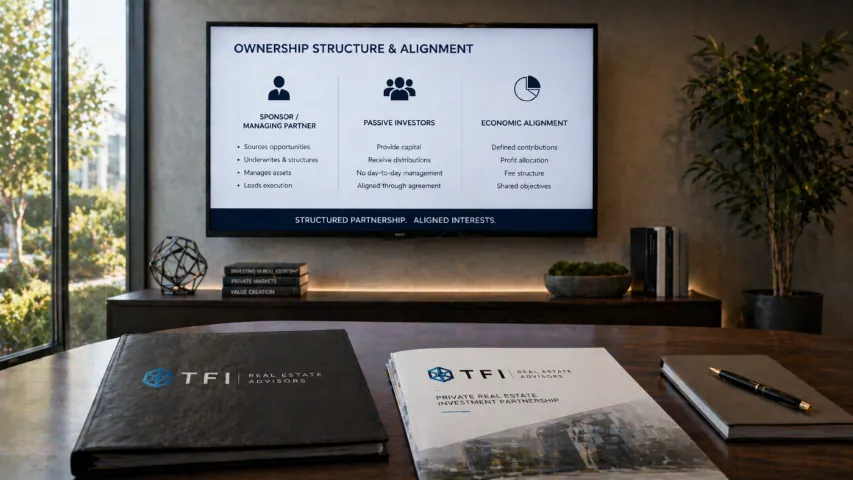
A private real estate investment partnership generally brings together a sponsor or managing member, operating parties, and investors contributing capital to acquire, develop, improve, refinance, or operate real property. The entity is often a limited partnership or limited liability company, although the appropriate structure depends on the transaction and advice from legal and tax professionals.
The sponsor typically identifies the opportunity, negotiates the acquisition, develops the business plan, arranges financing, coordinates diligence, and oversees execution. Investors participate economically under the partnership agreement and offering documents. Their voting, consent, information, and transfer rights depend on the negotiated structure rather than on a single universal model.
The partnership documents should establish how capital is contributed, how decisions are made, how cash is distributed, how conflicts are addressed, what reporting is provided, and how the investment may ultimately be refinanced, sold, extended, or otherwise resolved.
Who May Use This Partnership Framework
This framework may be relevant to individual accredited investors, family offices, private capital groups, operating-business owners, and institutions seeking direct real estate exposure without assuming every operational responsibility. Some investors prefer one property they can evaluate in depth; others consider a portfolio, fund, repeat joint venture, or programmatic relationship.
The appropriate format depends on capital size, liquidity, time horizon, risk tolerance, desired diversification, tax and estate considerations, and the investor's preferred degree of control. A structure suited to a family office with internal real estate expertise may be inappropriate for an individual investor seeking passive exposure and predictable reporting.
Investor qualification is determined by the applicable offering exemption, governing documents, and professional advisers. Some private offerings may be limited to accredited investors or other defined investor categories.
Sponsor, Operator, and Investor Roles
A partnership operates more effectively when responsibility is explicit. The sponsor or managing member normally leads sourcing, underwriting, transaction execution, financing, major business-plan decisions, and investor communication, while property managers, construction managers, leasing teams, brokers, or other operating partners handle defined responsibilities under that oversight.
Passive investors generally contribute capital and receive the economic and information rights described in the agreements. Depending on the structure, investors may also have approval rights over major decisions such as a material change in strategy, related-party transaction, additional capital, refinancing, sale, extension, or removal of the manager for defined cause.
Good structure gives the operating team enough authority to execute while preserving appropriate accountability to the investors whose capital is at risk.
The Property and Business Plan Come First
Preferred returns, promotes, and distribution waterfalls cannot rescue a weak property or unrealistic business plan. Before evaluating the economics, investors need to understand how the property is expected to create and preserve value.
A stabilized property may depend primarily on durable income, lease quality, resident demand, expense control, and prudent financing. A value-add strategy may require renovation, leasing, operational improvement, or repositioning. Development involves additional entitlement, construction, cost, timing, absorption, and capital risks. A recapitalization may rely on the quality of the existing asset, sponsor execution, and the reason new capital is needed. Investor returns may come from current operating cash flow, appreciation created through improved operations or market conditions, refinancing or other capital events, and eventual sale proceeds. The relative importance of each source should be visible in the underwriting rather than obscured by a single projected return.
TFI's Deal Sourcing and Underwriting Work connects the proposed structure to the actual property, market, financing, and execution assumptions. The goal is to understand what must occur for the business plan to work and what happens if those assumptions are delayed or missed.
Sponsor Alignment and Economic Participation
Sponsor alignment is more than stated confidence. Investors should understand the sponsor’s capital contribution, fees, guarantees or other obligations, decision authority, related-party relationships, and participation in profits and losses.
A meaningful sponsor investment can support alignment, but the amount must be considered in relation to the sponsor's resources and responsibilities. Fees may compensate the sponsor and affiliated parties for sourcing, acquisition, financing, asset management, construction oversight, property management, disposition, or other work. Those fees should be disclosed, understandable, and evaluated together rather than in isolation.
Performance participation, often described through a promote or carried interest, can reward successful execution after defined distribution priorities are met. The economic structure should encourage the sponsor to create durable value without promoting excessive leverage, premature transactions, or risk that is inconsistent with the investor mandate.
Fees, Preferred Returns, and Distribution Waterfalls
Cash flow and sale proceeds follow the governing documents. Some structures provide a preferred return before the sponsor participates disproportionately in additional profits; others use multiple hurdles, catch-up provisions, or different treatment for operating cash flow, refinancing proceeds, and sale proceeds.
A preferred return is not the same as a guaranteed payment. The property must generate sufficient distributable cash, and the documents determine whether any unpaid preference accrues, compounds, or is simply subordinate to available funds. Investors should also understand whether the waterfall is calculated at the property, investment, investor, or portfolio level and whether sponsor fees are paid regardless of investment performance.
The most useful analysis focuses on net investor economics under several plausible outcomes, including a slower business plan, lower income, higher costs, a delayed sale, or a less favorable exit value.
Governance, Decision Rights, and Conflict Management
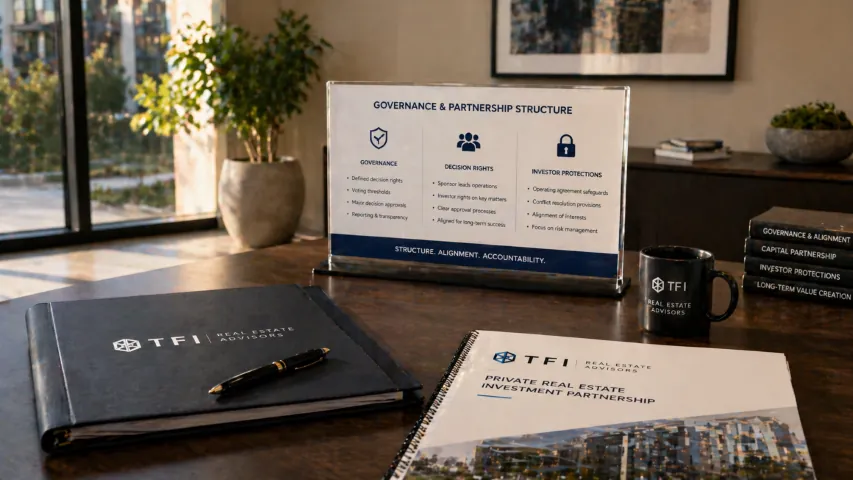
Governance determines how the partnership will respond when the plan changes. The agreements should address ordinary operating authority, major-decision thresholds, amendments, related-party transactions, additional debt, capital calls, extensions, transfers, key-person events, sponsor removal, deadlocks, defaults, and dissolution.
Potential conflicts should be identified before capital is committed. These may involve affiliated property management, construction, brokerage, financing, consulting, or ownership interests; allocation of opportunities among related vehicles; sponsor time and attention; or transactions between affiliated entities.
Clear disclosure does not eliminate every conflict, but it allows investors and their advisers to assess whether the controls, consent rights, pricing methods, and reporting are appropriate.
Capital Commitments, Reserves, and Liquidity
Private real estate partnerships are generally illiquid. You may be unable to sell or redeem an interest on demand, transfers may require sponsor approval or compliance with securities and partnership restrictions, and the hold period may extend when market, financing, leasing, construction, or property conditions warrant more time.
Capital may be contributed entirely at closing or through future capital calls. Investors should understand the expected commitment, funding schedule, reserve policy, consequences of failing to fund, and whether the sponsor can borrow or admit new capital if additional money is required.
Liquidity planning should occur before investment. A partnership commitment should not depend on money the investor may need for near-term obligations, emergencies, taxes, other capital calls, or portfolio rebalancing.
Underwriting, Downside Analysis, and Risk
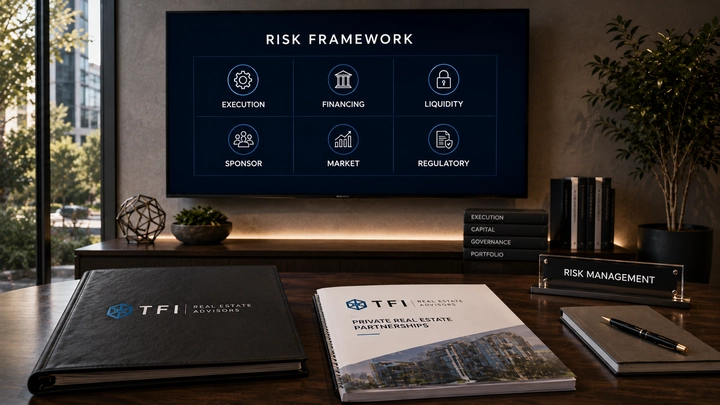
Private real estate investing combines property, market, financing, operating, sponsor, legal, tax, and liquidity risk. Which risks matter most depends on the strategy: tenant rollover can threaten office or industrial income, renovation cost and resident disruption can impair multifamily value-add execution, and development adds entitlement, construction, financing, absorption, and timing exposure.
Underwriting should distinguish verified information from assumptions, normalize income and expenses, identify capital needs, test financing, and evaluate more than one exit outcome. Investors should understand which variables have the greatest effect on cash flow, capital preservation, and eventual return.
Projected returns are useful only when considered with the assumptions, timing, leverage, fees, risks, and range of potential outcomes that produce them. Private investments can result in delayed distributions, reduced returns, or partial or total loss of capital.
Investor Due Diligence
Investor diligence needs to examine both the property and the sponsor. Property review may include market conditions, leases or rent rolls, historical operations, taxes, insurance, physical condition, environmental matters, capital requirements, financing, title, zoning, management, and the proposed exit.
Sponsor review may include relevant experience, prior business plans, realized and unrealized results, staffing, financial resources, reporting history, litigation or regulatory matters, references, affiliated relationships, and how the sponsor handled investments that did not perform as expected.
The offering and governing documents deserve the same attention as the financial model. Investors should review the private placement memorandum when one is used, subscription agreement, operating or partnership agreement, conflicts, risk factors, use of proceeds, fees, waterfall, valuation methods, reporting, transfer limits, capital-call terms, and exit provisions with their own legal, tax, financial, and investment professionals.
Reporting, Communication, and Ongoing Oversight
Reporting should let investors compare actual performance with the original underwriting and business plan. Useful reporting may cover occupancy, leasing, operating results, capital expenditures, debt compliance, construction or renovation progress, material risks, updated forecasts, and explanations of significant variances.
Communication is particularly important when results differ from expectations. A strong sponsor explains what changed, what actions are being taken, what decisions may be required, and how the change affects capital, timing, risk, and exit options.
The appropriate reporting frequency depends on the strategy and agreements, but expectations should be defined before investment rather than improvised after closing.
Portfolio Fit and Long-Term Capital Planning
A partnership can look attractive on a standalone basis and still be wrong for the investor’s broader position. The commitment may deepen concentration in one market, property type, sponsor, tenant, financing structure, or business plan while reducing liquidity needed for other real estate or private investments.
TFI's Real Estate Investment Strategy and Portfolio Advisory helps investors evaluate direct property exposure, leverage, liquidity, concentration, capital pacing, and hold-versus-sell decisions. Broader securities allocation, financial planning, and investment-management advice should be coordinated with the investor's registered investment adviser or other qualified professional.
Tax and estate considerations can also affect ownership form, income and loss allocation, depreciation, distributions, transfers, and exit planning. Those matters should be addressed with the investor's CPA, tax counsel, and estate-planning attorney before the structure is finalized.
How TFI-Sponsored or Aligned Relationships May Be Formed
Tesseract Financial Investments is the related private investment entity through which TFI-sponsored funds, joint ventures, syndications, or other structures may be formed when the property, business plan, operating capability, investor fit, and compliant offering process support them.
A conversation with TFI may also concern an investor's participation in a third-party property, a family-office or institutional joint venture, or a direct ownership relationship requiring broker-led underwriting and transaction support. The scope, roles, compensation, conflicts, decision authority, and legal structure should be established for each relationship.
TFI does not use this page to imply that a current investment is available. When a formal offering exists, participation is determined by the offering documents, applicable investor qualifications, and the investor's independent review with qualified advisers.
Geographic and Property Scope
TFI's core real estate market is the Greater Phoenix Area and Arizona. Partnership and capital relationships may also involve select national commercial, multifamily, portfolio, institutional, or capital-driven assignments when the property, operating resources, local market coverage, and structure support the engagement.
Potential property types may include multifamily, office, industrial, retail, mixed-use, development, and other commercial or residential investment assets where TFI and the assembled project team have an appropriate basis to evaluate and execute the strategy.
Frequently Asked Questions About the Private Real Estate Partnership Framework
Does TFI currently have a private real estate investment available?
This page does not represent a current offering. TFI may discuss investor objectives and potential relationship fit, but any actual opportunity would be presented only through the appropriate formal offering process and documents.
What is the difference between a sponsor and a passive investor?
The sponsor or managing member generally sources, structures, finances, executes, and oversees the investment. Passive investors contribute capital and receive the economic, information, and approval rights defined in the governing documents without managing daily operations.
Are private real estate partnerships limited to accredited investors?
Some private offerings are limited to accredited investors or other defined investor categories, while the applicable requirements depend on the offering exemption and structure. Investor eligibility must be determined through the formal offering process and qualified securities counsel.
Are preferred returns or projected returns guaranteed?
No. Preferred returns and projections describe contractual priorities or modeled outcomes; they do not guarantee that the property will generate sufficient cash or value. Actual results depend on property performance, leverage, execution, market conditions, fees, timing, and other risks.
How liquid is a private real estate partnership investment?
Private partnership interests are generally illiquid, may have multi-year hold periods, and often cannot be transferred or redeemed freely. Investors should review the transfer, redemption, extension, and exit provisions and commit only capital that can remain invested for the required period.
What should I review before investing?
Investors should evaluate the property, sponsor, business plan, financing, assumptions, risks, fees, conflicts, waterfall, governance, reporting, capital calls, transfer restrictions, and exit provisions. The legal and tax documents should be reviewed with the investor's own qualified professionals.
What role can TFI provide?
Depending on the relationship, TFI may provide real estate strategy, sourcing, Underwriting, brokerage, transaction coordination, partnership analysis, or sponsor-level execution through an appropriately structured TFI relationship. The scope is defined before an opportunity or engagement advances.
Investment and Regulatory Disclosure
Private real estate investments involve substantial risk, illiquidity, reliance on sponsor performance, and possible loss of principal. This page provides general real estate information and is not an offer to sell, a solicitation to purchase, or a recommendation of any security. Any offering, if made, will be made only through its formal documents and in compliance with applicable law. Investors should rely on their own legal, tax, accounting, securities, and financial advisers when evaluating a private investment.